trust
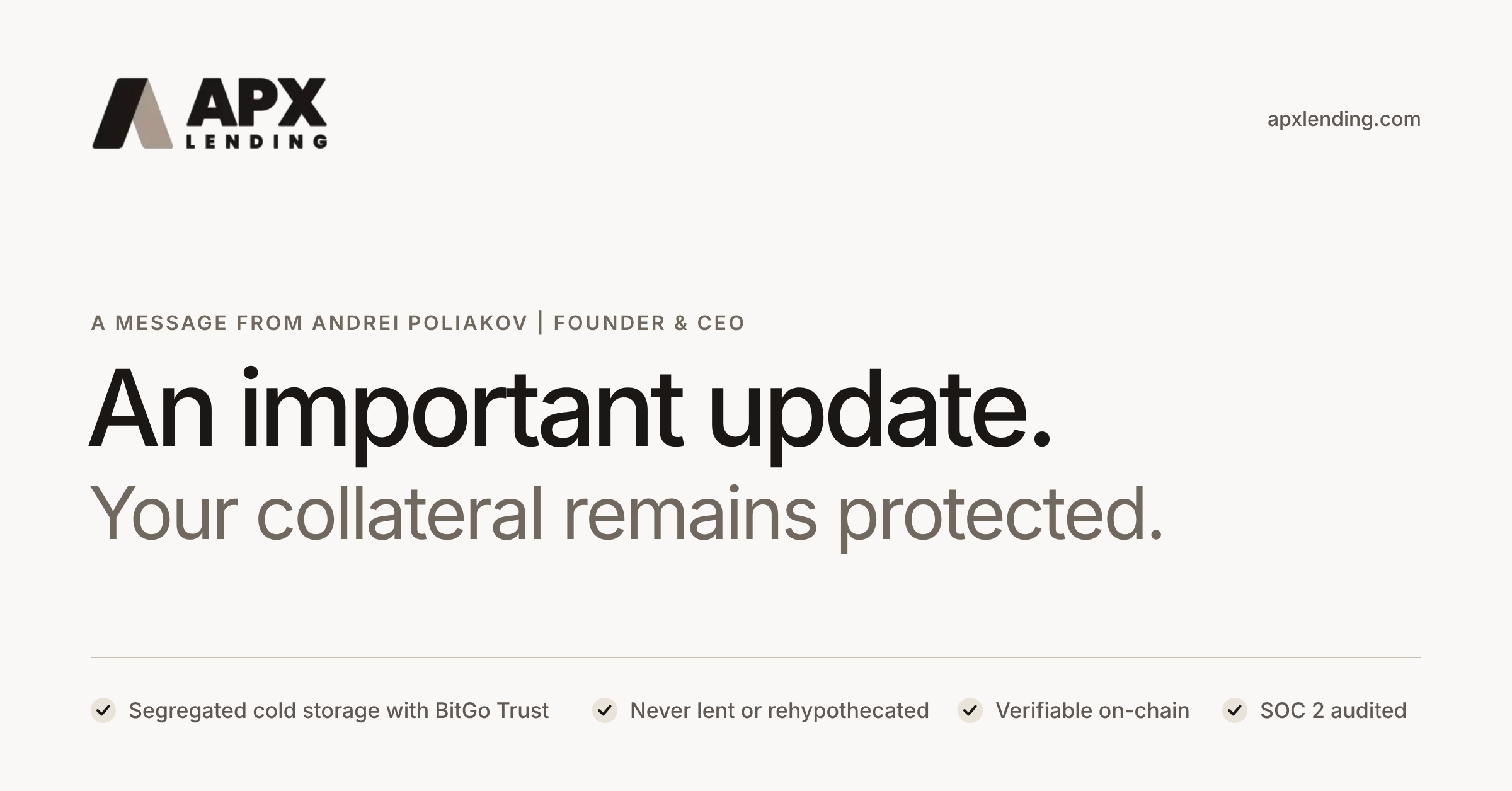
Founder Note | Your Collateral Remains Protected

November 3, 2026
Read more



Rehypothecation happens when a lender or other financial intermediary reuses assets pledged by a customer—for example, by lending or pledging the same collateral to another party. That can create exposures beyond the original loan. If you are borrowing against Bitcoin or Ethereum, the question is not only how much you pay in interest, but also what happens to your crypto while the loan is outstanding.
APX Lending states that it does not rehypothecate, re-lend or pool borrower collateral. Its model uses segregated BitGo Trust cold-storage wallets, while the borrower retains ownership subject to APX’s security interest and the loan terms. Here is how to evaluate that distinction.
Suppose you pledge Bitcoin to secure a loan. Under a rehypothecation arrangement, a lender could use that same Bitcoin as collateral for its own borrowing or transfer it into another permitted financing transaction. The asset now supports more than one obligation. Depending on the legal arrangements, you may become exposed to counterparties or claims you did not expect when you took out your loan.
Rehypothecation is not identical to simply holding collateral with a third-party custodian. Custody concerns where and how assets are stored. Rehypothecation concerns whether those assets can be reused to support other obligations.
These risks do not establish that every lender permitting collateral reuse is insolvent or that a no-rehypothecation arrangement is risk-free. Review the actual legal terms rather than relying on a marketing label alone.
APX’s disclosed custody model uses segregated cold storage with BitGo Trust. Under its published policy, pledged Bitcoin and Ethereum are not pooled or rehypothecated. Borrowers retain legal ownership of pledged assets, subject to APX’s security interest and contractual rights if the borrower defaults or liquidation rules apply.
APX also provides on-chain visibility into relevant collateral holdings. This offers a way to review blockchain balances, although on-chain visibility alone cannot prove all off-chain contractual or insolvency rights.
APX describes access to BitGo’s up to US$250 million aggregate custody insurance, subject to the applicable policy, exclusions and limits. This is not a dedicated US$250 million policy for each borrower. It does not insure against ordinary Bitcoin or Ethereum price declines, loan default or collateral liquidation.
Market risk remains even when collateral is not reused. If the value of pledged crypto falls, the loan-to-value (LTV) ratio can rise. APX issues automated risk notifications at 80% LTV. At 90%, it initiates partial liquidation to target approximately 85% LTV, with no APX liquidation fee or sale spread under its published terms. Further price declines can cause additional sales.
Read the liquidation guide for the mechanics and the BitGo custody overview for more on collateral protection.
Ask for contractual wording and risk disclosures. A simple “your crypto is safe” claim is not a substitute for those details.
Under its published lending and custody model, APX does not re-lend, pledge or reuse customer collateral. Review your specific loan and custody documents for the legally binding terms.
No. Qualified custody and segregated wallets address important risks, but neither guarantees that every operational, legal, cyber or insolvency event is covered.
Yes. The APX 90/85 Standard permits partial liquidation at 90% LTV to target approximately 85%. This is different from rehypothecation.
No individual borrower receives a dedicated US$250 million policy. The published figure refers to aggregate custody insurance, subject to its terms and exclusions.
Read the loan agreement, custody terms and risk disclosures. Ask the lender to identify the clauses covering ownership, segregation, permitted use and liquidation.
Rehypothecation is one part of the decision. Compare loan costs, starting LTV, liquidation thresholds, repayment terms and custody protections together. The APX Crypto-Backed Loan Guide explains those factors; use the borrowing calculator to estimate a conservative starting LTV.
APX Lending is a crypto-backed lender operating in the US, Canada, and globally. APX Lending does not offer financial or tax advice. We strongly encourage you to consult with a certified financial or tax professional for guidance on any related inquiries you may have.