trust
APX Lending vs Ledn: Which Partial Liquidation Policy Lets You Keep More Bitcoin

October 29, 2026
Read more


When Bitcoin prices fall, the difference between lenders can determine how much of your Bitcoin you actually keep.
On October 28, 2026, Ledn announced a significant change to its Bitcoin-backed loan liquidation policy. Starting November 9, eligible loans reaching 80% loan-to-value (LTV) will no longer be closed entirely. Instead, Ledn will sell enough Bitcoin to reduce the loan's LTV to 65%, leaving the remaining loan open.
It's a meaningful improvement for Bitcoin borrowers.
But how does Ledn's new partial liquidation policy compare with APX Lending's existing 90/85 Standard, and which approach allows borrowers to retain more Bitcoin?
The difference is substantial.
The short answer: Ledn begins selling Bitcoin at 80% LTV and resets the loan to 65%. APX Lending issues warnings at 80% but doesn't begin selling collateral until 90% LTV, at which point it sells only enough to return the loan to 85%. APX also charges a 0% liquidation fee and a 0% sale spread.
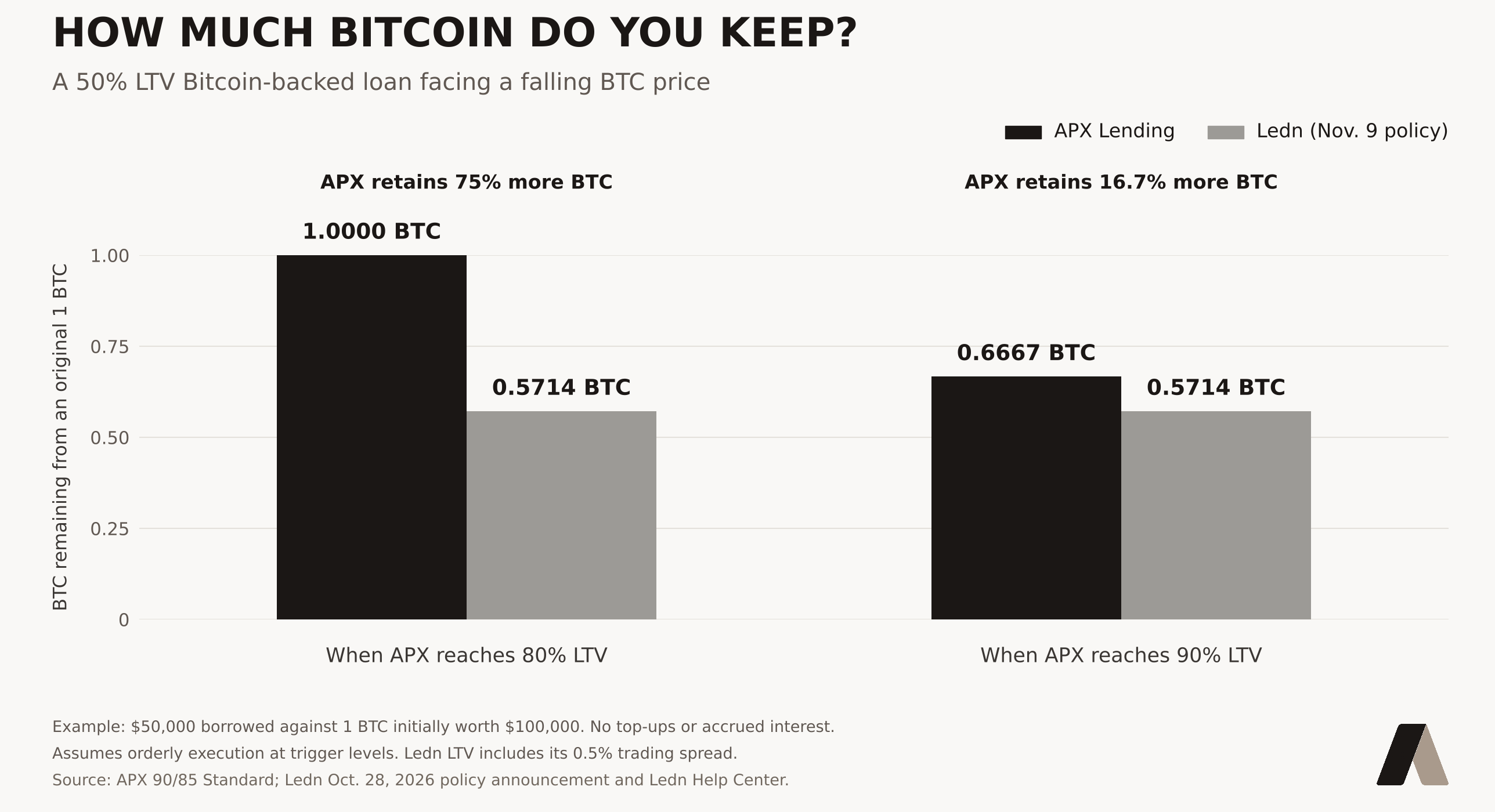
In the examples below, a borrower with APX retains 75% more Bitcoin when the original loan reaches 80% LTV, and 16.7% more Bitcoin after the market decline reaches APX's 90% liquidation threshold.
Partial liquidation is when a lender sells some of a borrower's Bitcoin collateral to reduce an outstanding loan balance, rather than selling enough to close the loan entirely.
Bitcoin-backed loans use a metric called loan-to-value (LTV), which measures outstanding debt relative to the value of the pledged Bitcoin.
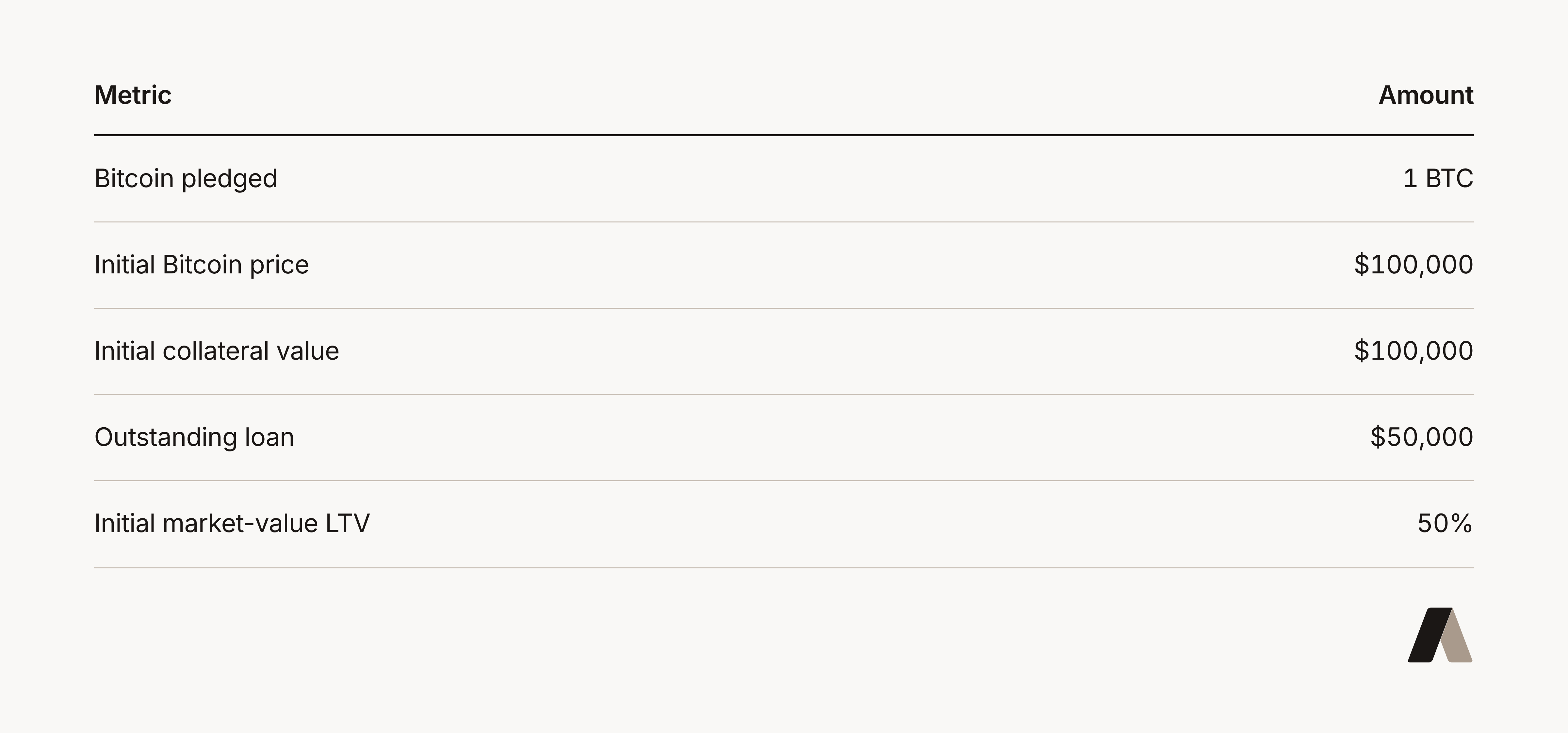
For example, borrowing $50,000 against $100,000 worth of Bitcoin creates an initial LTV of 50%.
If Bitcoin's price falls while the loan balance stays unchanged, the LTV increases. Eventually, it can reach a lender's liquidation threshold.
Rather than closing the entire loan, partial liquidation allows the lender to sell a portion of the collateral, apply the proceeds toward the debt, and keep the remaining loan active.
But not all partial liquidation policies preserve the same amount of Bitcoin.
Two numbers are especially important:
The earlier the lender begins liquidating, and the lower its reset target, the more Bitcoin it may need to sell.
Here is how the two Bitcoin-backed lending models compare under Ledn's newly announced policy.
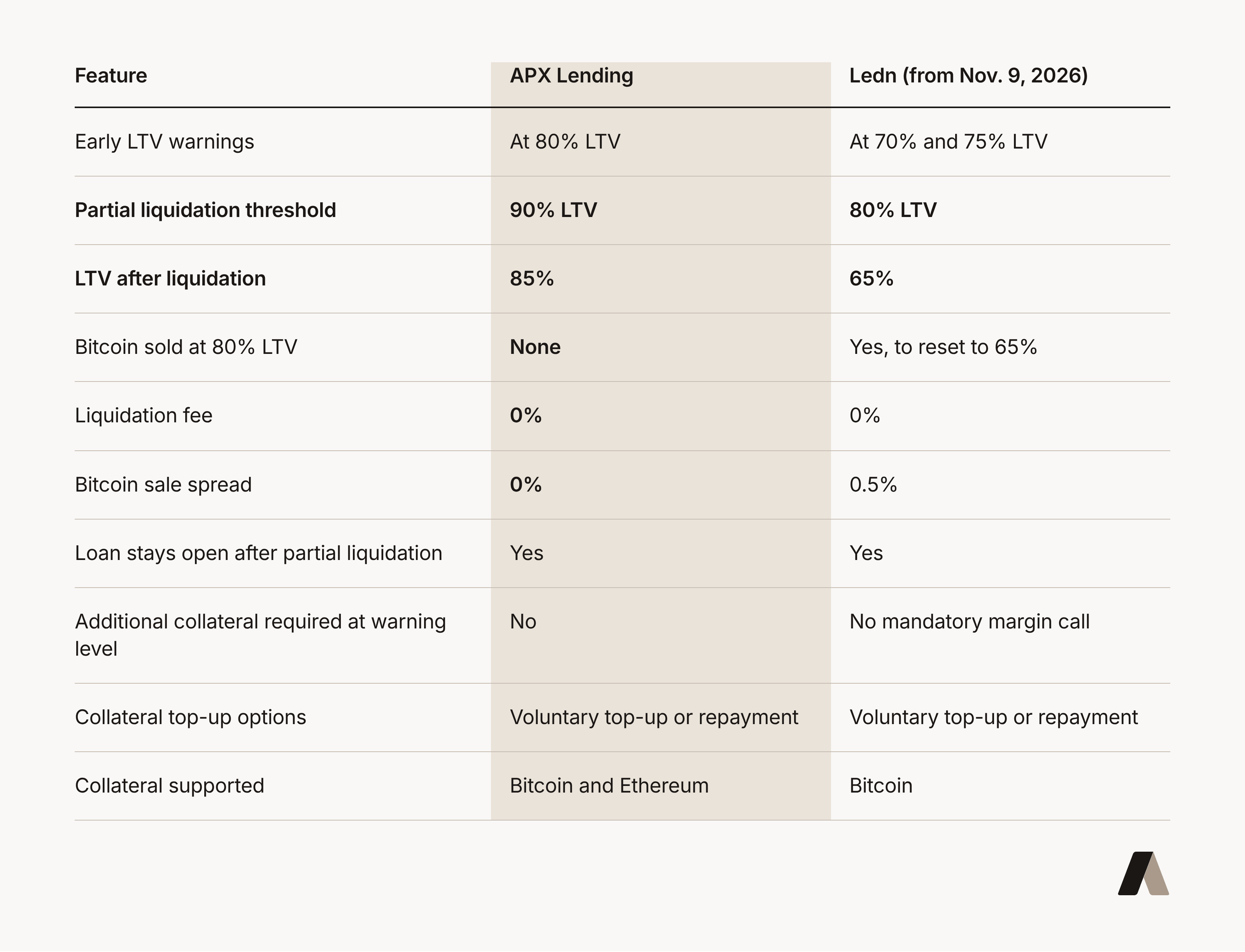
The biggest difference isn't the liquidation fee. It's how much Bitcoin each lender sells and when.
Ledn's new system is designed to deleverage a position relatively early, bringing it back to a more conservative 65% LTV.
APX Lending's 90/85 Standard takes a different approach: allow more room for Bitcoin price volatility before liquidation and, if selling becomes necessary, minimize how much collateral is sold.
Both approaches manage credit risk, but their implications for long-term Bitcoin ownership are very different.
Let's compare two borrowers with identical starting positions.
Starting position
Now assume Bitcoin's price declines from $100,000 to $62,500.
The original loan's market-value LTV rises from 50% to 80%.
At 80% LTV, APX Lending sends an automated warning. The borrower can add Bitcoin collateral, repay part of the outstanding balance, or simply continue monitoring the loan.
No Bitcoin is sold.
The borrower retains:
APX continues sending warnings every six hours while LTV remains at or above 80%, but no liquidation occurs unless LTV reaches 90%.
Under its announced November 9 policy, Ledn automatically sells enough Bitcoin at 80% LTV to bring the loan back to 65%.
One important detail: Ledn calculates LTV using a Bitcoin price adjusted for its 0.5% trading spread. That means its 80% trigger is reached slightly earlier in this example, at a market price of approximately $62,814.
At that point, Ledn sells approximately 0.4286 BTC.
The resulting position is:
The remaining loan stays active. But the Bitcoin already sold is gone from the borrower's position.
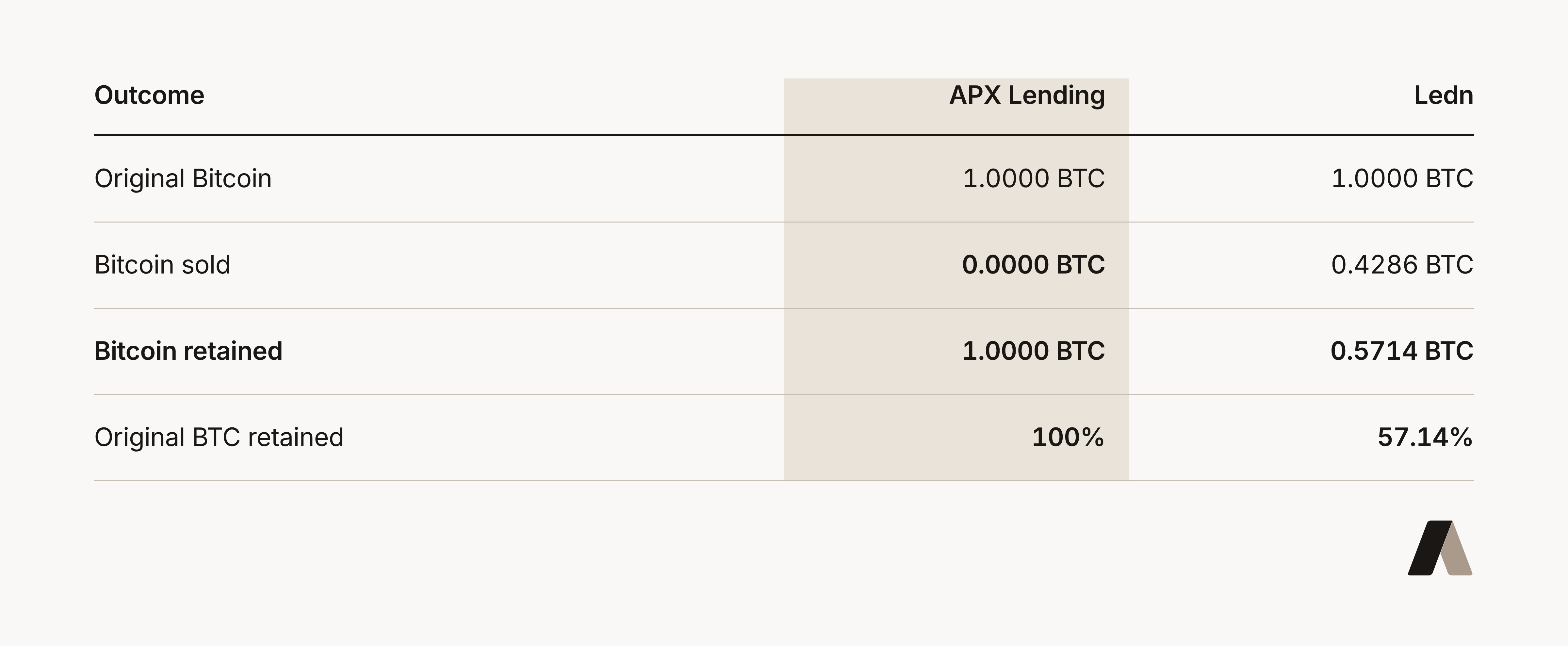
At the same Bitcoin price, the APX borrower still holds their entire original Bitcoin position.
The Ledn borrower has already sold approximately 42.86% of it.
That's 75% more Bitcoin retained with APX Lending.
This distinction matters especially during short-lived market declines. If Bitcoin quickly recovers, the APX borrower retains exposure to the recovery through their entire original BTC position. The Ledn borrower participates with fewer BTC, unless they subsequently buy more.
Now let's take the same borrowers and continue the market decline.
Bitcoin falls from its original $100,000 price to approximately $55,556.
Without previous liquidations or repayments, a $50,000 loan against 1 BTC would now have an LTV of 90%.
This is where APX Lending's 90/85 Standard comes into play.
It's important to account for the full price path: Ledn has already liquidated part of its borrower's Bitcoin at 80%, so its loan balance and LTV are no longer the same as APX's.
When the loan reaches 90% LTV, APX automatically sells only enough collateral to reduce the loan's LTV to 85%.
In this example:
The loan remains active, and the borrower retains two-thirds of their original Bitcoin.
Ledn has already completed its partial liquidation at the earlier 80% threshold.
Because that sale reduced the borrower's loan balance to approximately $23,214, the further Bitcoin price decline does not trigger another liquidation in this particular scenario.
At the new BTC market price of approximately $55,556, the Ledn borrower has:
Ledn's earlier liquidation has created a larger buffer against further price declines. However, that buffer was achieved by selling more of the borrower's Bitcoin sooner.
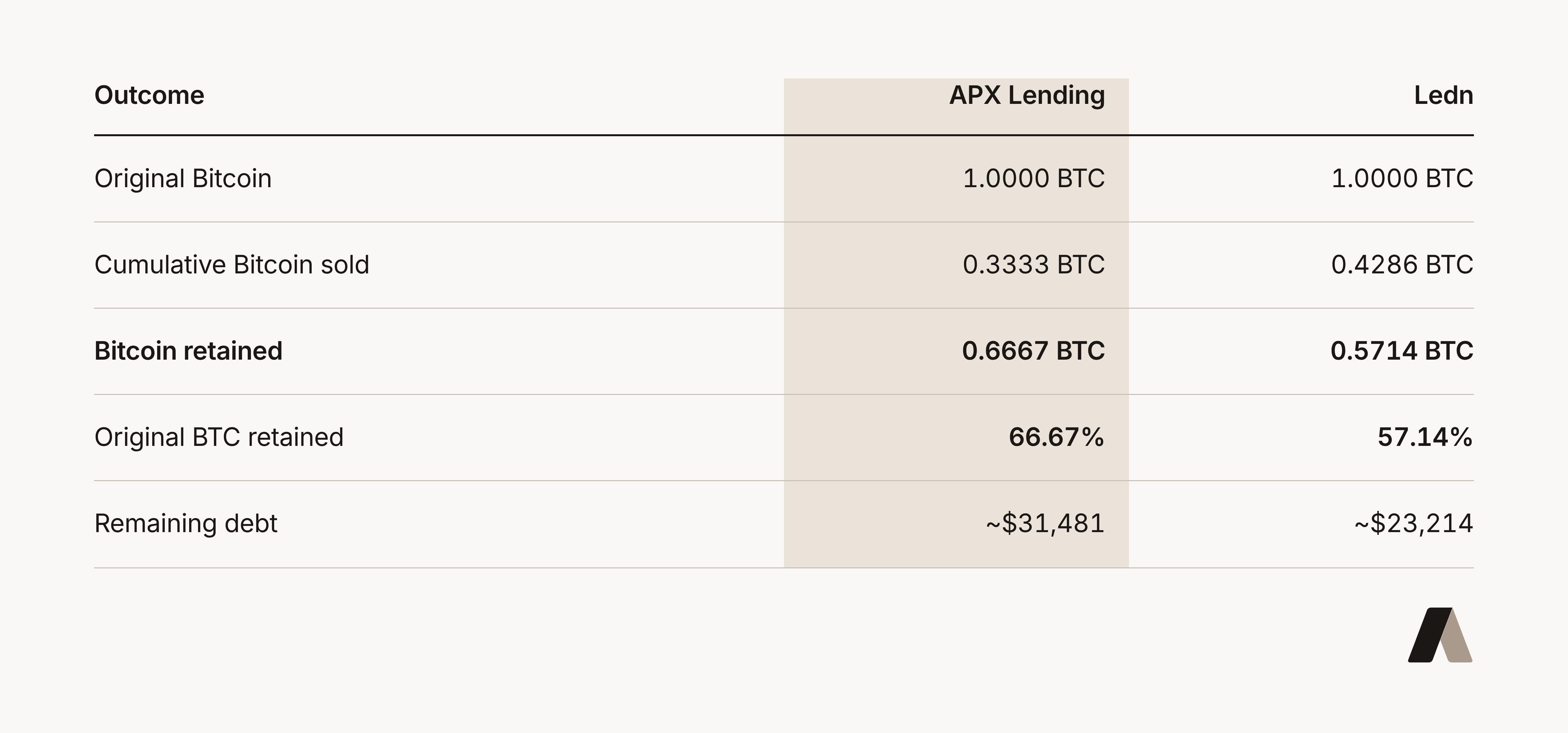
Even after APX's liquidation is triggered at 90% LTV, its borrower still retains approximately 16.7% more Bitcoin than the Ledn borrower.
That's approximately 0.0952 additional BTC preserved from the original 1 BTC position.
And because APX charges no sale spread or liquidation fee, all liquidation proceeds go toward reducing the outstanding loan balance.
For a borrower whose objective is to retain as much Bitcoin as possible, every fraction of a BTC matters.
A forced sale reduces the number of Bitcoin the borrower will hold during any subsequent price recovery.
APX's higher liquidation threshold and more limited reset are designed to preserve that Bitcoin exposure for longer.
For borrowers focused on maintaining long-term Bitcoin holdings, APX's approach can preserve materially more BTC during the same market decline.
Both APX Lending and Ledn advertise zero liquidation fees under their respective partial liquidation policies.
However, there is another important distinction: the price at which collateral is sold.
Ledn applies a 0.5% trading spread to the Bitcoin sold during liquidation.
APX Lending applies a 0% sale spread and charges a 0% liquidation fee.
This means APX applies the full sale proceeds directly toward the outstanding debt, without retaining a spread or liquidation charge.
A 0.5% spread may appear small. But on a $100,000 Bitcoin liquidation, it represents approximately $500 in execution cost.
The cost can grow with the amount of collateral sold or the number of liquidation events.
And although costs are important, the amount of Bitcoin sold remains the much larger distinction between these two policies.
When APX introduced the 90/85 Standard in August 2026, the objective was straightforward: protect the loan without unnecessarily selling borrowers' Bitcoin.
The standard has three core components.
80% LTV: Warning, not liquidation.
Borrowers receive automated notifications but are not required to add collateral or make an immediate repayment.
90% LTV: Partial liquidation begins.
Only when the LTV reaches 90% does APX sell collateral to protect the loan.
85% LTV: The liquidation stops.
APX stops selling once the loan has been reduced to approximately 85% LTV.
Combined with a 0% fee and a 0% execution spread, the policy is designed to preserve as much collateral as possible while maintaining the loan.
Why reset to 85%, rather than 65%?
A deeper reset creates a larger cushion before another liquidation, but also requires more Bitcoin to be sold.
APX selected 85% after reviewing historical liquidation events, market volatility and borrower behaviour, seeking a balance between reducing repeated-liquidation risk and preserving collateral.
Neither approach eliminates liquidation risk. A further price decline that pushes an APX loan back to 90% can trigger another partial sale.
The distinction is how much Bitcoin is sold during each intervention.
Starting November 9, 2026, Ledn eligible Bitcoin-backed loans reaching 80% LTV will undergo partial liquidation rather than automatically closing the entire loan. Enough Bitcoin will be sold to restore the loan to 65% LTV, with the remaining loan staying open.
APX Lending begins partial liquidation at 90% LTV. It sells only enough collateral to reduce LTV to approximately 85%. At 80% LTV, borrowers receive warnings rather than a mandatory liquidation or margin call.
APX Lending preserves substantially more Bitcoin in most market scenarios. In the examples above, at an original 80% LTV, APX retains 1 BTC compared with approximately 0.5714 BTC at Ledn. After the decline reaches APX's 90% threshold, APX retains approximately 0.6667 BTC versus 0.5714 BTC at Ledn.
Actual results depend on execution prices, loan balances, interest, collateral additions and market conditions.
No. APX Lending charges a 0% liquidation fee and a 0% sale spread. The full proceeds of the collateral sale are used to reduce the outstanding loan balance.
In most cases- yes. A higher liquidation threshold allows borrowers to maintain Bitcoin exposure through deeper market declines.
Borrowers can reduce liquidation risk by using a lower starting LTV, adding collateral or repaying part of their loan before the liquidation threshold is reached.
Neither lender can guarantee that Bitcoin will never be liquidated during a severe or prolonged market decline.
Keeping a loan open isn't the same as keeping as much Bitcoin as possible.
Under Ledn's announced policy, an 80% LTV triggers a Bitcoin sale to reset the loan to 65%.
Under APX Lending's 90/85 Standard, 80% LTV triggers a warning, not a sale. And even at 90%, APX sells only enough collateral to return the loan to 85%.
Both lenders manage risk through partial liquidation. APX's model places greater emphasis on preserving borrowers' Bitcoin holdings and exposure to potential price recovery.
Because the goal of borrowing against your Bitcoin should be to access liquidity without selling more Bitcoin than necessary.
Explore APX Lending's Bitcoin-backed loans or learn more about the 90/85 Standard.
This article is for general informational purposes only and does not constitute financial, investment, tax or legal advice. Cryptocurrency-backed loans involve risks, including the potential loss of collateral through liquidation. Borrowers should review their loan agreements and assess their financial circumstances before borrowing.
When Bitcoin prices fall, the difference between lenders can determine how much of your Bitcoin you actually keep.
On October 28, 2026, Ledn announced a significant change to its Bitcoin-backed loan liquidation policy. Starting November 9, eligible loans reaching 80% loan-to-value (LTV) will no longer be closed entirely. Instead, Ledn will sell enough Bitcoin to reduce the loan's LTV to 65%, leaving the remaining loan open.
It's a meaningful improvement for Bitcoin borrowers.
But how does Ledn's new partial liquidation policy compare with APX Lending's existing 90/85 Standard, and which approach allows borrowers to retain more Bitcoin?
The difference is substantial.
The short answer: Ledn begins selling Bitcoin at 80% LTV and resets the loan to 65%. APX Lending issues warnings at 80% but doesn't begin selling collateral until 90% LTV, at which point it sells only enough to return the loan to 85%. APX also charges a 0% liquidation fee and a 0% sale spread.
In the examples below, a borrower with APX retains 75% more Bitcoin when the original loan reaches 80% LTV, and 16.7% more Bitcoin after the market decline reaches APX's 90% liquidation threshold.
Partial liquidation is when a lender sells some of a borrower's Bitcoin collateral to reduce an outstanding loan balance, rather than selling enough to close the loan entirely.
Bitcoin-backed loans use a metric called loan-to-value (LTV), which measures outstanding debt relative to the value of the pledged Bitcoin.
For example, borrowing $50,000 against $100,000 worth of Bitcoin creates an initial LTV of 50%.
If Bitcoin's price falls while the loan balance stays unchanged, the LTV increases. Eventually, it can reach a lender's liquidation threshold.
Rather than closing the entire loan, partial liquidation allows the lender to sell a portion of the collateral, apply the proceeds toward the debt, and keep the remaining loan active.
But not all partial liquidation policies preserve the same amount of Bitcoin.
Two numbers are especially important:
The earlier the lender begins liquidating, and the lower its reset target, the more Bitcoin it may need to sell.
Here is how the two Bitcoin-backed lending models compare under Ledn's newly announced policy.
The biggest difference isn't the liquidation fee. It's how much Bitcoin each lender sells and when.
Ledn's new system is designed to deleverage a position relatively early, bringing it back to a more conservative 65% LTV.
APX Lending's 90/85 Standard takes a different approach: allow more room for Bitcoin price volatility before liquidation and, if selling becomes necessary, minimize how much collateral is sold.
Both approaches manage credit risk, but their implications for long-term Bitcoin ownership are very different.
Let's compare two borrowers with identical starting positions.
Starting position
Now assume Bitcoin's price declines from $100,000 to $62,500.
The original loan's market-value LTV rises from 50% to 80%.
At 80% LTV, APX Lending sends an automated warning. The borrower can add Bitcoin collateral, repay part of the outstanding balance, or simply continue monitoring the loan.
No Bitcoin is sold.
The borrower retains:
APX continues sending warnings every six hours while LTV remains at or above 80%, but no liquidation occurs unless LTV reaches 90%.
Under its announced November 9 policy, Ledn automatically sells enough Bitcoin at 80% LTV to bring the loan back to 65%.
One important detail: Ledn calculates LTV using a Bitcoin price adjusted for its 0.5% trading spread. That means its 80% trigger is reached slightly earlier in this example, at a market price of approximately $62,814.
At that point, Ledn sells approximately 0.4286 BTC.
The resulting position is:
The remaining loan stays active. But the Bitcoin already sold is gone from the borrower's position.
At the same Bitcoin price, the APX borrower still holds their entire original Bitcoin position.
The Ledn borrower has already sold approximately 42.86% of it.
That's 75% more Bitcoin retained with APX Lending.
This distinction matters especially during short-lived market declines. If Bitcoin quickly recovers, the APX borrower retains exposure to the recovery through their entire original BTC position. The Ledn borrower participates with fewer BTC, unless they subsequently buy more.
Now let's take the same borrowers and continue the market decline.
Bitcoin falls from its original $100,000 price to approximately $55,556.
Without previous liquidations or repayments, a $50,000 loan against 1 BTC would now have an LTV of 90%.
This is where APX Lending's 90/85 Standard comes into play.
It's important to account for the full price path: Ledn has already liquidated part of its borrower's Bitcoin at 80%, so its loan balance and LTV are no longer the same as APX's.
When the loan reaches 90% LTV, APX automatically sells only enough collateral to reduce the loan's LTV to 85%.
In this example:
The loan remains active, and the borrower retains two-thirds of their original Bitcoin.
Ledn has already completed its partial liquidation at the earlier 80% threshold.
Because that sale reduced the borrower's loan balance to approximately $23,214, the further Bitcoin price decline does not trigger another liquidation in this particular scenario.
At the new BTC market price of approximately $55,556, the Ledn borrower has:
Ledn's earlier liquidation has created a larger buffer against further price declines. However, that buffer was achieved by selling more of the borrower's Bitcoin sooner.
Even after APX's liquidation is triggered at 90% LTV, its borrower still retains approximately 16.7% more Bitcoin than the Ledn borrower.
That's approximately 0.0952 additional BTC preserved from the original 1 BTC position.
And because APX charges no sale spread or liquidation fee, all liquidation proceeds go toward reducing the outstanding loan balance.
For a borrower whose objective is to retain as much Bitcoin as possible, every fraction of a BTC matters.
A forced sale reduces the number of Bitcoin the borrower will hold during any subsequent price recovery.
APX's higher liquidation threshold and more limited reset are designed to preserve that Bitcoin exposure for longer.
For borrowers focused on maintaining long-term Bitcoin holdings, APX's approach can preserve materially more BTC during the same market decline.
Both APX Lending and Ledn advertise zero liquidation fees under their respective partial liquidation policies.
However, there is another important distinction: the price at which collateral is sold.
Ledn applies a 0.5% trading spread to the Bitcoin sold during liquidation.
APX Lending applies a 0% sale spread and charges a 0% liquidation fee.
This means APX applies the full sale proceeds directly toward the outstanding debt, without retaining a spread or liquidation charge.
A 0.5% spread may appear small. But on a $100,000 Bitcoin liquidation, it represents approximately $500 in execution cost.
The cost can grow with the amount of collateral sold or the number of liquidation events.
And although costs are important, the amount of Bitcoin sold remains the much larger distinction between these two policies.
When APX introduced the 90/85 Standard in August 2026, the objective was straightforward: protect the loan without unnecessarily selling borrowers' Bitcoin.
The standard has three core components.
80% LTV: Warning, not liquidation.
Borrowers receive automated notifications but are not required to add collateral or make an immediate repayment.
90% LTV: Partial liquidation begins.
Only when the LTV reaches 90% does APX sell collateral to protect the loan.
85% LTV: The liquidation stops.
APX stops selling once the loan has been reduced to approximately 85% LTV.
Combined with a 0% fee and a 0% execution spread, the policy is designed to preserve as much collateral as possible while maintaining the loan.
Why reset to 85%, rather than 65%?
A deeper reset creates a larger cushion before another liquidation, but also requires more Bitcoin to be sold.
APX selected 85% after reviewing historical liquidation events, market volatility and borrower behaviour, seeking a balance between reducing repeated-liquidation risk and preserving collateral.
Neither approach eliminates liquidation risk. A further price decline that pushes an APX loan back to 90% can trigger another partial sale.
The distinction is how much Bitcoin is sold during each intervention.
Starting November 9, 2026, Ledn eligible Bitcoin-backed loans reaching 80% LTV will undergo partial liquidation rather than automatically closing the entire loan. Enough Bitcoin will be sold to restore the loan to 65% LTV, with the remaining loan staying open.
APX Lending begins partial liquidation at 90% LTV. It sells only enough collateral to reduce LTV to approximately 85%. At 80% LTV, borrowers receive warnings rather than a mandatory liquidation or margin call.
APX Lending preserves substantially more Bitcoin in most market scenarios. In the examples above, at an original 80% LTV, APX retains 1 BTC compared with approximately 0.5714 BTC at Ledn. After the decline reaches APX's 90% threshold, APX retains approximately 0.6667 BTC versus 0.5714 BTC at Ledn.
Actual results depend on execution prices, loan balances, interest, collateral additions and market conditions.
No. APX Lending charges a 0% liquidation fee and a 0% sale spread. The full proceeds of the collateral sale are used to reduce the outstanding loan balance.
In most cases- yes. A higher liquidation threshold allows borrowers to maintain Bitcoin exposure through deeper market declines.
Borrowers can reduce liquidation risk by using a lower starting LTV, adding collateral or repaying part of their loan before the liquidation threshold is reached.
Neither lender can guarantee that Bitcoin will never be liquidated during a severe or prolonged market decline.
Keeping a loan open isn't the same as keeping as much Bitcoin as possible.
Under Ledn's announced policy, an 80% LTV triggers a Bitcoin sale to reset the loan to 65%.
Under APX Lending's 90/85 Standard, 80% LTV triggers a warning, not a sale. And even at 90%, APX sells only enough collateral to return the loan to 85%.
Both lenders manage risk through partial liquidation. APX's model places greater emphasis on preserving borrowers' Bitcoin holdings and exposure to potential price recovery.
Because the goal of borrowing against your Bitcoin should be to access liquidity without selling more Bitcoin than necessary.
Explore APX Lending's Bitcoin-backed loans or learn more about the 90/85 Standard.
This article is for general informational purposes only and does not constitute financial, investment, tax or legal advice. Cryptocurrency-backed loans involve risks, including the potential loss of collateral through liquidation. Borrowers should review their loan agreements and assess their financial circumstances before borrowing.