

.jpg)
Trust
Crypto-Backed Lending 101: Every Term You Need to Know

October 6, 2026
Read more


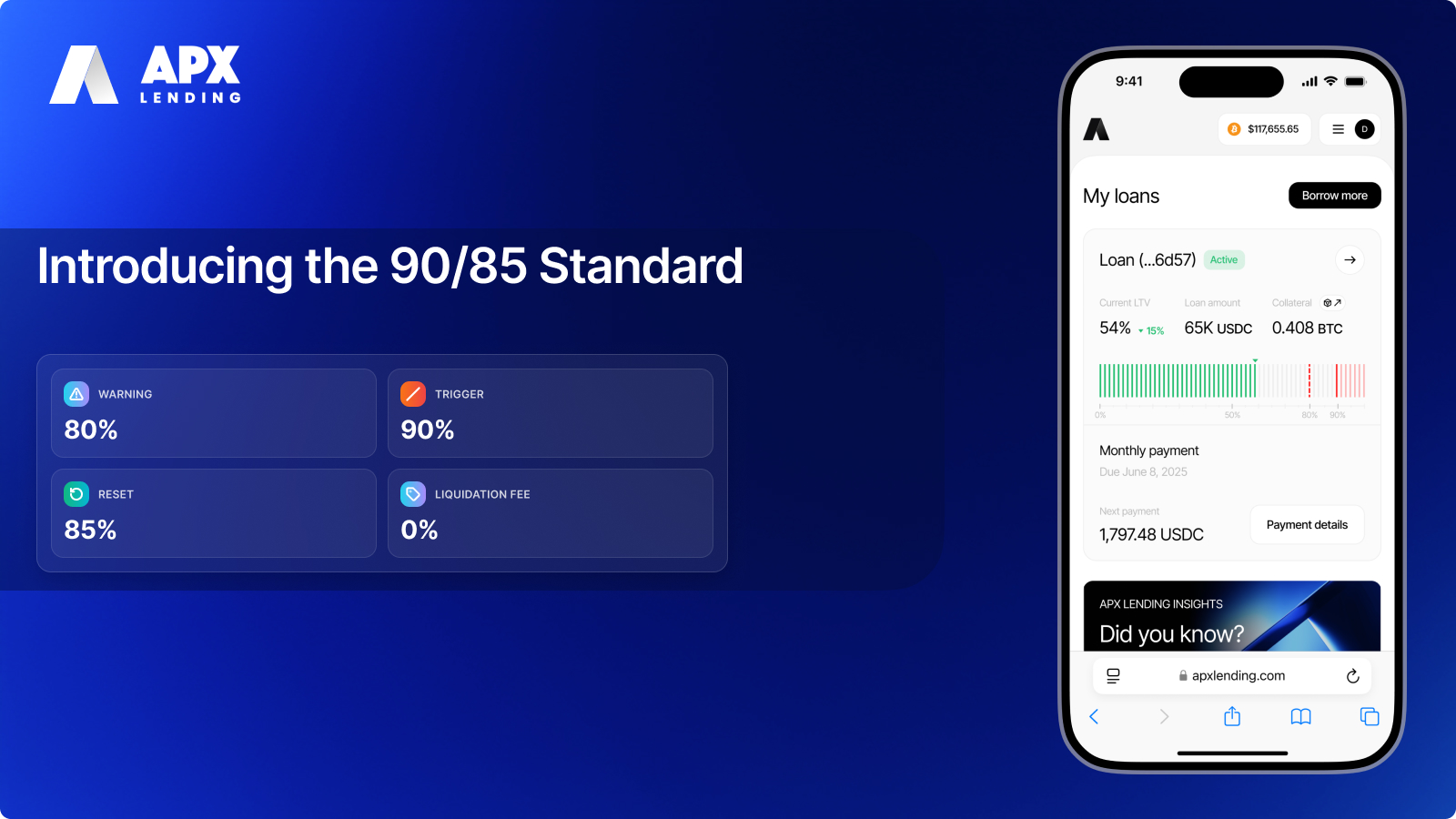
80% warning. 90% liquidation. 85% reset. 0% liquidation fee.
Anyone who has borrowed against Bitcoin or other crypto knows the number that matters most when crypto prices fall: the liquidation LTV. The liquidation LTV is the LTV at which a lender begins selling collateral to prevent the loan from becoming undercollateralized.
For example, if you borrow $90,000 against $180,000 of collateral, your LTV is 50%.
If the value of your collateral now falls to $112,500, your loan LTV becomes $90,000/$112,500 = 80%.
If the value of your collateral falls to $100,000, your loan LTV becomes $90,000/$100,000 = 90%.
The higher your liquidation LTV, the more you can afford to have your collateral fall in value, before the lender starts liquidating it to pay off your loan – and in most cases they sell enough collateral to pay off and close your entire loan (or at least enough to bring your loan back down to originating LTV). The issue is that even a brief market move can turn your collateral into a forced sale. Your LTV can move from 89.9% to 90.1% momentarily, and suddenly Bitcoin you may have spent years accumulating is liquidated.
We think Bitcoin-backed lending can do better.
For Bitcoin-backed borrowers, one of the greatest fears is losing the Bitcoin they specifically chose to borrow against instead of selling.
That can happen through counterparty failure, a risk APX was built to address through a regulated lending model, or through liquidation when Bitcoin prices fall. The 90/85 Standard is designed to address the second. And today, APX Lending is introducing the 90/85 Standard - a new approach to liquidation designed around one principle: protecting the loan while preserving as much of your Bitcoin as possible.
The new standard has three components:
Why did we decide to redefine what liquidation looks like for Bitcoin-backed borrowers?
The answer is simple – we believe in Bitcoin and we want our borrowers to keep as much of it as possible. Liquidation is there to protect the loan. It shouldn't be designed to sell more of your Bitcoin than needed and it shouldn't be a profit centre for the lender.
High Liquidation LTV. Less liquidation. Zero incentive for APX to profit from the event.
Under many crypto-backed lending models, reaching liquidation LTV triggers full liquidation, or liquidation back down to the originating LTV.
That can mean most or all of the borrower’s collateral is sold, the loan is repaid or substantially reduced, and any remaining collateral or proceeds are returned to the borrower.
Your debt is gone, but so is most, if not all, of your Bitcoin collateral. And in the case of a momentary dip in prices, you could be faced with having no more Bitcoin, a significant taxable sale, and no participation in any subsequent Bitcoin price recovery.
You may receive the residual value of your collateral after the loan is repaid, but the Bitcoin you specifically chose not to sell when you took the loan is gone.
APX already offers a 90% liquidation LTV, among the highest in the market, giving borrowers substantial room to react when Bitcoin prices fall. But even so, we still believe that a momentary drop in prices should not unnecessarily determine the fate of your entire collateral position, if your loan does cross 90% LTV.
So we changed the model.
90% remains APX's liquidation threshold. But reaching 90% no longer means automatically liquidating the entire position. APX sells only enough collateral to reduce the loan to 85% LTV and then stops. If the loan subsequently reaches 90% again, the process repeats.
For example, assuming you have:
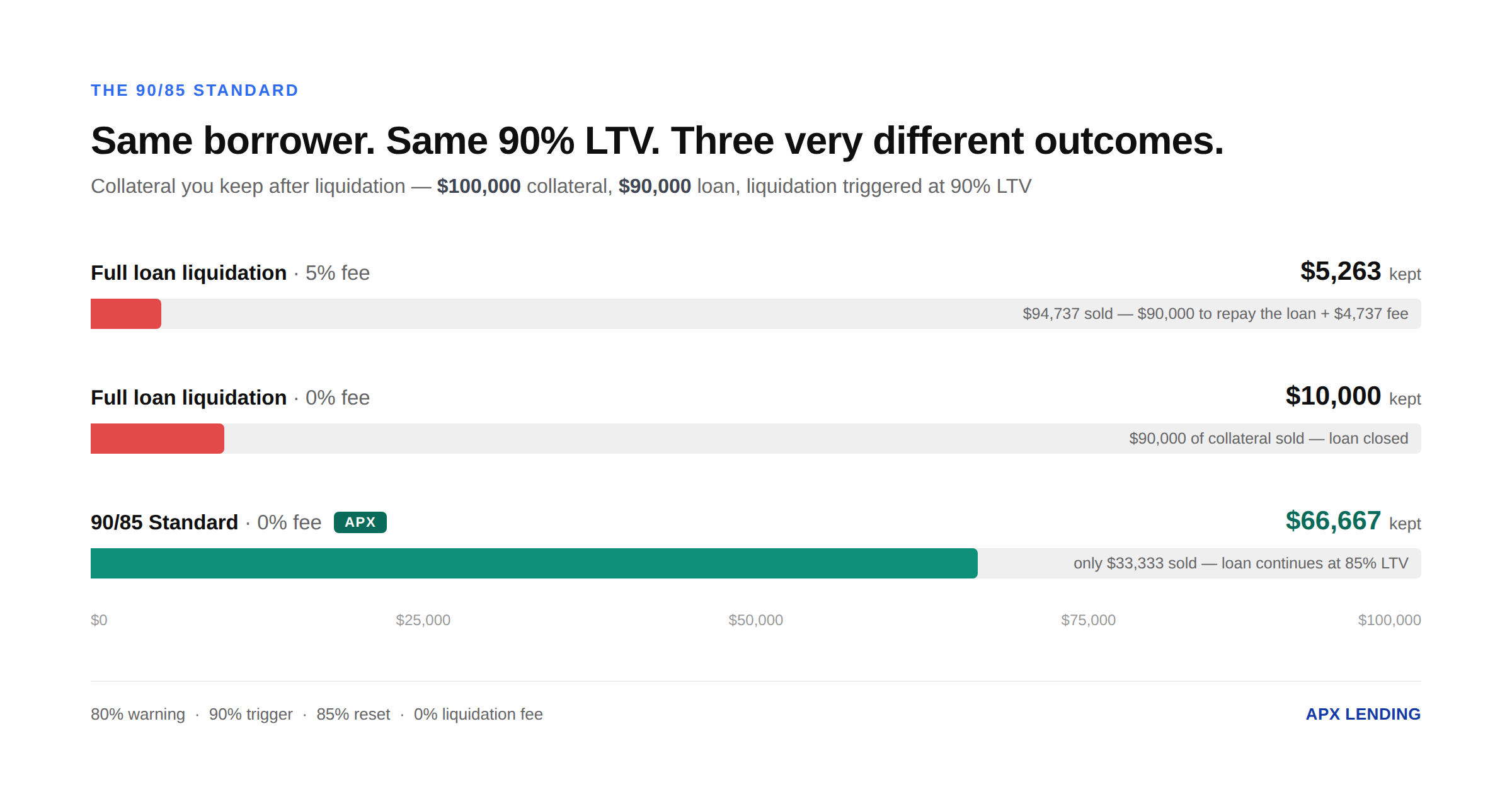
Under the full-liquidation model, assuming no additional liquidation fee, $90,000 of your collateral would be sold to close out the loan. You’d only have $10,000 of collateral left.
Under the full-liquidation model with a typical 5% liquidation fee, $94,737 of your collateral would need to be sold: $90,000 to repay the loan and $4,737 as the liquidation fee. You would only have $5,263 of your $100,000 collateral left.
Under the new 90/85 Standard, APX would sell only $33,333 of collateral and apply the proceeds against the loan. You would be left with:
And because APX is eliminating liquidation fees, there is no additional liquidation charge eating into the collateral being preserved.
Instead of being left with as little as $5,263, you keep $66,667 of your original collateral position. Same borrower. Same 90% LTV. But under the 90/85 Standard, nearly 13 times as much collateral remains ($66,667 vs $5,263). A massive difference!
To determine the appropriate reset LTV, we analyzed historical APX liquidation events, how quickly borrower LTVs moved during severe market volatility, and borrower top-up behaviour. We were balancing two competing objectives:
(1) Liquidate as little collateral as possible so our borrowers keep as much Bitcoin as possible. If that were the only consideration, we could create a 90/89 Standard and sell just enough collateral to move a borrower from 90% to 89%. But that creates another problem. In a rapidly falling market, the borrower could almost immediately return to 90%. Then we could be forced to liquidate repeatedly as the market continued lower. That's not necessarily a better borrower outcome.
(2) Create as much LTV distance from the liquidation threshold as possible to reduce the likelihood of repeated liquidations during the same market decline. At the extreme, this would lead us back to selling all the collateral and closing down the loan.
Our data-based analysis led us to 85% as the appropriate balance. Enough breathing room to manage the loan responsibly. But close enough to 90% that we preserve as much borrower collateral as reasonably possible.
When your LTV reaches 80%, APX begins notifying you every 6 hours that your position is approaching liquidation.
But there is an important distinction: Unlike most digital asset lenders, 80% is not a margin call - we don't tell you that you have 24 hours or 48 hours to deposit more collateral or repay your loan, or otherwise we start selling your collateral. There is no arbitrary cure period simply because your LTV crosses 80%. Instead, we start to notify you through emails and in app notifications that you may want to:
Only if your LTV reaches 90% does APX take action. Even then, the objective is no longer to close your position. We sell only enough collateral to bring your loan back to 85% LTV.
We’re happy to also announce that our liquidation fee is going from 5% to 0%. Simply put, we don't think that as a lender we should have any financial incentive to make money when borrowers’ collateral gets liquidated. Liquidation exists to manage credit risk. That’s it. That’s all.
This also creates an important distinction between the APX model and many DeFi lenders out in the market.
DeFi protocols require economic incentives for third parties to execute liquidations, which results in additional costs for borrowers. For example, Aave uses liquidation bonuses (around 5% depending on asset), while Compound uses configurable liquidation fees (5-8%). Coinbase's Morpho-powered crypto-backed loans currently offer 86% liquidation LTV and charge a 4.38% penalty upon liquidation.
At APX we decided to eliminate liquidation fees altogether. This way, every satoshi of collateral that does not need to be sold stays with you, the borrower. That is one area where a regulated, actively managed lending platform can provide a materially better borrower experience.
Put everything together and the model is simple:
80% : Warning. No margin call. No arbitrary 24- or 48-hour cure period.
90% : Trigger. Partial liquidation begins.
85% : Reset. Only enough collateral is sold to bring the loan LTV down to 85%.
0% : Liquidation Fee. APX does not charge any fees for liquidating collateral.
High Liquidation LTV. Less liquidation. Zero liquidation fees.
That's the new 90/85 Standard.
Note: If you would prefer to retain the liquidation threshold set out in your existing loan agreement, please contact us at support@apxlending.com by August 30, 2026.
This article is for informational and educational purposes only and does not constitute legal, financial, investment, or tax advice. APX Lending does not provide investment or tax recommendations. Borrowers should consult qualified professionals and conduct their own due diligence before entering into any crypto-backed lending arrangement.
80% warning. 90% liquidation. 85% reset. 0% liquidation fee.
Anyone who has borrowed against Bitcoin or other crypto knows the number that matters most when crypto prices fall: the liquidation LTV. The liquidation LTV is the LTV at which a lender begins selling collateral to prevent the loan from becoming undercollateralized.
For example, if you borrow $90,000 against $180,000 of collateral, your LTV is 50%.
If the value of your collateral now falls to $112,500, your loan LTV becomes $90,000/$112,500 = 80%.
If the value of your collateral falls to $100,000, your loan LTV becomes $90,000/$100,000 = 90%.
The higher your liquidation LTV, the more you can afford to have your collateral fall in value, before the lender starts liquidating it to pay off your loan – and in most cases they sell enough collateral to pay off and close your entire loan (or at least enough to bring your loan back down to originating LTV). The issue is that even a brief market move can turn your collateral into a forced sale. Your LTV can move from 89.9% to 90.1% momentarily, and suddenly Bitcoin you may have spent years accumulating is liquidated.
We think Bitcoin-backed lending can do better.
For Bitcoin-backed borrowers, one of the greatest fears is losing the Bitcoin they specifically chose to borrow against instead of selling.
That can happen through counterparty failure, a risk APX was built to address through a regulated lending model, or through liquidation when Bitcoin prices fall. The 90/85 Standard is designed to address the second. And today, APX Lending is introducing the 90/85 Standard - a new approach to liquidation designed around one principle: protecting the loan while preserving as much of your Bitcoin as possible.
The new standard has three components:
Why did we decide to redefine what liquidation looks like for Bitcoin-backed borrowers?
The answer is simple – we believe in Bitcoin and we want our borrowers to keep as much of it as possible. Liquidation is there to protect the loan. It shouldn't be designed to sell more of your Bitcoin than needed and it shouldn't be a profit centre for the lender.
High Liquidation LTV. Less liquidation. Zero incentive for APX to profit from the event.
Under many crypto-backed lending models, reaching liquidation LTV triggers full liquidation, or liquidation back down to the originating LTV.
That can mean most or all of the borrower’s collateral is sold, the loan is repaid or substantially reduced, and any remaining collateral or proceeds are returned to the borrower.
Your debt is gone, but so is most, if not all, of your Bitcoin collateral. And in the case of a momentary dip in prices, you could be faced with having no more Bitcoin, a significant taxable sale, and no participation in any subsequent Bitcoin price recovery.
You may receive the residual value of your collateral after the loan is repaid, but the Bitcoin you specifically chose not to sell when you took the loan is gone.
APX already offers a 90% liquidation LTV, among the highest in the market, giving borrowers substantial room to react when Bitcoin prices fall. But even so, we still believe that a momentary drop in prices should not unnecessarily determine the fate of your entire collateral position, if your loan does cross 90% LTV.
So we changed the model.
90% remains APX's liquidation threshold. But reaching 90% no longer means automatically liquidating the entire position. APX sells only enough collateral to reduce the loan to 85% LTV and then stops. If the loan subsequently reaches 90% again, the process repeats.
For example, assuming you have:
Under the full-liquidation model, assuming no additional liquidation fee, $90,000 of your collateral would be sold to close out the loan. You’d only have $10,000 of collateral left.
Under the full-liquidation model with a typical 5% liquidation fee, $94,737 of your collateral would need to be sold: $90,000 to repay the loan and $4,737 as the liquidation fee. You would only have $5,263 of your $100,000 collateral left.
Under the new 90/85 Standard, APX would sell only $33,333 of collateral and apply the proceeds against the loan. You would be left with:
And because APX is eliminating liquidation fees, there is no additional liquidation charge eating into the collateral being preserved.
Instead of being left with as little as $5,263, you keep $66,667 of your original collateral position. Same borrower. Same 90% LTV. But under the 90/85 Standard, nearly 13 times as much collateral remains ($66,667 vs $5,263). A massive difference!
To determine the appropriate reset LTV, we analyzed historical APX liquidation events, how quickly borrower LTVs moved during severe market volatility, and borrower top-up behaviour. We were balancing two competing objectives:
(1) Liquidate as little collateral as possible so our borrowers keep as much Bitcoin as possible. If that were the only consideration, we could create a 90/89 Standard and sell just enough collateral to move a borrower from 90% to 89%. But that creates another problem. In a rapidly falling market, the borrower could almost immediately return to 90%. Then we could be forced to liquidate repeatedly as the market continued lower. That's not necessarily a better borrower outcome.
(2) Create as much LTV distance from the liquidation threshold as possible to reduce the likelihood of repeated liquidations during the same market decline. At the extreme, this would lead us back to selling all the collateral and closing down the loan.
Our data-based analysis led us to 85% as the appropriate balance. Enough breathing room to manage the loan responsibly. But close enough to 90% that we preserve as much borrower collateral as reasonably possible.
When your LTV reaches 80%, APX begins notifying you every 6 hours that your position is approaching liquidation.
But there is an important distinction: Unlike most digital asset lenders, 80% is not a margin call - we don't tell you that you have 24 hours or 48 hours to deposit more collateral or repay your loan, or otherwise we start selling your collateral. There is no arbitrary cure period simply because your LTV crosses 80%. Instead, we start to notify you through emails and in app notifications that you may want to:
Only if your LTV reaches 90% does APX take action. Even then, the objective is no longer to close your position. We sell only enough collateral to bring your loan back to 85% LTV.
We’re happy to also announce that our liquidation fee is going from 5% to 0%. Simply put, we don't think that as a lender we should have any financial incentive to make money when borrowers’ collateral gets liquidated. Liquidation exists to manage credit risk. That’s it. That’s all.
This also creates an important distinction between the APX model and many DeFi lenders out in the market.
DeFi protocols require economic incentives for third parties to execute liquidations, which results in additional costs for borrowers. For example, Aave uses liquidation bonuses (around 5% depending on asset), while Compound uses configurable liquidation fees (5-8%). Coinbase's Morpho-powered crypto-backed loans currently offer 86% liquidation LTV and charge a 4.38% penalty upon liquidation.
At APX we decided to eliminate liquidation fees altogether. This way, every satoshi of collateral that does not need to be sold stays with you, the borrower. That is one area where a regulated, actively managed lending platform can provide a materially better borrower experience.
Put everything together and the model is simple:
80% : Warning. No margin call. No arbitrary 24- or 48-hour cure period.
90% : Trigger. Partial liquidation begins.
85% : Reset. Only enough collateral is sold to bring the loan LTV down to 85%.
0% : Liquidation Fee. APX does not charge any fees for liquidating collateral.
High Liquidation LTV. Less liquidation. Zero liquidation fees.
That's the new 90/85 Standard.
Note: If you would prefer to retain the liquidation threshold set out in your existing loan agreement, please contact us at support@apxlending.com by August 30, 2026.
This article is for informational and educational purposes only and does not constitute legal, financial, investment, or tax advice. APX Lending does not provide investment or tax recommendations. Borrowers should consult qualified professionals and conduct their own due diligence before entering into any crypto-backed lending arrangement.





.webp)


