You built your crypto stack for a reason: long-term upside. But what happens when you need liquidity right now?
A lot of investors assume their only option is to sell. But selling triggers tax, reduces your exposure, and can leave you regretting the exit if the market rebounds. Borrowing gives you another path: unlock cash without giving up your position.
This guide breaks down, in plain language:
What happens when you sell your crypto
What happens when you borrow against it
When each option makes the most sense
How to borrow safely, transparently, and with minimal risk
Let’s dive in.
What happens when you sell crypto
Across both Canada and the United States, regulators treat crypto as property, not currency. That means selling, swapping, or spending crypto creates a taxable event.
Instead of selling your BTC or ETH, you can post it as collateral and borrow fiat (or stablecoin) against it. Increasingly, long-term holders use this to stay invested while accessing cash when they need it.
Is borrowing a taxable event?
In most jurisdictions, no.
A loan backed by crypto is not considered a sale, so you generally don’t trigger capital gains when the loan originates.
However:
If your collateral is liquidated, that may count as a disposal.
If you repay the loan in appreciated crypto, that may also trigger tax.
Some jurisdictions may treat things like wrapping (BTC → cbBTC), transfers, or interest differently. Always confirm with a tax professional.
Why borrowing can make sense
Stay invested: You keep exposure to future upside.
Defer tax: No realization event at origination.
Unlock cash: Use funds for real estate, business investment, or market opportunities.
Optionality: If markets run, you’re still in the game.
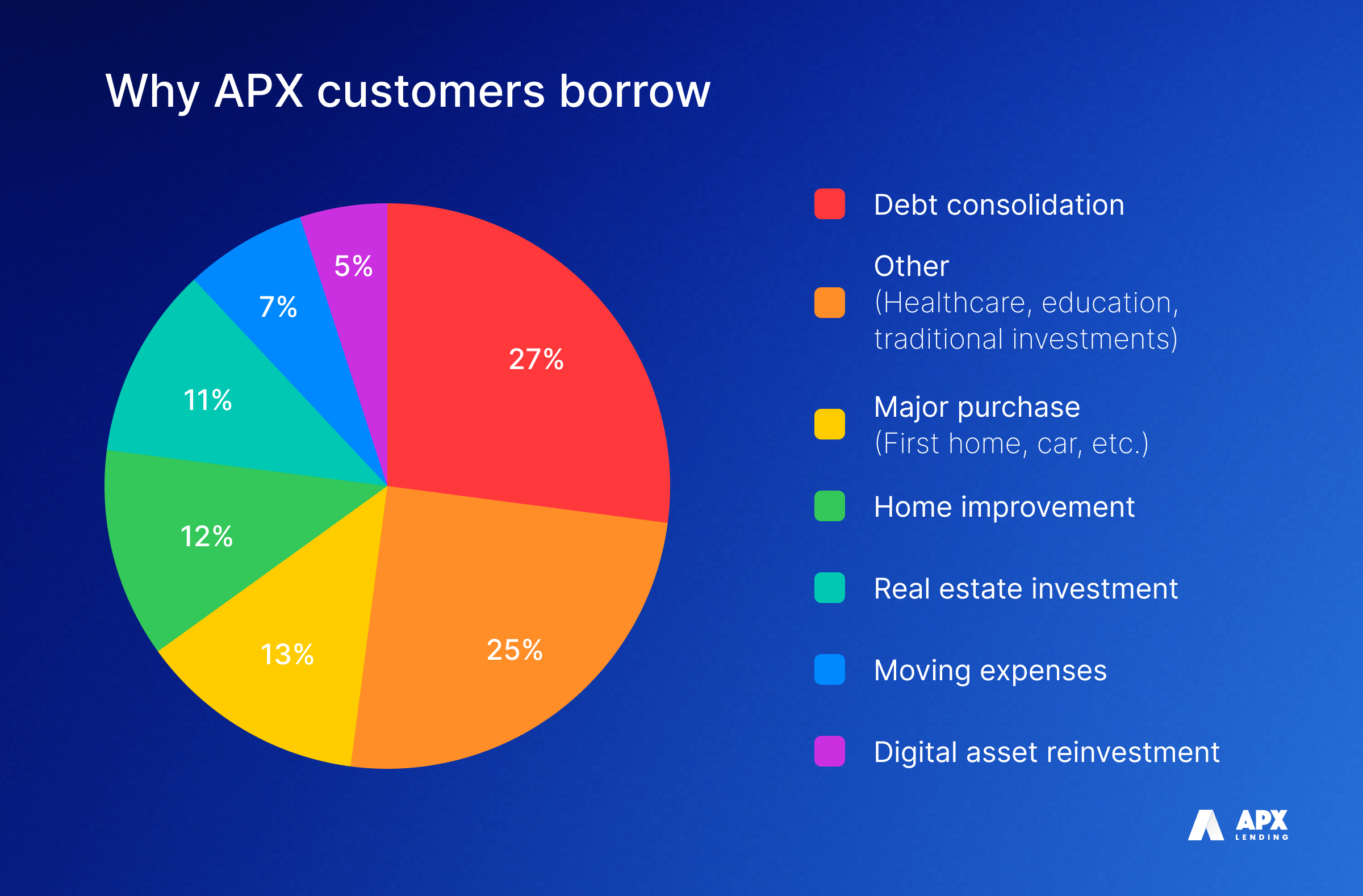
Many APX customers borrow for:
Down payments
Business expansion
Taxes or operational liquidity
Portfolio rebalancing without selling core holdings
Source: priopriatry data
Potential risks
Liquidation risk: If BTC or ETH drops and your LTV rises, your collateral may need a top-up. If liquidation risk is a real concern, check out our primer on crypto-loan liquidation.
Interest costs: Make sure borrowing costs are lower than the value you expect to preserve by not selling. For a convenient look at what the biggest lenders are charging, check out our platform-by-platform comparison guide.
Documentation: You’ll need clear records for tax purposes.
Repayment method: Repaying in crypto may trigger taxable disposal.
Borrow vs. sell: side-by-side comparison
Feature
Sell Crypto
Borrow Against Crypto
Tax event today
Yes — sale triggers capital gains
Usually no tax at origination
Ownership
You exit your position
You keep full market exposure
Liquidity timing
Instant upon sale
Fast, depending on lender
Market upside
None — you’re out
Fully retained
Risk of liquidation
None
Yes — tied to crypto price
Best for
Reducing exposure or exiting crypto
Staying invested while accessing cash
When borrowing makes the most sense
Borrowing is especially compelling when:
You believe your BTC or ETH will continue to appreciate
You need liquidity now but don’t want to exit your position
You’re using funds for high-ROI activities (business, real estate, reinvestment)
If your goal is to unlock cash today without giving up your crypto’s future upside, borrowing against your holdings can be a smart strategy, especially when done through a regulated, transparent lender.
If you’re ready to de-risk or exit positions, selling may be the better choice.
Whatever you choose, custody, compliance, and clarity matter. APX Lending is designed to give Canadian and U.S. investors a safe, regulated way to borrow against their crypto without taking on platform risk.
Generally no — unless your collateral is later liquidated or you repay the loan with appreciated crypto.
Is borrowing against crypto taxable in the U.S.?
Loan origination is usually not taxable, but liquidation or crypto-based repayment may be.
Do I still own my Bitcoin when I use it as collateral?
You keep exposure to price moves. The lender simply holds it under the agreed custody terms.
Is interest deductible?
It depends on your jurisdiction, whether the loan is for investment or business use, and your personal tax profile. Consult your tax advisor.
APX Lending is a crypto-backed lender operating in the US, Canada, and globally. APX Lending does not offer financial or tax advice. We strongly encourage you to consult with a certified financial or tax professional for guidance on any related inquiries you may have.
Borrow vs. sell: The tax-smart way to access your Bitcoin
Borrow vs. sell: The tax-smart way to access your Bitcoin
Explainer
December 17, 2025
5min read
You built your crypto stack for a reason: long-term upside. But what happens when you need liquidity right now?
A lot of investors assume their only option is to sell. But selling triggers tax, reduces your exposure, and can leave you regretting the exit if the market rebounds. Borrowing gives you another path: unlock cash without giving up your position.
This guide breaks down, in plain language:
What happens when you sell your crypto
What happens when you borrow against it
When each option makes the most sense
How to borrow safely, transparently, and with minimal risk
Let’s dive in.
What happens when you sell crypto
Across both Canada and the United States, regulators treat crypto as property, not currency. That means selling, swapping, or spending crypto creates a taxable event.
Instead of selling your BTC or ETH, you can post it as collateral and borrow fiat (or stablecoin) against it. Increasingly, long-term holders use this to stay invested while accessing cash when they need it.
Is borrowing a taxable event?
In most jurisdictions, no.
A loan backed by crypto is not considered a sale, so you generally don’t trigger capital gains when the loan originates.
However:
If your collateral is liquidated, that may count as a disposal.
If you repay the loan in appreciated crypto, that may also trigger tax.
Some jurisdictions may treat things like wrapping (BTC → cbBTC), transfers, or interest differently. Always confirm with a tax professional.
Why borrowing can make sense
Stay invested: You keep exposure to future upside.
Defer tax: No realization event at origination.
Unlock cash: Use funds for real estate, business investment, or market opportunities.
Optionality: If markets run, you’re still in the game.
Many APX customers borrow for:
Down payments
Business expansion
Taxes or operational liquidity
Portfolio rebalancing without selling core holdings
Source: priopriatry data
Potential risks
Liquidation risk: If BTC or ETH drops and your LTV rises, your collateral may need a top-up. If liquidation risk is a real concern, check out our primer on crypto-loan liquidation.
Interest costs: Make sure borrowing costs are lower than the value you expect to preserve by not selling. For a convenient look at what the biggest lenders are charging, check out our platform-by-platform comparison guide.
Documentation: You’ll need clear records for tax purposes.
Repayment method: Repaying in crypto may trigger taxable disposal.
Borrow vs. sell: side-by-side comparison
Feature
Sell Crypto
Borrow Against Crypto
Tax event today
Yes — sale triggers capital gains
Usually no tax at origination
Ownership
You exit your position
You keep full market exposure
Liquidity timing
Instant upon sale
Fast, depending on lender
Market upside
None — you’re out
Fully retained
Risk of liquidation
None
Yes — tied to crypto price
Best for
Reducing exposure or exiting crypto
Staying invested while accessing cash
When borrowing makes the most sense
Borrowing is especially compelling when:
You believe your BTC or ETH will continue to appreciate
You need liquidity now but don’t want to exit your position
You’re using funds for high-ROI activities (business, real estate, reinvestment)
If your goal is to unlock cash today without giving up your crypto’s future upside, borrowing against your holdings can be a smart strategy, especially when done through a regulated, transparent lender.
If you’re ready to de-risk or exit positions, selling may be the better choice.
Whatever you choose, custody, compliance, and clarity matter. APX Lending is designed to give Canadian and U.S. investors a safe, regulated way to borrow against their crypto without taking on platform risk.
Generally no — unless your collateral is later liquidated or you repay the loan with appreciated crypto.
Is borrowing against crypto taxable in the U.S.?
Loan origination is usually not taxable, but liquidation or crypto-based repayment may be.
Do I still own my Bitcoin when I use it as collateral?
You keep exposure to price moves. The lender simply holds it under the agreed custody terms.
Is interest deductible?
It depends on your jurisdiction, whether the loan is for investment or business use, and your personal tax profile. Consult your tax advisor.
APX Lending is a crypto-backed lender operating in the US, Canada, and globally. APX Lending does not offer financial or tax advice. We strongly encourage you to consult with a certified financial or tax professional for guidance on any related inquiries you may have.
We use cookies to enhance your browsing experience, analyze site traffic, and personalize content. By clicking 'Accept,' you consent to the use of cookies as described in our Privacy Policy.


.png)


%201%20(3).png)


.png)

.webp)


