.png)


.jpg)
Trust
Crypto-Backed Lending 101: Every Term You Need to Know

October 6, 2026
Read more


How crypto loan interest rates work: fixed rates, LTV, and payment plans
Crypto-backed loans have gone mainstream, and for good reason. Whether you hold Bitcoin or Ethereum, they’re an efficient way to access liquidity without selling your assets. But one question we conistently here from borrowers is:
How do crypto loan interest rates actually work?
Thankfully, the answer is simple.
Unlike DeFi lending markets, where rates fluctuate constantly, CeFi lenders use fixed interest rates, predictable terms, and clear loan-to-value (LTV) thresholds. That stability makes borrowing against your crypto far more straightforward than many expect.
This guide breaks down how fixed crypto loan rates are set, how LTV impacts your cost, and how to choose between interest-only and amortized payment plans.
A crypto loan interest rate is the cost of borrowing cash using your digital assets as collateral. In CeFi, interest rates are fixed for the full term, typically 6 to 36 months (3 to 60 for us), so your monthly payment stays the same.
Most reputable lenders fall somewhere in the 8% – 16% APR range, which can depend on several key factors, like: the lender cost of capital, LTV, collateral type, and custody model.
Fixed rates give borrowers:
Every lender uses its own risk model, but fixed rates generally reflect five core factors.
Behind every crypto loan rate is a lender’s cost of capital, the cost of sourcing the money they lend out. If that cost rises, rates rise. If it falls, rates fall. Regulated CeFi lenders often use a mix of treasury reserves, credit facilities, and institutional partners to supply capital. Lenders who rely on expensive deposits or unsecured credit lines tend to have higher, more volatile rates.
APX uses a conservative capital structure with segregated collateral custody, which allows us to maintain stable, transparent pricing without relying on risky rehypothecation practices.
For some lenders, LTV ratio can influence rates. In the interest of keeping things simple and offering as much flexibility as possible to our lenders, APX doesn't do this.
Lower LTV = lower risk = lower interest rate.
LTV tiers:
Because Bitcoin is less volatile and more liquid than Ethereum, BTC-backed loans often receive slightly lower rates.
ETH’s higher volatility introduces more collateral risk, which introduces a slightly higher cost of capital for lenders.
This is where CeFi lenders differ dramatically.
Lenders using institutional cold storage with segregated assets (e.g., BitGo) face significantly lower security and counterparty risk.
Lower risk means a more stable fixed rate for borrowers.
If a lender rehypothecates collateral, something APX never does, the risk spikes.
Borrowers should confirm:
Along with interest rates, most lenders charge an origination fee. This is a one-time cost added at the beginning of your loan. Origination fees typically range from 1% to 4% of the loan amount, depending on the lender’s operating model and risk framework.
You can look at an origination fee as the cost of provisioning your loan, including:
Because crypto loans are often larger than typical consumer loans, and because lenders bear collateral-management responsibilities, origination fees are common across the industry.
At APX, we do not charge origination fees. Everything is baked in to your final rate in the interest of keeping things simple and transparent. In other words, what you see when you confirm your loan agreement is what you get.
How origination fees impact borrowing:
Regulated CeFi lenders like APX typically maintain:
This framework results in more predictable rates compared to offshore or unregulated lenders, where prices fluctuate to offset systemic and operational risk. If you want to learn more about the standards we hold ourselves to, as the only crypto lender to-date that is authorized by the CSA, you can read our decision here.
Here's the quick and dirty:
CeFi lenders (APX, Ledn, Coinbase Borrow)
→ Fixed rates
→ Predictable monthly payment
→ No dynamic interest fluctuations
DeFi lenders (Aave, Compound)
→ Variable rates
→ Rates change based on liquidity pools
→ Designed for traders, not long-term borrowers
Borrowers looking for stability and long-term planning almost always prefer fixed-rate CeFi loans. They're safe, secure, and predictable.
Your repayment structure significantly impacts your monthly budget and total lifetime cost. APX, like many other bitcoin-backed lenders, offers two payment options: interest-only and amortized.
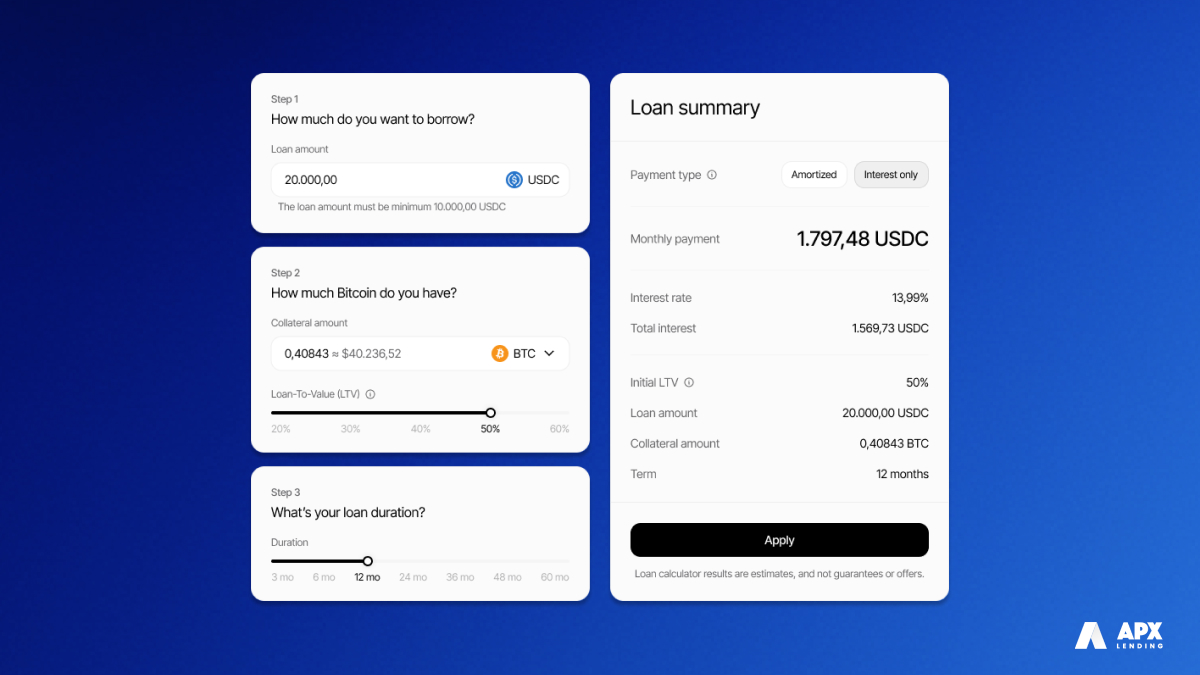
Interest-only payments mean you pay only the interest during your term. Your principal stays intact until the final balloon payment which you must settle upon your loan’s maturation date.
Best for:
Advantages
Trade-offs
An amortized loan includes both interest and principal in each monthly payment. Your outstanding balance shrinks consistently.
Best for:
Advantages
Trade-offs
Here’s the simplest decision framework:
Choose interest-only if you want:
Choose amortized if you want:
Most borrowers know their answer within minutes of reviewing their calculator output.
Borrowing against Bitcoin or Ethereum makes sense when:
APX’s regulated framework, fixed-rate structure, and cold-storage custody make borrowing far safer than the early days of crypto lending.
APX Lending is a crypto-backed lender operating in the US, Canada, and globally. APX Lending does not offer financial or tax advice. We strongly encourage you to consult with a certified financial or tax professional for guidance on any related inquiries you may have.
How crypto loan interest rates work: fixed rates, LTV, and payment plans
Crypto-backed loans have gone mainstream, and for good reason. Whether you hold Bitcoin or Ethereum, they’re an efficient way to access liquidity without selling your assets. But one question we conistently here from borrowers is:
How do crypto loan interest rates actually work?
Thankfully, the answer is simple.
Unlike DeFi lending markets, where rates fluctuate constantly, CeFi lenders use fixed interest rates, predictable terms, and clear loan-to-value (LTV) thresholds. That stability makes borrowing against your crypto far more straightforward than many expect.
This guide breaks down how fixed crypto loan rates are set, how LTV impacts your cost, and how to choose between interest-only and amortized payment plans.
A crypto loan interest rate is the cost of borrowing cash using your digital assets as collateral. In CeFi, interest rates are fixed for the full term, typically 6 to 36 months (3 to 60 for us), so your monthly payment stays the same.
Most reputable lenders fall somewhere in the 8% – 16% APR range, which can depend on several key factors, like: the lender cost of capital, LTV, collateral type, and custody model.
Fixed rates give borrowers:
Every lender uses its own risk model, but fixed rates generally reflect five core factors.
Behind every crypto loan rate is a lender’s cost of capital, the cost of sourcing the money they lend out. If that cost rises, rates rise. If it falls, rates fall. Regulated CeFi lenders often use a mix of treasury reserves, credit facilities, and institutional partners to supply capital. Lenders who rely on expensive deposits or unsecured credit lines tend to have higher, more volatile rates.
APX uses a conservative capital structure with segregated collateral custody, which allows us to maintain stable, transparent pricing without relying on risky rehypothecation practices.
For some lenders, LTV ratio can influence rates. In the interest of keeping things simple and offering as much flexibility as possible to our lenders, APX doesn't do this.
Lower LTV = lower risk = lower interest rate.
LTV tiers:
Because Bitcoin is less volatile and more liquid than Ethereum, BTC-backed loans often receive slightly lower rates.
ETH’s higher volatility introduces more collateral risk, which introduces a slightly higher cost of capital for lenders.
This is where CeFi lenders differ dramatically.
Lenders using institutional cold storage with segregated assets (e.g., BitGo) face significantly lower security and counterparty risk.
Lower risk means a more stable fixed rate for borrowers.
If a lender rehypothecates collateral, something APX never does, the risk spikes.
Borrowers should confirm:
Along with interest rates, most lenders charge an origination fee. This is a one-time cost added at the beginning of your loan. Origination fees typically range from 1% to 4% of the loan amount, depending on the lender’s operating model and risk framework.
You can look at an origination fee as the cost of provisioning your loan, including:
Because crypto loans are often larger than typical consumer loans, and because lenders bear collateral-management responsibilities, origination fees are common across the industry.
At APX, we do not charge origination fees. Everything is baked in to your final rate in the interest of keeping things simple and transparent. In other words, what you see when you confirm your loan agreement is what you get.
How origination fees impact borrowing:
Regulated CeFi lenders like APX typically maintain:
This framework results in more predictable rates compared to offshore or unregulated lenders, where prices fluctuate to offset systemic and operational risk. If you want to learn more about the standards we hold ourselves to, as the only crypto lender to-date that is authorized by the CSA, you can read our decision here.
Here's the quick and dirty:
CeFi lenders (APX, Ledn, Coinbase Borrow)
→ Fixed rates
→ Predictable monthly payment
→ No dynamic interest fluctuations
DeFi lenders (Aave, Compound)
→ Variable rates
→ Rates change based on liquidity pools
→ Designed for traders, not long-term borrowers
Borrowers looking for stability and long-term planning almost always prefer fixed-rate CeFi loans. They're safe, secure, and predictable.
Your repayment structure significantly impacts your monthly budget and total lifetime cost. APX, like many other bitcoin-backed lenders, offers two payment options: interest-only and amortized.
Interest-only payments mean you pay only the interest during your term. Your principal stays intact until the final balloon payment which you must settle upon your loan’s maturation date.
Best for:
Advantages
Trade-offs
An amortized loan includes both interest and principal in each monthly payment. Your outstanding balance shrinks consistently.
Best for:
Advantages
Trade-offs
Here’s the simplest decision framework:
Choose interest-only if you want:
Choose amortized if you want:
Most borrowers know their answer within minutes of reviewing their calculator output.
Borrowing against Bitcoin or Ethereum makes sense when:
APX’s regulated framework, fixed-rate structure, and cold-storage custody make borrowing far safer than the early days of crypto lending.
APX Lending is a crypto-backed lender operating in the US, Canada, and globally. APX Lending does not offer financial or tax advice. We strongly encourage you to consult with a certified financial or tax professional for guidance on any related inquiries you may have.





.webp)


