trust
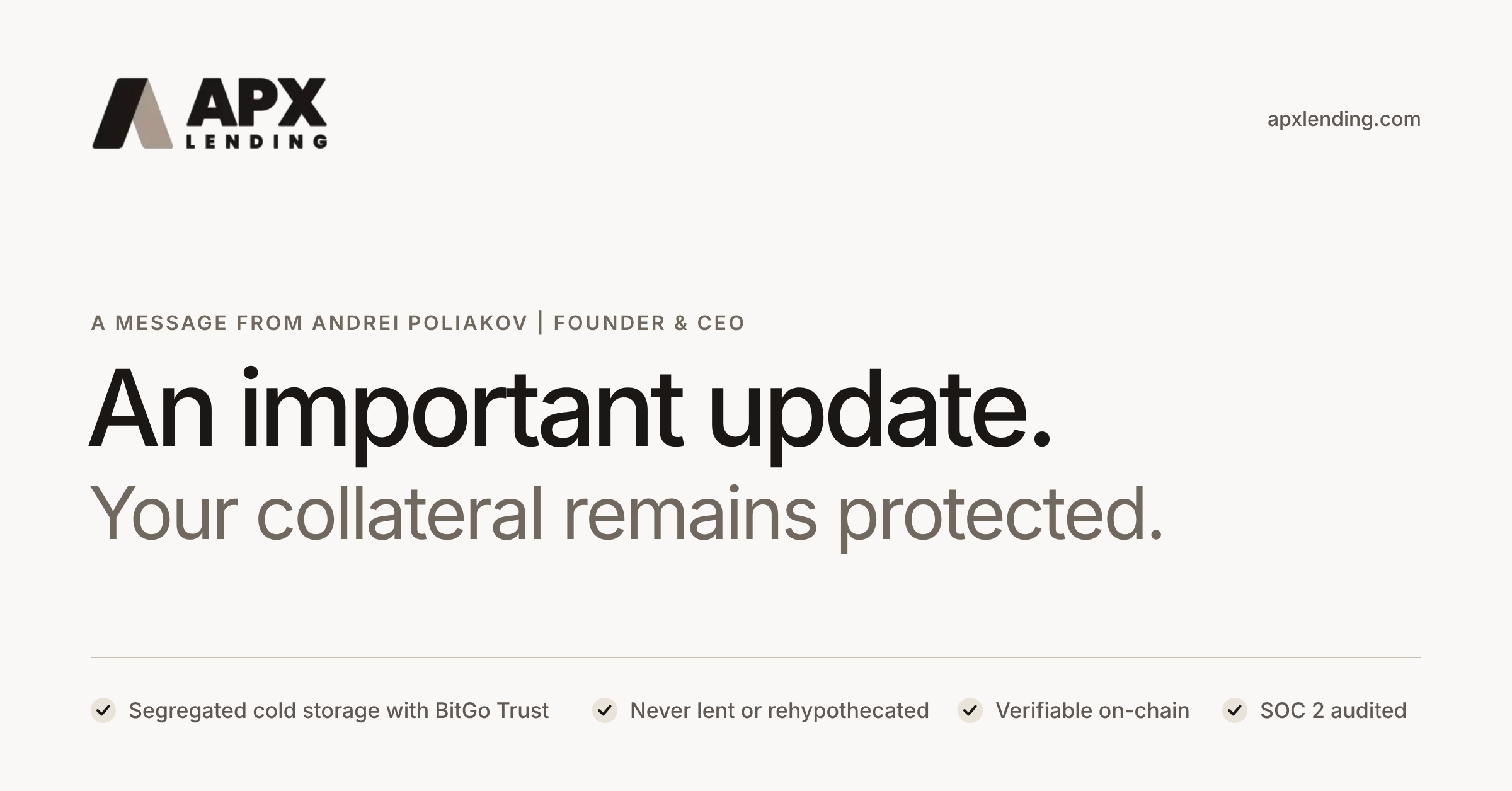
Founder Note | Your Collateral Remains Protected

November 3, 2026
Read more


Crypto-backed loans are no longer fringe.
As the market matures, the difference between safety, clarity, and risk becomes clearer. And more important.
In our corner, we believe in providing borrowers with liquidity without sacrificing control, clarity, and compliance. That’s central to how we do things and ultimately feeds into our mission.
To accelerate crypto adoption through trust, transparency, and regulatory excellence.
With that said: Let’s see how we stack up against Coinbase’s approach.
APX Lending
We offer fixed APRs based on loan size irrespective of loan term or LTV. We offer tiered rates: 11.49% APR (<$100K), 10.99% APR ($100K–$1M), and 9.99% APR (>$1M).
That said, we’re always negotiating better terms with our partners- so keep that in mind.
There are no origination fees or hidden charges, and interest is simple (i.e. you pay only on the principal outstanding).
Coinbase / Morpho
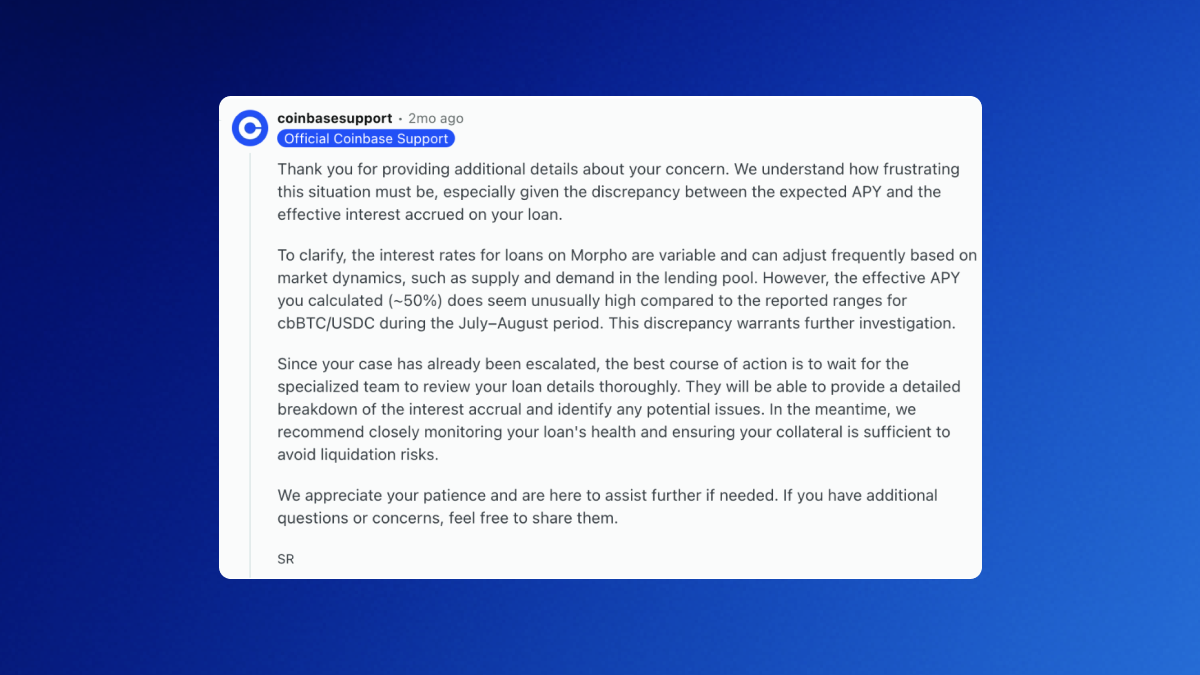
Coinbase now offers both variable-rate and fixed-rate USDC loans through its Morpho-powered borrowing experience. Variable-rate loans fluctuate with market supply and demand; fixed-rate loans lock in a rate for a defined term. Coinbase also charges processing fees and may charge platform fees. Borrowers should compare total costs, not just advertised APRs.
Takeaway:
APX and Coinbase both offer fixed-rate borrowing today. APX publishes fixed-term rate tiers by loan size, while Coinbase quotes rates and fees for the particular fixed-rate or variable-rate loan. Compare costs, repayment obligations and custody arrangements before choosing.
APX Lending
For CAD loans, we disburse your funds within 24 hours (often faster) once your collateral has arrived and been verified.
For USDC-type loans, funding is often nearly instantaneous upon confirmation.
Coinbase / Morpho
Disbursement is essentially instantaneous because everything is handled on-chain: your BTC is converted to cbBTC and locked into the Morpho smart contract, then USDC is issued.
Takeaway:
Coinbase offers rapid on-chain USDC disbursement. APX typically funds USDC after collateral confirmation and can send CAD by wire, subject to approval and payment rails. The relevant differences are currency, eligibility, custody and loan terms, not simply which provider is faster.
APX Lending
We support Bitcoin (BTC) and Ethereum (ETH) as collateral, giving borrowers flexibility. You can borrow in USDC (for U.S. / cross border) or CAD and USDC (for Canadian users).
Coinbase / Morpho
Coinbase accepts BTC, ETH and a broader set of eligible assets as collateral, depending on the jurisdiction, asset and rate product. Crypto-backed loans are funded in USDC. When BTC is pledged, Coinbase uses cbBTC within its Morpho-powered borrowing structure. See Coinbase's current collateral list.
Takeaway:
Both platforms support borrowing against BTC and ETH. APX offers CAD or USDC loans in Canada and USDC loans in eligible U.S. markets; Coinbase offers USDC loans and more collateral types, subject to regional eligibility. Custody structure and currency options are more meaningful distinctions than ETH availability.
APX Lending
APX fixed-term loans run 12 to 60 months. They can be repaid early in full or in part, subject to a fee generally equal to three months' interest on the amount repaid, as set out in the loan agreement. For repeat draws, APX separately offers a five-year revolving line of credit. Extensions or increases in borrowing are subject to approval and applicable terms.
At origination, APX loans offer 20%–60% LTV. APX notifies borrowers when LTV reaches 80%, and the 90/85 partial-liquidation standard is designed to reduce LTV from 90% to 85% when liquidation is required, under the applicable terms.
APX offers two distinct products: a fixed-term loan and a revolving line of credit, with different repayment and borrowing mechanics.
Coinbase / Morpho
Coinbase's variable-rate loans are open-ended, with no fixed principal repayment schedule. Its fixed-rate loans have a defined term and maturity date; they must be repaid by maturity, and early repayment does not reduce the interest owed. Interest accrues according to the loan terms until repayment.
Takeaway:
Both providers now have fixed-rate products. APX additionally offers a separate revolving credit line, while Coinbase's variable-rate loans offer open-ended repayment. Compare the maturity terms, early repayment costs and liquidation rules for the specific product.
APX Lending
We hold collateral in segregated cold storage, with rigorous custody security (e.g. BitGo Trust) and insurance coverage (up to ~$250M). Under our OSC exemptive relief, the collateral is held in SPVs, not rehypothecated, and APX does not accept deposits.
Coinbase / Morpho
When BTC is pledged, Coinbase uses cbBTC within Morpho's on-chain lending protocol. Collateral treatment and liquidation mechanics depend on the underlying asset and market; liquidation thresholds and penalties can vary. The on-chain model enables automation but introduces protocol and smart-contract risks.
Smart contract architecture yields transparency and automation but also exposes you to the risk of bugs, protocol upgrades, and code vulnerabilities.
APX Lending
One of APX’s major differentiators is its regulatory alignment:
Coinbase / Morpho
Coinbase is a large crypto exchange offering access to Morpho-powered borrowing. The legal entity, jurisdictional eligibility, custody mechanics and the role of the on-chain protocol should be assessed separately from APX's Canadian exemptive-relief and custodial model. See Coinbase's product description.
Coinbase's current fixed-rate and variable-rate products have different terms and risks. Borrowers should rely on the current product disclosures rather than terms from its discontinued earlier Borrow product.
Protocol-based lending involves a different combination of smart-contract, liquidity, custody, operational and regulatory risks than a lender using segregated custodian-held collateral.
APX Lending
We build for people, not just code. From onboarding to repayment, users get:
Coinbase / Morpho
In short: Coinbase’s UX is slick, but APX offers more accountability when things get complicated.
Shared risks
APX-specific
Coinbase / Morpho-specific
COMP CHART (CODE IN DYNAMIC RATES)
Coinbase's Morpho-powered model offers rapid USDC borrowing, multiple collateral types, and a choice of fixed-rate or variable-rate terms. Those advantages should be weighed against processing fees, market-specific liquidation terms, and on-chain protocol risks.
APX emphasizes fixed-term pricing, segregated insured BitGo custody, human servicing and a Canadian exemptive-relief framework. Coinbase offers both fixed-rate and variable-rate borrowing through Morpho, with different currencies, collateral options and risks. Which is better depends on the borrower's needs, loan terms, total costs, jurisdiction and preferred custody model.
APX Lending is a crypto-backed lender operating in the US, Canada, and globally. APX Lending does not offer financial or tax advice. We strongly encourage you to consult with a certified financial or tax professional for guidance on any related inquiries you may have.
Crypto-backed loans are no longer fringe.
As the market matures, the difference between safety, clarity, and risk becomes clearer. And more important.
In our corner, we believe in providing borrowers with liquidity without sacrificing control, clarity, and compliance. That’s central to how we do things and ultimately feeds into our mission.
To accelerate crypto adoption through trust, transparency, and regulatory excellence.
With that said: Let’s see how we stack up against Coinbase’s approach.
APX Lending
We offer fixed APRs based on loan size irrespective of loan term or LTV. We offer tiered rates: 11.49% APR (<$100K), 10.99% APR ($100K–$1M), and 9.99% APR (>$1M).
That said, we’re always negotiating better terms with our partners- so keep that in mind.
There are no origination fees or hidden charges, and interest is simple (i.e. you pay only on the principal outstanding).
Coinbase / Morpho
Coinbase now offers both variable-rate and fixed-rate USDC loans through its Morpho-powered borrowing experience. Variable-rate loans fluctuate with market supply and demand; fixed-rate loans lock in a rate for a defined term. Coinbase also charges processing fees and may charge platform fees. Borrowers should compare total costs, not just advertised APRs.
Takeaway:
APX and Coinbase both offer fixed-rate borrowing today. APX publishes fixed-term rate tiers by loan size, while Coinbase quotes rates and fees for the particular fixed-rate or variable-rate loan. Compare costs, repayment obligations and custody arrangements before choosing.
APX Lending
For CAD loans, we disburse your funds within 24 hours (often faster) once your collateral has arrived and been verified.
For USDC-type loans, funding is often nearly instantaneous upon confirmation.
Coinbase / Morpho
Disbursement is essentially instantaneous because everything is handled on-chain: your BTC is converted to cbBTC and locked into the Morpho smart contract, then USDC is issued.
Takeaway:
Coinbase offers rapid on-chain USDC disbursement. APX typically funds USDC after collateral confirmation and can send CAD by wire, subject to approval and payment rails. The relevant differences are currency, eligibility, custody and loan terms, not simply which provider is faster.
APX Lending
We support Bitcoin (BTC) and Ethereum (ETH) as collateral, giving borrowers flexibility. You can borrow in USDC (for U.S. / cross border) or CAD and USDC (for Canadian users).
Coinbase / Morpho
Coinbase accepts BTC, ETH and a broader set of eligible assets as collateral, depending on the jurisdiction, asset and rate product. Crypto-backed loans are funded in USDC. When BTC is pledged, Coinbase uses cbBTC within its Morpho-powered borrowing structure. See Coinbase's current collateral list.
Takeaway:
Both platforms support borrowing against BTC and ETH. APX offers CAD or USDC loans in Canada and USDC loans in eligible U.S. markets; Coinbase offers USDC loans and more collateral types, subject to regional eligibility. Custody structure and currency options are more meaningful distinctions than ETH availability.
APX Lending
APX fixed-term loans run 12 to 60 months. They can be repaid early in full or in part, subject to a fee generally equal to three months' interest on the amount repaid, as set out in the loan agreement. For repeat draws, APX separately offers a five-year revolving line of credit. Extensions or increases in borrowing are subject to approval and applicable terms.
At origination, APX loans offer 20%–60% LTV. APX notifies borrowers when LTV reaches 80%, and the 90/85 partial-liquidation standard is designed to reduce LTV from 90% to 85% when liquidation is required, under the applicable terms.
APX offers two distinct products: a fixed-term loan and a revolving line of credit, with different repayment and borrowing mechanics.
Coinbase / Morpho
Coinbase's variable-rate loans are open-ended, with no fixed principal repayment schedule. Its fixed-rate loans have a defined term and maturity date; they must be repaid by maturity, and early repayment does not reduce the interest owed. Interest accrues according to the loan terms until repayment.
Takeaway:
Both providers now have fixed-rate products. APX additionally offers a separate revolving credit line, while Coinbase's variable-rate loans offer open-ended repayment. Compare the maturity terms, early repayment costs and liquidation rules for the specific product.
APX Lending
We hold collateral in segregated cold storage, with rigorous custody security (e.g. BitGo Trust) and insurance coverage (up to ~$250M). Under our OSC exemptive relief, the collateral is held in SPVs, not rehypothecated, and APX does not accept deposits.
Coinbase / Morpho
When BTC is pledged, Coinbase uses cbBTC within Morpho's on-chain lending protocol. Collateral treatment and liquidation mechanics depend on the underlying asset and market; liquidation thresholds and penalties can vary. The on-chain model enables automation but introduces protocol and smart-contract risks.
Smart contract architecture yields transparency and automation but also exposes you to the risk of bugs, protocol upgrades, and code vulnerabilities.
APX Lending
One of APX’s major differentiators is its regulatory alignment:
Coinbase / Morpho
Coinbase is a large crypto exchange offering access to Morpho-powered borrowing. The legal entity, jurisdictional eligibility, custody mechanics and the role of the on-chain protocol should be assessed separately from APX's Canadian exemptive-relief and custodial model. See Coinbase's product description.
Coinbase's current fixed-rate and variable-rate products have different terms and risks. Borrowers should rely on the current product disclosures rather than terms from its discontinued earlier Borrow product.
Protocol-based lending involves a different combination of smart-contract, liquidity, custody, operational and regulatory risks than a lender using segregated custodian-held collateral.
APX Lending
We build for people, not just code. From onboarding to repayment, users get:
Coinbase / Morpho
In short: Coinbase’s UX is slick, but APX offers more accountability when things get complicated.
Shared risks
APX-specific
Coinbase / Morpho-specific
COMP CHART (CODE IN DYNAMIC RATES)
Coinbase's Morpho-powered model offers rapid USDC borrowing, multiple collateral types, and a choice of fixed-rate or variable-rate terms. Those advantages should be weighed against processing fees, market-specific liquidation terms, and on-chain protocol risks.
APX emphasizes fixed-term pricing, segregated insured BitGo custody, human servicing and a Canadian exemptive-relief framework. Coinbase offers both fixed-rate and variable-rate borrowing through Morpho, with different currencies, collateral options and risks. Which is better depends on the borrower's needs, loan terms, total costs, jurisdiction and preferred custody model.
APX Lending is a crypto-backed lender operating in the US, Canada, and globally. APX Lending does not offer financial or tax advice. We strongly encourage you to consult with a certified financial or tax professional for guidance on any related inquiries you may have.