trust
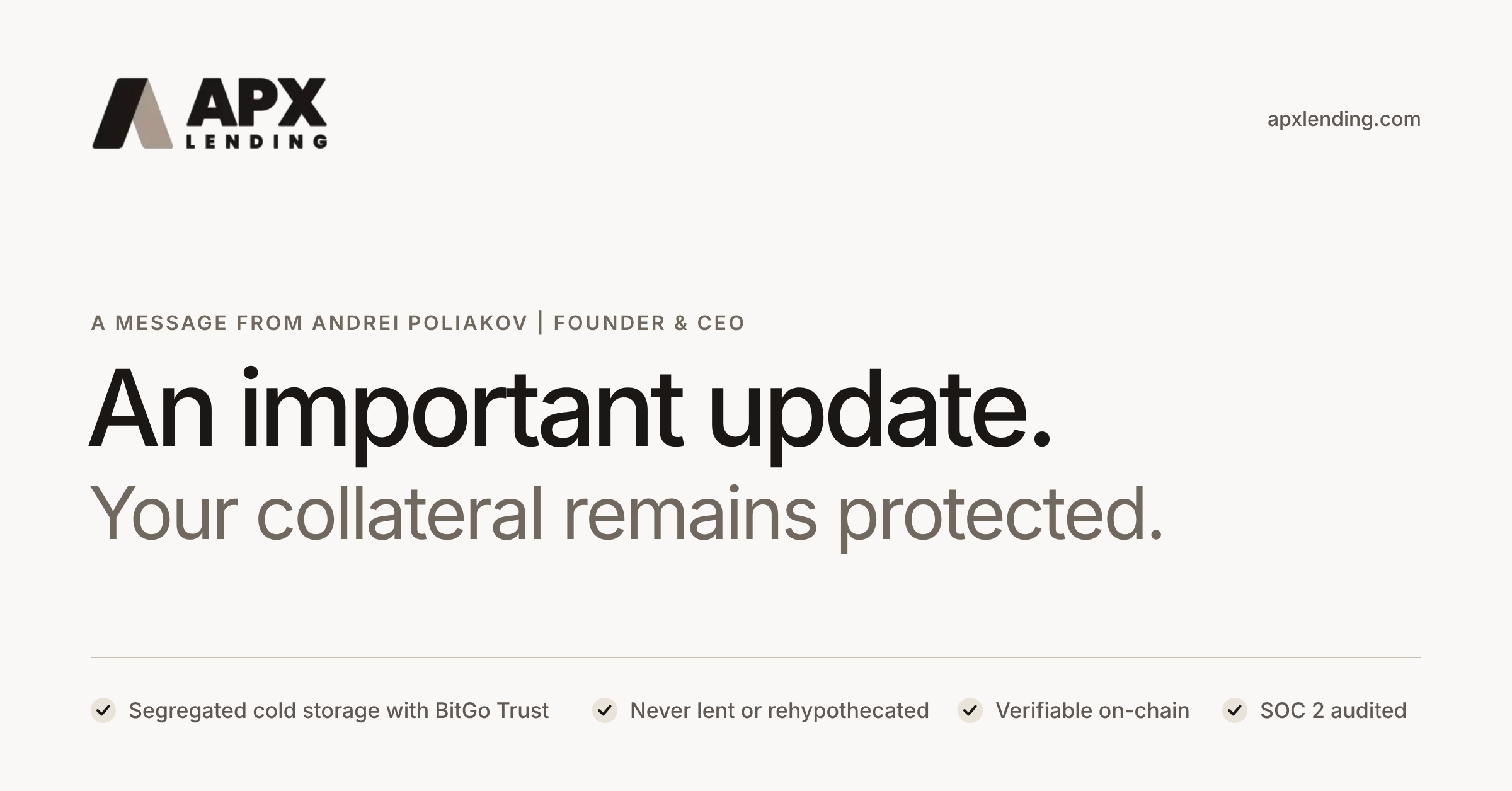
Founder Note | Your Collateral Remains Protected

November 3, 2026
Read more


Repaying a crypto-backed loan means paying the amount you owe under your loan agreement while managing the Bitcoin or Ethereum pledged as collateral. The schedule, early repayment rules and collateral-release process depend on whether you have a fixed-term loan or a revolving line of credit.
Here is how repayment works at APX Lending, including the costs and risks to review before you borrow.
APX fixed-term loans provide a lump sum with a fixed annual rate for the agreed term, starting at 9.99% for qualifying amounts. Depending on the product and agreement, repayments may be structured as interest-only, amortized, or with deferred interest payments. The actual schedule is set out before you sign.
Early repayment is not always free. Under APX’s published fixed-term terms, paying principal early can incur a charge equal to three months’ interest on the principal repaid early, or the interest remaining to maturity if less than three months remain. Review your specific agreement for exceptions or changes.
For example, if your agreement requires monthly interest payments and principal at maturity, paying the interest alone does not release the collateral: the principal and any remaining obligations still must be settled.
APX’s five-year revolving Line of Credit allows eligible borrowers to draw against an approved limit, repay principal and borrow again without a new application for each standard draw. Interest is charged on funds outstanding, not on unused approved credit.
Compare the products in Loan vs. Line of Credit.
APX holds eligible collateral in segregated BitGo Trust cold-storage wallets without rehypothecation. Once the loan is fully repaid and any remaining contractual obligations are satisfied, APX is responsible for returning the remaining collateral under the agreed release process. Transfer and blockchain processing times can vary.
The assets returned may be fewer than originally pledged if a partial liquidation took place while the loan was outstanding. Repayment does not undo earlier collateral sales.
Your LTV is the outstanding loan balance divided by the current market value of the collateral. A falling crypto price raises LTV even if you make scheduled payments. APX provides an 80% LTV risk notification without a margin call. Partial liquidation is triggered at 90% LTV to target approximately 85%, with no APX liquidation fee or sale spread. More declines can cause further sales.
Borrowing at a lower starting LTV, monitoring your position and maintaining a realistic repayment source may reduce—but cannot eliminate—liquidation risk. See How crypto loan liquidation works.
Missing an interest payment or failing to repay at maturity may constitute default under your agreement. A market-driven partial liquidation may occur even when you have not missed a payment. The consequences depend on the product terms, required notices and applicable remedies.
If repayment becomes difficult, review the agreement and contact APX before the due date rather than assuming a collateral-price increase will resolve the obligation.
Deductibility depends on how borrowed funds are used, the jurisdiction and your circumstances. Interest is not automatically deductible because a loan is secured by Bitcoin or Ethereum. Collateral sales—including a liquidation—can also have tax consequences. Keep records of borrowed funds, interest, transfers, repayments and dispositions.
Yes, subject to the product terms. Standard Line of Credit principal repayments do not carry an early repayment fee. Fixed-term loans may have an early repayment charge under the agreement.
After the secured obligations are paid, remaining collateral is returned under the contract. Any Bitcoin or Ethereum sold during prior liquidations is not restored by repayment.
Repayment options depend on the product and agreement. A revolving line permits principal repayment and redrawing subject to the approved facility; fixed-term payment and prepayment rules differ.
Do not assume you can direct a collateral sale as a routine payment. Available methods, processing times and sale consequences depend on your APX product and instructions.
No. BitGo-related custody insurance has aggregate limits, policy conditions and exclusions; it does not cover ordinary market-price movements or all lending risks.
Default remedies and price-triggered liquidation are separate concepts. APX’s market-driven 90% LTV trigger can apply even if payments are current. Other remedies are governed by the agreement.
Compare the total borrowing cost, the payment dates and the collateral buffer—not just the headline rate. Review the APX Crypto-Backed Loan Guide and use the calculator to test a borrowing amount against your collateral.
APX Lending is a crypto-backed lender operating in the US, Canada, and globally. APX Lending does not offer financial or tax advice. We strongly encourage you to consult with a certified financial or tax professional for guidance on any related inquiries you may have.