

.jpg)
Trust
Crypto-Backed Lending 101: Every Term You Need to Know

October 6, 2026
Read more


Bitcoin has evolved far beyond a speculative asset. Today, a growing number of investors, business owners, and long-term holders are using their crypto as collateral to access liquidity without selling their holdings.
In this interview, APX Lending CEO Andrei Poliakov sits down with Philip from the 720 Credit Score YouTube channel to discuss how crypto-backed lending works, why borrowers are choosing to borrow against Bitcoin instead of selling it, and where the industry is headed over the next decade.
The conversation covers everything from loan-to-value ratios and risk management to regulation, institutional adoption, and the future of credit in a Bitcoin-powered economy.
[00:00:00] Announcer: ,2026 when crypto enters the credit system. I'm here with Andrei Poliakov, CEO, and founder of APX lending, a crypto lender based in Canada and approved by the Canadian regulators.
[00:00:13] Phillip: Andrei, good to have you.
[00:00:15] Andrei: Thanks for having me, Phillip.
[00:00:16] Phillip: So let's start off by asking the obvious... like regulation... how do you get approved to be a crypto lender?
Why does this make you different compared to other lenders?
[00:00:27] Andrei: To answer that question, you have to take a a bit of a step back and shed some light on my history and in this space and what I've been spearheading here in Canada.
So in 2017 I launched a company called Coinberry, which became one of the largest regulated crypto trading platforms in Canada. We ran that company for about five years. Ended up selling it to a publicly traded company, but really what set us apart was the fact that we approached the regulators very early on with this vision of... you gotta think back almost 10 years, 2017, with this vision of how do you operate a regulated crypto business?
And that particular business was a trading business, but nevertheless, the question remained. And we engage with Ontario Securities Commission and through them the Canadian Securities Administrators, which is like the Canadian version of the SEC... in the US.
And so we engaged with them very early on and said, okay look, we have this business model. We wanna give people an opportunity to acquire Bitcoin in a safe, secure, and compliant manner. How do we do that? I worked with the regulators for a couple of years. I think it was two, three years it took us to go through that process. And then we became the first actually regulated crypto trading platform.
And so you think about, okay, so we have crypto, right? The first step is how do you get people to get into crypto? How do you get people to buy Bitcoin? Because without that, you can't have you can't have a credit system, you can't have a lending business. You can't have any of those sort of auxiliary second step sort of businesses.
So the first problem that I try to solve is how do you get people into the space in a safe, simple, and secure manner? The second step though, is once people have that crypto, once the people have that Bitcoin. How do you give them the liquidity, the freedom to actually use that Bitcoin without potentially selling it?
Without giving it up. Again in a safe and secure and compliant matter? And when I'm building these businesses, what I think about is mass adoption. And my point of view, mass adoption will not take place until and unless we have regulated and safe and secure businesses that the masses, not the sort of the leading people that are on the sort of the fringe, the edge of technology, but 90% of the population that just wants to use crypto without even understanding how it works, and inevitably, will end up doing that.
The same way that we currently use email without understanding how it works in the backend for the most part. So in order to get the technology to that point where it's that simple to use and that transparent, and to give people the comfort to start using these services, you really do need to go and work with the regulators hand in hand.
So I don't share that opinion of some people that all regulation is bad and all regulators are trying to stifle innovation, I don't think that's the case. I think as an industry, we need to work with regulators to find a balance so that we have innovation that's allowed to seed and grow and sometimes pushes the envelope.
On the other end of the scale you need that sort of the prudent approach and investor and borrower protection. And so for us, long-winded response, but for us when we launched APX was very important to work with the regulators to build a business that addressed the realities and the concerns that existed post Celsius and post BlockFI and address them not only at the business level, but also addressed it from the perspective of a regulatory framework. And so we work with the regulators in Canada for, again, it took about a year and a half to put together a framework of how a regulated crypto backed business could operate.
What are some of the protections? What are some of the stipulations? What can and cannot be done with a collateral? Where is it custody? I think we did a fairly good job and we operated a business which is extremely risk averse. And the latest sort of movements in market... we fared extremely well, as did you know, most of our borrowers. So we're very happy about that.
And again, all of the policies and procedures and insurances and all of that, that goes into building and operating a regulated business or regulatory approved business. You see the value of all of that during times of market movement and volatility and tribulation.
[00:04:44] Phillip: Andrei, help me understand, when people say crypto credit I think securitized just margining your Bitcoin or whatever that is, right? Speculation, margined, et cetera, et cetera. How is this different with APX?
[00:05:02] Andrei: Yeah, so a lot of our users actually borrow from us for things completely separate from trading on leverage. We have farmers that borrow that ended up mining Bitcoin early in the day and are now looking to buy more farmland. We have people borrow to invest in real estate, to invest in other businesses, to diversify their holdings. If you have Bitcoin, and you believe in the appreciating value of Bitcoin with time. You think that you know it's gonna grow with time, then it would be wise of you to not sell that Bitcoin. And then you're faced with this sort of dilemma of, okay, I can sit on it and just wait for it to appreciate. That's one thing I can do.
Or work with a company like APX, what you can do is actually borrow against that Bitcoin, so that happens all the time with securities. You can borrow against your securities, against your shares with your local broker.
There's some criteria about the type of shares and amounts and all those things. But fundamentally people do this all the time, especially wealthy people. They, hardly ever sell their equity and their shares. They borrow against it. And so if you look at how do wealthy people build their wealth and their generation wealth against their assets is one of those ways.
And so what we're allowed to do with APX, is we allow people to build that generation wealth by not giving up, not selling that Bitcoin while getting liquidity outta it. So how do you do that? Let's say for example, you have a hundred thousand dollars worth of Bitcoin. With a company like APX, you can actually borrow up to $60,000 against that Bitcoin. Now that Bitcoin is custodied with a qualified insured custodian, a licensed custodian, and that's the security against your loan.
You can take that loan, you can use it for various things. Like I said we have clients that use it to buy land, to buy real estate, to invest in other projects. Some clients use it to buy more crypto, but that's by far not the most common use of funds that we see on platform.
[00:06:58] Phillip: So let's play this out a little bit. So if someone had a hundred thousand dollars in Bitcoin and they borrowed $60,000 of it, what would those payments be? Would they be making like a monthly payment back to the account? Or how would that work?
[00:07:14] Andrei: Yeah. So there's different ways and we're very flexible in the product that we brought to market. So I'll give you a little bit more color on the product. So we allow our borrowers to borrow anywhere from 20 to 60% loan to value at origination. So in my example, if you have a hundred thousand worth of Bitcoin, you can choose to borrow anywhere from 20,000 all the way up to 60,000.
That depends on your own risk appetite. Because the Bitcoin, the collateral will go up or down in value. And if it goes up on value, that's wonderful. You can borrow more, you can pull more funds from your loan, just like you would with a line of credit.
If the collateral value drops, if the Bitcoin drops in value though, eventually what ends up happening is as the value of the collateral drops, the loan to value ratio starts increasing.
[00:07:57] Phillip: Increasing, right?
[00:07:58] Andrei: So let's say you have a, let's say you have a $50,000 loan on $100,000 worth of collateral.
That's a 50% loan to value, right? 50 over 100.
[00:08:09] Phillip: Right.
[00:08:09] Andrei: If that a hundred thousand now starts dropping, let's say it drops to 80 now you have a 50,000 loan, over $80,000 worth of collateral. So your loan to value is increasing. If your loan to value reaches 80%, we're very unique in that we'll start notifying you that your loan to value is increasing and might wanna top up... send more collateral, pay back some people and do something, but you don't have to.
And we're very unique in doing that because almost all of our competitors... when a margin... this is called a margin call... when a margin call happens, they usually give you a 24 hours or 48 hours to do something. We just notify you.
So you don't actually have to do anything, which is really convenient.
And what ends up happening, if the value of your collateral increases thereafter, amazing. Great. If it continues to decrease and the loan to value reaches 90%.
So in my example, you have a $50,000 loan the collateral will have to basically drop to around 55,000 dollars. So from 100,000 all the down to 55,000 so almost a two fold decrease in bitcoin price. At that point in time, then we start actually liquidating that collateral to pay back your loan because that collateral is the only security that we have. So there's no credit checks. There's nothing else that we take as security. It's just that Bitcoin. So we do have to liquidate it eventually to pay back your loan.
To answer your question about interest payments, but to go back to that...
[00:09:39] Phillip: We'll circle back to it.
[00:09:40] Andrei: Yeah. So with the interest payments. We offer a variety of different types of loans. We offer interest only loans, so you can take out a loan anywhere from three months to five years in length.
It's completely up to you as the borrower. And you pay only interest payments for the duration of that loan, and at the end of the loan, you pay back that principal amount. You can also choose to get amortized loans, so where you have equal payments of principal and interest for the duration of the loan.
So at the very end of the loan, there's no bulk payment of principle. It's all paid out. We're also rolling out balloon payments as well soon, which means the interest is accrued and accumulates, and there's only payable at the end of the loan.
So there's actually no interest payments throughout the loan term. And then you have your principle and interest payment as one bulk payment at the end of the loan. So a very varied product. We allow our users and our borrowers to pick and choose what they want with different LTVs, different lengths of loan, different types of loan interest payments.
There's a lot of flexibility that we offer, but what's key really for borrowers to understand when they price shop around, is again that fact that we have a very high liquidation LTV at 90%. We're the only player on the market that I'm aware of right now that offers such a high liquidation LTV.
And really what that means to you as the borrower is you can afford to have Bitcoin drop a lot more without having to do anything versus the competition, right? In our case, Bitcoin's around, what are we, hundred thousand right now, Canadian. So in US it would be around around 60 68 I suppose, 68 US. Fundamentally speaking, if you have a higher liquidation LTV, that Bitcoin can drop even further before you have to do anything.
[00:11:36] Phillip: Absolutely.
[00:11:36] Andrei: It's very convenient.
[00:11:37] Phillip: So let me, unpack a couple things. First of all, the interest rate, then I'll circle back to Bitcoin.
Apple's and apples comparison. Let's just say with APX versus someone non crypto based lending. What would the interest rate be at a 50% LTV over five years, what would your interest rate be and what would the interest rate be for a typical security? Do you know that comparison?
[00:12:02] Andrei: I can tell you that the asset class itself is starting to be taken more seriously with rates coming down with us specifically as of right now.
And again we're working, continues to bring in those rates.
[00:12:15] Phillip: Yeah.
[00:12:16] Andrei: Our rates are as low as 9.99%.
[00:12:19] Phillip: Okay.
[00:12:20] Andrei: On our loan. So very competitive. So we are getting outta that range where borrow against Bitcoin would net you basically unsecuritized rates, credit card rates, we're getting out of that.
And we're getting more into the range of securitized rates. Which is really good.
[00:12:37] Phillip: That's amazing. I'm actually shocked at that. I thought you were gonna say 18. I didn't think you were gonna say nine. Is that similar to lending on a normal security at 50%?
[00:12:48] Andrei: So that it depends on the security type. Okay. It depends, right?
[00:12:52] Phillip: Yeah.
[00:12:53] Andrei: But I think once you get into even high single digits, you get into very competitive landscape. There was a time where Bitcoin backed loans would be would be issued at 14, 15%.
Yeah, I remember that. And the whole industry has matured quite a bit.
[00:13:09] Phillip: It helps when you got the president of the United States going all in on it. Obviously it's moved the industry a lot, I would imagine, huh?
[00:13:18] Andrei: It has, it has. And it's interesting. Just to give you more color, we have two verticals to our business.
One is our own lending business that we operate using our own technology that we built out. But our technology is so good that we have other lenders globally that use it to issue their own loan. So we have clients in Europe, we have clients in Australia, in the US that use our technology in the backend.
And so we have our white label vertical that we offer to other lenders.
[00:13:46] Phillip: Good for you.
[00:13:47] Andrei: To banks, to credit unions. And I can tell you the discussions we're currently having with banks and credit unions that are looking to offer crypto back lending, not only North America but abroad as well, are very encouraging.
It's day and night versus like I said rewind 10 years ago when I was starting this.
[00:14:03] Phillip: I can imagine.
[00:14:04] Andrei: It's come around so much, and I'm very excited to have big financial institutions that have access to the hundreds of millions of retail clients for them to start rolling out whether it's trading products or lending products.
I'm all about that mass adoption. And so for us, even if we offer our technology to a bank, which is then gonna be able to offer crypto back loans to their clients and undercut us on pricing, that's great. That's great because if we can get utility of crypto and the ability to utilize Bitcoin as an asset class to borrow against into the hands of hundreds of millions of people, I think that's the real win. And so I'm less focused or sensitive about what's the rate today versus what can we do big picture wise to really get this product into the hands of hundreds of millions of people in the US and Canada globally.
[00:15:02] Phillip: That would be a huge market share.
[00:15:04] Andrei: Exactly.
[00:15:05] Phillip: Andrei, help me understand. So in the past month, Bitcoin's down 25, 26, 27%. And, that's the big rub when it comes to crypto lending. I would imagine the volatility, right? It moves fast. And a lot of people who are involved in this, they have a high risk tolerance, right?
Like they don't mind the swings compared to some other people, right? You agree with me? So, the concern would be that the people that have this high risk tolerance would leverage more and pour more into it. So when the call comes or they get the notification at 60 or at 70 saying, Hey, you may wanna add more to it, they don't have that to add, right?
And then it ends up selling, et cetera, et cetera. Where do you go with that? What is your experience?
[00:15:57] Andrei: Yeah look, I think just judging by what happened in the last two weeks, obviously there were some automated liquidations that brought the price down. I think there's some leverage derivative trading that brought the whole thing down to where it's now.
That being said, I've seen Bitcoin go from $600 to 10,000 down to 3,000, up to 60, down to 16, up to 80, down to whatever, to 50 up to 125 now. Or I think 121, 125 down to the current whatever. So if you look at the actual volatility of Bitcoin, not withstanding the last two weeks, it's actually been subsiding and coming down quite a bit.
There are a ton of stocks out there, that are an order of magnitude more volatile. And I'm talking about blue chip stocks that are more volatile than what Bitcoin was until again, notwithstanding the last two weeks. So I think the narrative that Bitcoin is this extremely volatile asset class, used to be more pertinent back in the day. I think we're starting to calm down. Even now, if you look at, okay, so we dropped 15, 20%. If you take out a 60% loan, you'd be at 80% now. So we're not talking about Bitcoin dropping 50% overnight anymore.
It just doesn't happen anymore. And to answer your question, yes some borrowers on our platform did get liquidated. Yes, that's a fact.
[00:17:24] Phillip: Do you have a number on that? How often when you say or in the last month, 'cause it's just so timely. How often do you say, okay we had to send a call or a notification to add more to it?
What percentage of time do you have to liquidate? I don't know if you're allowed to, you feel comfortable?
[00:17:40] Andrei: Oh yeah. I can tell you that the vast majority of borrows top up. A vast majority. Yeah.
[00:17:45] Phillip: So when you say vast majority, 60%, 70%?
[00:17:48] Andrei: Like I would say 80%. 80% of borrowers that were in that margin territory.
So you know, between 80 and 90%, I would say about 80% of them top up. About 20% didn't and got liquidated. And that's just the ones that hit the 80% of...
[00:18:03] Phillip: That's reasonable.
[00:18:03] Andrei: Didn't hit 80%.
[00:18:04] Phillip: Yeah.
[00:18:05] Andrei: Yeah. So for the most part people have, let's say they have 50,000 worth of Bitcoin or 100,000, and that's all they have and they borrow against absolutely...
[00:18:12] Phillip: Yeah.
[00:18:12] Andrei: All that they have.
Usually people are sitting on, let's say you're sitting on even that same a hundred, 200 you, borrow maybe 20, $30,000. You have a lot of buffer room. And we see that. And we give the option of either topping up with more collateral or paying back some of the loan as well. So we've had that happen as well.
A lot of people would say, I'm sitting on some cash right now, lemme pay back some of my loan, bring my LTV into solid territory.
But yeah, so I think the asset class in on itself is becoming more stable and is starting even... we work with private funds that provide the liquidity that we lend out, right?
So we we're not a DeFi protocol.
We're a centralized, compliant platform. And so we work with, multiple liquidity partners that provide us capital.
Even in discussions with these funds, and these are big funds... even discussions with them.
The understanding that Bitcoin is no more sort of a fringe asset class and is now a serious class that you can actually collateralize and lend against... it's just where we are right now. That's the reality, which is very positive. It's a very positive direction that we...
[00:19:17] Phillip: Big direction for your type of industry.
When did that shift happen? Did that shift really happen when Trump got elected and he is "I'm a pro Bitcoin President"? Did you see it galvanize around that. Or was it before that?
[00:19:32] Andrei: For us it was two things. So we got our regulatory approval right around when he got elected.
I think April 1st and so for us, the timing worked really well. So for us, having that stamp of approval from the regulators, again it's like our version of the SEC in the US. So imagine you had the...
[00:19:49] Phillip: It's a big deal.
[00:19:50] Andrei: Exactly.
For us that finalized a lot of discussions that were ongoing. I think, of course with the Trump family in general being extremely supportive of the industry and the changes that took place with the leadership of the SEC and the statements that came out... that inevitably ended up pushing the industry forward massively. Which I'm very happy about because Bitcoin is just the application of blockchain as a technology to the financial markets. Like you, you can apply the blockchain to supply chain, like you can apply it to different industries. So my belief, my true belief is that this particular use case for blockchain is truly to give people the freedom to own and control our own financial instruments without being dependent on third parties is... I don't think people really understand... until you have your bank account closed... by the government, you really don't appreciate...
[00:20:54] Phillip: The bank account.
[00:20:55] Andrei: The value of financial freedom. Like you can't, you can hypothesize, but you can't.
And a lot of the reason that... and I've been at a number of conferences where Eric Trump was talking about how the Trump family had their bank accounts closed during the previous administration and how that sort of formulated their opinion and understanding of what crypto really is.
I've lived through similar, at a much smaller scale. But there's similar experiences with the banks and it really, it rings true. Unless and until you experience the freedom versus the lack thereof from a financial perspective. You really can't appreciate what Bitcoin really is.
And so for me, we are on this journey and it's a movement that isn't gonna stop with any one administration. There's some administrations that may be more positive in certain countries, some that are less. Or supportive, but the train has left the station like we are on this train altogether now, and it's just a matter of how do we see this financial future?
Do we see it as a number of rogue players and rug pulls and all those things, or do we go about building utility and services that really bring value to humanity? And again, my belief is we do that by building safe, secure, compliant businesses that really give people the financial freedom that they currently have with all of the other financial instruments that exist. With stocks and shares and everything, and houses you can borrow against.
If you think about it you could, you borrow against your house all the time, right? In the form of a mortgage. As a lender, the cost of repossessing a house, like all of those things is phenomenal. That gets priced into your mortgage.
With Bitcoin, this is an asset class that you can liquidate 24 7.
Where the cost of liquidation is basically zero, to the lender.
[00:22:47] Phillip: And let me tell you, to get a first trustee on a mortgage, to get a lender, to get a loan, you gotta jump through a lot of hoops.
[00:22:53] Andrei: Exactly. Exactly.
[00:22:54] Phillip: A lot of hoops, credit scoring, asset verification, income verification.
There's a cadre of hurdles you're jumping through. And the loans aren't that much cheaper. Right now, six and a half percent.
[00:23:09] Andrei: Exactly. And why do they do all that? Is to prevent themselves from being in a scenario where they have to liquidate the collateral, the house, because it's an expensive and lengthy process.
So how do they do that? They mitigate that by looking at your income, looking at your payment history and saying, okay, notwithstanding the fact that there's already a house that's backing this this mortgage, what other indicators can we look at to give us comfort that we're really not gonna be in a scenario to actually go out and repossess and sell this house?
That's what it's for.
When you're borrowing against Bitcoin, you don't need any of those indicators because the asset class itself is tradeable 24 7 at fully liquid markets. And so for us like our technology, we mark to market our entire loan book every 30 seconds. So every 30 seconds we get a price point on our entire loan book.
And that gives us basically real time price. So yeah.
[00:24:02] Phillip: So Andrei, the 9.9%, just going back then straight for a second, this is for everybody, regardless of where they live, their credit score, their zip code, their net worth, nothing.
It's a flat rate? Or does it shift? And if it does shift, what are the qualifications for around that?
[00:24:20] Andrei: Sure. So we offer loans in Canada and the US as a lender, so Canada, coast to coast, both retail institutional lenders, and then the US to institutional lenders. The 9.9% is for loan sizes of a million and above.
If it's a loan size of less than a million it, goes up slightly. Currently we offer loans between 25 and a hundred thousand dollars are at 11.49, and then between a hundred thousand dollars and a million, it's 10.99, and then a million and above is 9.99. Again we are constantly working on improving those, but those are still very competitive rates.
As I mentioned, as a lender we operate in North America. We have partner companies that use our technology, that operate in other jurisdictions globally, in Europe and in Australia. And so as a lender, the rates that I'm talking about, that's for North America only, and then again, we're [inaudible].
[00:25:11] Phillip: Okay.
And, is that regardless of credit score, net worth, anything, or is that regardless of security?
[00:25:18] Andrei: We don't look at your credit score and getting a loan from us doesn't impact your credit score because we don't report it.
Yeah. It's a fully securitized loan against the Bitcoin and that is it.
We're happy to service anybody that has legal use case for it.
[00:25:31] Phillip: Andrei, another question. What does this look like in 10 years?
[00:25:35] Andrei: That's a great question. In 10 years...
[00:25:36] Phillip: What does this look like?
Yeah. What does this look like? Yeah. Or five years. Take your pick, but where does this look like? What does your company look like? What does crypto lending look like? What does crypto look like down the road?
[00:25:47] Andrei: Yeah. Look, I'm truly excited about what the promise of DeFI and how that plays into everything.
And so DeFi is basically, instead of borrowing through a centralized entity like ours, you borrow peer-to-peer, but on a global scale. One thing that DeFi is missing right now that is preventing it from being utilized at scale is a compliance layer. That there's no financial institution, there's no bank that's gonna utilize DeFi because there's no compliance layer.
And at the end of the day, you do want some sort of.... know your client, anti-money laundering, anti-terrorism financing protections in the services that you're offering and the clients that you're working with. Like personally, if I'm able to get 2% from an individual direct, that's great, but if that individual got that money through terrorism financing, I personally, I don't wanna do that. So you want and need that compliance layer that's currently missing from the DeFi space. So for me in five, 10 years, we're operating in a place where people don't even need to know, or don't even care to know the technological specificities of how they're getting their, for example, credit on their crypto.
Where people are able to whether through an online platform or their favorite financial institution or bank, are able to plug into a global DeFi network that already has a anti-money laundering compliant layer in it. So that you know that you're not in participating in this network, that you're not financing...
[00:27:16] Phillip: Wow.
[00:27:18] Andrei: Anybody evil. And that's that's not gonna happen in five years, but I think in 10 years that would be something that I think would be very exciting for us. And from our perspective, our vantage point as a company we want to bring those compliant products that have phenomenal rates and plug into global liquidity to clients and again, in a safe, compliant, and secure manner.
Easier said than done.
[00:27:41] Phillip: That would be wow. That would be disruptive.
[00:27:45] Andrei: Yeah.
[00:27:46] Phillip: That would be disruptive. Just cutting out the lender. Cutting out this middleman because it'd go peer to peer, whatever... if someone wants to give you a rate at X, they give it, but it would work with crypto as opposed to real estate because it's always accessible and sold.
[00:28:06] Andrei: There's a lot of discussions that we're currently having with real estate developers as well that are looking for a lot of clients that have.... I'm talking about use case of loans. A lot of clients that have crypto that wanna diversify. Real estate developers that want funds.
How do you marry the two in the middle? Take the crypto, provide the funds. There's an infinite amount of use cases for a loan. To me, the most important concept is... how do you allow people to again create that or keep that generational wealth through the accumulation of Bitcoin versus the sale of Bitcoin?
[00:28:40] Phillip: Yeah. Yeah. That's the key. You brought that up early and that's the key takeaway, or one of the key takeaways on this video. One last question, Andrei. What do you worry about? What, what keeps you up at night? If this happened would not be good.
[00:28:54] Andrei: Yeah. That's an interesting... quantum computing there's some interesting articles are coming out about the resilience of the protocol against quantum computing and the wallet addresses that have to be updated.
So that's a problem that's existential. It needs to be resolved and it's being resolved. That's one really important thing. I think for me... we work very closely with regulators, so I have one foot in the regulatory legacy financial system, which moves extremely slowly.
Like it's painfully slow. And then my other foot's in the crypto world, which moves at lightning speed with innovation and teams that are just like creating phenomenal financial products and instruments. And it is painful to be able to see how quickly and efficiently and effectively things can be done.
And, then on the other hand, trying to convince or work with systems and people that just... it's like... trying to convince it toward us to run as quick as a rabbit... it's just, it's not made to do that. And you're unfortunately stuck in the middle trying to marry the two. And for somebody like me that it's an entrepreneur in this space and I like scale compliant businesses.
It's hard. It's frustrating sometimes. But again it's part that and...
[00:30:10] Phillip: The fact that you can do it is extraordinary. That's a unique ability, right?
[00:30:14] Andrei: Yeah. Yeah. It's
[00:30:16] Phillip: Andrei, what happens if Bitcoin hits 25,000?
[00:30:19] Andrei: Nothing really happened then. Bitcoin has a cyclical cycle that we've been seeing for the past 15 years now.
And again, I've seen Bitcoin retreat and go up and retreat and go up and eventually.... it's very easy for me to say, 'cause I build like massive, thick skin around this. But again, once you've seen that go up and down, you stop paying like attention. So I think nothing will happen at 25. I think it'll rebound. There's a phenomenal amount of buyers that would like to buy Bitcoin at 25. If you had said two and a half thousand I'd probably have a hard time believing that.
[00:30:53] Phillip: Yeah.
[00:30:54] Andrei: But 25, 30... would I like to see there? No. It's not gonna... nothing's going happen to the overarching sort of thesis if Bitcoin drops down to like the thirties.
[00:31:06] Phillip: Yeah. It's still this cutting edge new type of platform that you're lending in, which is very unique. These interest rates are a lot lower than I ever imagined you were gonna say, frankly.
[00:31:21] Andrei: Alright.
[00:31:22] Phillip: Andrei, appreciate your time being on the call.
[00:31:24] Andrei: Thanks so much for having me.
[00:31:26] Announcer: You've been watching the 720 Credit Score YouTube channel.
If you want to rebuild your credit the right way, visit 720creditscore.com. Please like this video and subscribe for more great content.
This article is for informational and educational purposes only and does not constitute legal, financial, investment, or tax advice. APX Lending does not provide investment or tax recommendations. Borrowers should consult qualified professionals and conduct their own due diligence before entering into any crypto-backed lending arrangement.
Bitcoin has evolved far beyond a speculative asset. Today, a growing number of investors, business owners, and long-term holders are using their crypto as collateral to access liquidity without selling their holdings.
In this interview, APX Lending CEO Andrei Poliakov sits down with Philip from the 720 Credit Score YouTube channel to discuss how crypto-backed lending works, why borrowers are choosing to borrow against Bitcoin instead of selling it, and where the industry is headed over the next decade.
The conversation covers everything from loan-to-value ratios and risk management to regulation, institutional adoption, and the future of credit in a Bitcoin-powered economy.
[00:00:00] Announcer: ,2026 when crypto enters the credit system. I'm here with Andrei Poliakov, CEO, and founder of APX lending, a crypto lender based in Canada and approved by the Canadian regulators.
[00:00:13] Phillip: Andrei, good to have you.
[00:00:15] Andrei: Thanks for having me, Phillip.
[00:00:16] Phillip: So let's start off by asking the obvious... like regulation... how do you get approved to be a crypto lender?
Why does this make you different compared to other lenders?
[00:00:27] Andrei: To answer that question, you have to take a a bit of a step back and shed some light on my history and in this space and what I've been spearheading here in Canada.
So in 2017 I launched a company called Coinberry, which became one of the largest regulated crypto trading platforms in Canada. We ran that company for about five years. Ended up selling it to a publicly traded company, but really what set us apart was the fact that we approached the regulators very early on with this vision of... you gotta think back almost 10 years, 2017, with this vision of how do you operate a regulated crypto business?
And that particular business was a trading business, but nevertheless, the question remained. And we engage with Ontario Securities Commission and through them the Canadian Securities Administrators, which is like the Canadian version of the SEC... in the US.
And so we engaged with them very early on and said, okay look, we have this business model. We wanna give people an opportunity to acquire Bitcoin in a safe, secure, and compliant manner. How do we do that? I worked with the regulators for a couple of years. I think it was two, three years it took us to go through that process. And then we became the first actually regulated crypto trading platform.
And so you think about, okay, so we have crypto, right? The first step is how do you get people to get into crypto? How do you get people to buy Bitcoin? Because without that, you can't have you can't have a credit system, you can't have a lending business. You can't have any of those sort of auxiliary second step sort of businesses.
So the first problem that I try to solve is how do you get people into the space in a safe, simple, and secure manner? The second step though, is once people have that crypto, once the people have that Bitcoin. How do you give them the liquidity, the freedom to actually use that Bitcoin without potentially selling it?
Without giving it up. Again in a safe and secure and compliant matter? And when I'm building these businesses, what I think about is mass adoption. And my point of view, mass adoption will not take place until and unless we have regulated and safe and secure businesses that the masses, not the sort of the leading people that are on the sort of the fringe, the edge of technology, but 90% of the population that just wants to use crypto without even understanding how it works, and inevitably, will end up doing that.
The same way that we currently use email without understanding how it works in the backend for the most part. So in order to get the technology to that point where it's that simple to use and that transparent, and to give people the comfort to start using these services, you really do need to go and work with the regulators hand in hand.
So I don't share that opinion of some people that all regulation is bad and all regulators are trying to stifle innovation, I don't think that's the case. I think as an industry, we need to work with regulators to find a balance so that we have innovation that's allowed to seed and grow and sometimes pushes the envelope.
On the other end of the scale you need that sort of the prudent approach and investor and borrower protection. And so for us, long-winded response, but for us when we launched APX was very important to work with the regulators to build a business that addressed the realities and the concerns that existed post Celsius and post BlockFI and address them not only at the business level, but also addressed it from the perspective of a regulatory framework. And so we work with the regulators in Canada for, again, it took about a year and a half to put together a framework of how a regulated crypto backed business could operate.
What are some of the protections? What are some of the stipulations? What can and cannot be done with a collateral? Where is it custody? I think we did a fairly good job and we operated a business which is extremely risk averse. And the latest sort of movements in market... we fared extremely well, as did you know, most of our borrowers. So we're very happy about that.
And again, all of the policies and procedures and insurances and all of that, that goes into building and operating a regulated business or regulatory approved business. You see the value of all of that during times of market movement and volatility and tribulation.
[00:04:44] Phillip: Andrei, help me understand, when people say crypto credit I think securitized just margining your Bitcoin or whatever that is, right? Speculation, margined, et cetera, et cetera. How is this different with APX?
[00:05:02] Andrei: Yeah, so a lot of our users actually borrow from us for things completely separate from trading on leverage. We have farmers that borrow that ended up mining Bitcoin early in the day and are now looking to buy more farmland. We have people borrow to invest in real estate, to invest in other businesses, to diversify their holdings. If you have Bitcoin, and you believe in the appreciating value of Bitcoin with time. You think that you know it's gonna grow with time, then it would be wise of you to not sell that Bitcoin. And then you're faced with this sort of dilemma of, okay, I can sit on it and just wait for it to appreciate. That's one thing I can do.
Or work with a company like APX, what you can do is actually borrow against that Bitcoin, so that happens all the time with securities. You can borrow against your securities, against your shares with your local broker.
There's some criteria about the type of shares and amounts and all those things. But fundamentally people do this all the time, especially wealthy people. They, hardly ever sell their equity and their shares. They borrow against it. And so if you look at how do wealthy people build their wealth and their generation wealth against their assets is one of those ways.
And so what we're allowed to do with APX, is we allow people to build that generation wealth by not giving up, not selling that Bitcoin while getting liquidity outta it. So how do you do that? Let's say for example, you have a hundred thousand dollars worth of Bitcoin. With a company like APX, you can actually borrow up to $60,000 against that Bitcoin. Now that Bitcoin is custodied with a qualified insured custodian, a licensed custodian, and that's the security against your loan.
You can take that loan, you can use it for various things. Like I said we have clients that use it to buy land, to buy real estate, to invest in other projects. Some clients use it to buy more crypto, but that's by far not the most common use of funds that we see on platform.
[00:06:58] Phillip: So let's play this out a little bit. So if someone had a hundred thousand dollars in Bitcoin and they borrowed $60,000 of it, what would those payments be? Would they be making like a monthly payment back to the account? Or how would that work?
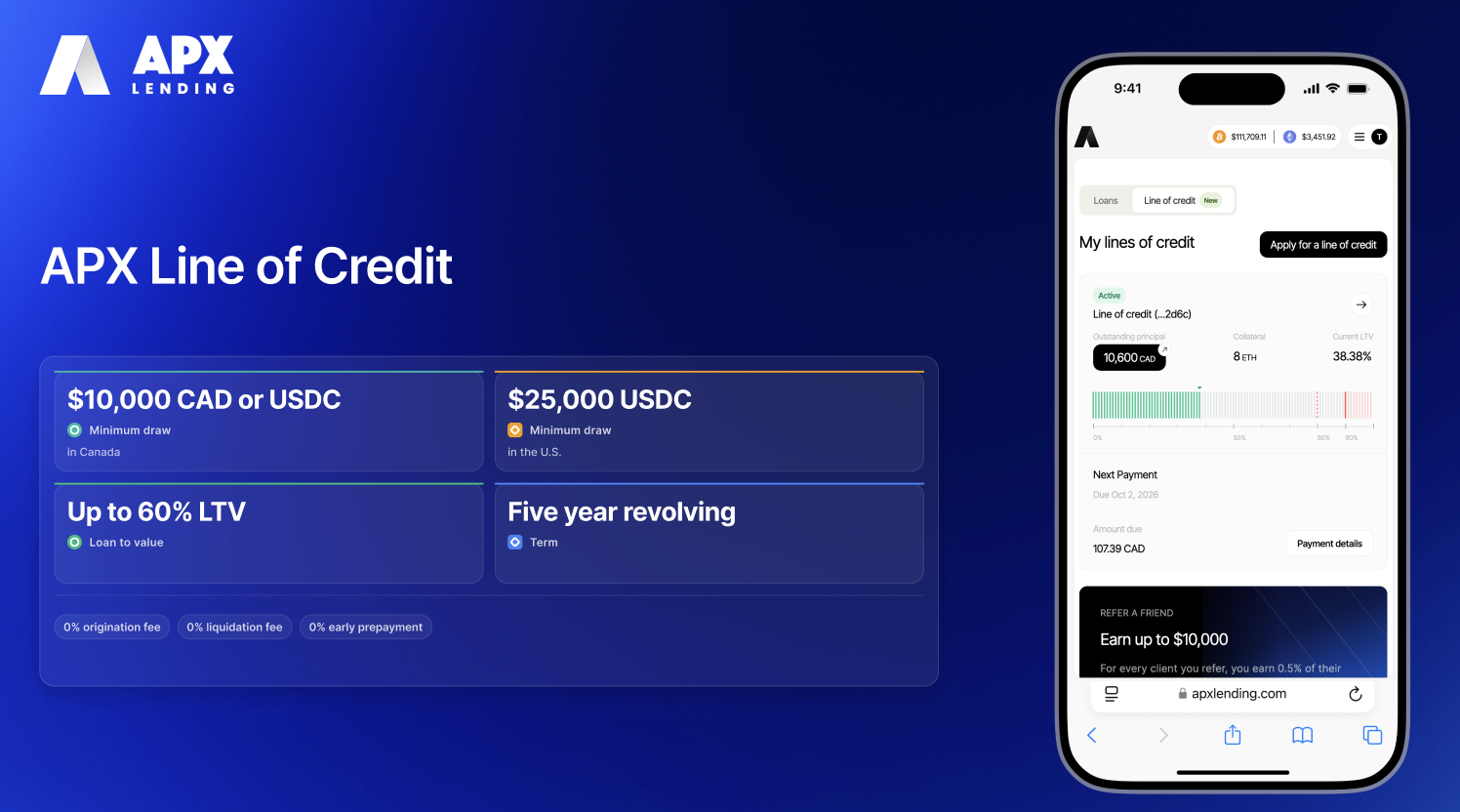
[00:07:14] Andrei: Yeah. So there's different ways and we're very flexible in the product that we brought to market. So I'll give you a little bit more color on the product. So we allow our borrowers to borrow anywhere from 20 to 60% loan to value at origination. So in my example, if you have a hundred thousand worth of Bitcoin, you can choose to borrow anywhere from 20,000 all the way up to 60,000.
That depends on your own risk appetite. Because the Bitcoin, the collateral will go up or down in value. And if it goes up on value, that's wonderful. You can borrow more, you can pull more funds from your loan, just like you would with a line of credit.
If the collateral value drops, if the Bitcoin drops in value though, eventually what ends up happening is as the value of the collateral drops, the loan to value ratio starts increasing.
[00:07:57] Phillip: Increasing, right?
[00:07:58] Andrei: So let's say you have a, let's say you have a $50,000 loan on $100,000 worth of collateral.
That's a 50% loan to value, right? 50 over 100.
[00:08:09] Phillip: Right.
[00:08:09] Andrei: If that a hundred thousand now starts dropping, let's say it drops to 80 now you have a 50,000 loan, over $80,000 worth of collateral. So your loan to value is increasing. If your loan to value reaches 80%, we're very unique in that we'll start notifying you that your loan to value is increasing and might wanna top up... send more collateral, pay back some people and do something, but you don't have to.
And we're very unique in doing that because almost all of our competitors... when a margin... this is called a margin call... when a margin call happens, they usually give you a 24 hours or 48 hours to do something. We just notify you.
So you don't actually have to do anything, which is really convenient.
And what ends up happening, if the value of your collateral increases thereafter, amazing. Great. If it continues to decrease and the loan to value reaches 90%.
So in my example, you have a $50,000 loan the collateral will have to basically drop to around 55,000 dollars. So from 100,000 all the down to 55,000 so almost a two fold decrease in bitcoin price. At that point in time, then we start actually liquidating that collateral to pay back your loan because that collateral is the only security that we have. So there's no credit checks. There's nothing else that we take as security. It's just that Bitcoin. So we do have to liquidate it eventually to pay back your loan.
To answer your question about interest payments, but to go back to that...
[00:09:39] Phillip: We'll circle back to it.
[00:09:40] Andrei: Yeah. So with the interest payments. We offer a variety of different types of loans. We offer interest only loans, so you can take out a loan anywhere from three months to five years in length.
It's completely up to you as the borrower. And you pay only interest payments for the duration of that loan, and at the end of the loan, you pay back that principal amount. You can also choose to get amortized loans, so where you have equal payments of principal and interest for the duration of the loan.
So at the very end of the loan, there's no bulk payment of principle. It's all paid out. We're also rolling out balloon payments as well soon, which means the interest is accrued and accumulates, and there's only payable at the end of the loan.
So there's actually no interest payments throughout the loan term. And then you have your principle and interest payment as one bulk payment at the end of the loan. So a very varied product. We allow our users and our borrowers to pick and choose what they want with different LTVs, different lengths of loan, different types of loan interest payments.
There's a lot of flexibility that we offer, but what's key really for borrowers to understand when they price shop around, is again that fact that we have a very high liquidation LTV at 90%. We're the only player on the market that I'm aware of right now that offers such a high liquidation LTV.
And really what that means to you as the borrower is you can afford to have Bitcoin drop a lot more without having to do anything versus the competition, right? In our case, Bitcoin's around, what are we, hundred thousand right now, Canadian. So in US it would be around around 60 68 I suppose, 68 US. Fundamentally speaking, if you have a higher liquidation LTV, that Bitcoin can drop even further before you have to do anything.
[00:11:36] Phillip: Absolutely.
[00:11:36] Andrei: It's very convenient.
[00:11:37] Phillip: So let me, unpack a couple things. First of all, the interest rate, then I'll circle back to Bitcoin.
Apple's and apples comparison. Let's just say with APX versus someone non crypto based lending. What would the interest rate be at a 50% LTV over five years, what would your interest rate be and what would the interest rate be for a typical security? Do you know that comparison?
[00:12:02] Andrei: I can tell you that the asset class itself is starting to be taken more seriously with rates coming down with us specifically as of right now.
And again we're working, continues to bring in those rates.
[00:12:15] Phillip: Yeah.
[00:12:16] Andrei: Our rates are as low as 9.99%.
[00:12:19] Phillip: Okay.
[00:12:20] Andrei: On our loan. So very competitive. So we are getting outta that range where borrow against Bitcoin would net you basically unsecuritized rates, credit card rates, we're getting out of that.
And we're getting more into the range of securitized rates. Which is really good.
[00:12:37] Phillip: That's amazing. I'm actually shocked at that. I thought you were gonna say 18. I didn't think you were gonna say nine. Is that similar to lending on a normal security at 50%?
[00:12:48] Andrei: So that it depends on the security type. Okay. It depends, right?
[00:12:52] Phillip: Yeah.
[00:12:53] Andrei: But I think once you get into even high single digits, you get into very competitive landscape. There was a time where Bitcoin backed loans would be would be issued at 14, 15%.
Yeah, I remember that. And the whole industry has matured quite a bit.
[00:13:09] Phillip: It helps when you got the president of the United States going all in on it. Obviously it's moved the industry a lot, I would imagine, huh?
[00:13:18] Andrei: It has, it has. And it's interesting. Just to give you more color, we have two verticals to our business.
One is our own lending business that we operate using our own technology that we built out. But our technology is so good that we have other lenders globally that use it to issue their own loan. So we have clients in Europe, we have clients in Australia, in the US that use our technology in the backend.
And so we have our white label vertical that we offer to other lenders.
[00:13:46] Phillip: Good for you.
[00:13:47] Andrei: To banks, to credit unions. And I can tell you the discussions we're currently having with banks and credit unions that are looking to offer crypto back lending, not only North America but abroad as well, are very encouraging.
It's day and night versus like I said rewind 10 years ago when I was starting this.
[00:14:03] Phillip: I can imagine.
[00:14:04] Andrei: It's come around so much, and I'm very excited to have big financial institutions that have access to the hundreds of millions of retail clients for them to start rolling out whether it's trading products or lending products.
I'm all about that mass adoption. And so for us, even if we offer our technology to a bank, which is then gonna be able to offer crypto back loans to their clients and undercut us on pricing, that's great. That's great because if we can get utility of crypto and the ability to utilize Bitcoin as an asset class to borrow against into the hands of hundreds of millions of people, I think that's the real win. And so I'm less focused or sensitive about what's the rate today versus what can we do big picture wise to really get this product into the hands of hundreds of millions of people in the US and Canada globally.
[00:15:02] Phillip: That would be a huge market share.
[00:15:04] Andrei: Exactly.
[00:15:05] Phillip: Andrei, help me understand. So in the past month, Bitcoin's down 25, 26, 27%. And, that's the big rub when it comes to crypto lending. I would imagine the volatility, right? It moves fast. And a lot of people who are involved in this, they have a high risk tolerance, right?
Like they don't mind the swings compared to some other people, right? You agree with me? So, the concern would be that the people that have this high risk tolerance would leverage more and pour more into it. So when the call comes or they get the notification at 60 or at 70 saying, Hey, you may wanna add more to it, they don't have that to add, right?
And then it ends up selling, et cetera, et cetera. Where do you go with that? What is your experience?
[00:15:57] Andrei: Yeah look, I think just judging by what happened in the last two weeks, obviously there were some automated liquidations that brought the price down. I think there's some leverage derivative trading that brought the whole thing down to where it's now.
That being said, I've seen Bitcoin go from $600 to 10,000 down to 3,000, up to 60, down to 16, up to 80, down to whatever, to 50 up to 125 now. Or I think 121, 125 down to the current whatever. So if you look at the actual volatility of Bitcoin, not withstanding the last two weeks, it's actually been subsiding and coming down quite a bit.
There are a ton of stocks out there, that are an order of magnitude more volatile. And I'm talking about blue chip stocks that are more volatile than what Bitcoin was until again, notwithstanding the last two weeks. So I think the narrative that Bitcoin is this extremely volatile asset class, used to be more pertinent back in the day. I think we're starting to calm down. Even now, if you look at, okay, so we dropped 15, 20%. If you take out a 60% loan, you'd be at 80% now. So we're not talking about Bitcoin dropping 50% overnight anymore.
It just doesn't happen anymore. And to answer your question, yes some borrowers on our platform did get liquidated. Yes, that's a fact.
[00:17:24] Phillip: Do you have a number on that? How often when you say or in the last month, 'cause it's just so timely. How often do you say, okay we had to send a call or a notification to add more to it?
What percentage of time do you have to liquidate? I don't know if you're allowed to, you feel comfortable?
[00:17:40] Andrei: Oh yeah. I can tell you that the vast majority of borrows top up. A vast majority. Yeah.
[00:17:45] Phillip: So when you say vast majority, 60%, 70%?
[00:17:48] Andrei: Like I would say 80%. 80% of borrowers that were in that margin territory.
So you know, between 80 and 90%, I would say about 80% of them top up. About 20% didn't and got liquidated. And that's just the ones that hit the 80% of...
[00:18:03] Phillip: That's reasonable.
[00:18:03] Andrei: Didn't hit 80%.
[00:18:04] Phillip: Yeah.
[00:18:05] Andrei: Yeah. So for the most part people have, let's say they have 50,000 worth of Bitcoin or 100,000, and that's all they have and they borrow against absolutely...
[00:18:12] Phillip: Yeah.
[00:18:12] Andrei: All that they have.
Usually people are sitting on, let's say you're sitting on even that same a hundred, 200 you, borrow maybe 20, $30,000. You have a lot of buffer room. And we see that. And we give the option of either topping up with more collateral or paying back some of the loan as well. So we've had that happen as well.
A lot of people would say, I'm sitting on some cash right now, lemme pay back some of my loan, bring my LTV into solid territory.
But yeah, so I think the asset class in on itself is becoming more stable and is starting even... we work with private funds that provide the liquidity that we lend out, right?
So we we're not a DeFi protocol.
We're a centralized, compliant platform. And so we work with, multiple liquidity partners that provide us capital.
Even in discussions with these funds, and these are big funds... even discussions with them.
The understanding that Bitcoin is no more sort of a fringe asset class and is now a serious class that you can actually collateralize and lend against... it's just where we are right now. That's the reality, which is very positive. It's a very positive direction that we...
[00:19:17] Phillip: Big direction for your type of industry.
When did that shift happen? Did that shift really happen when Trump got elected and he is "I'm a pro Bitcoin President"? Did you see it galvanize around that. Or was it before that?
[00:19:32] Andrei: For us it was two things. So we got our regulatory approval right around when he got elected.
I think April 1st and so for us, the timing worked really well. So for us, having that stamp of approval from the regulators, again it's like our version of the SEC in the US. So imagine you had the...
[00:19:49] Phillip: It's a big deal.
[00:19:50] Andrei: Exactly.
For us that finalized a lot of discussions that were ongoing. I think, of course with the Trump family in general being extremely supportive of the industry and the changes that took place with the leadership of the SEC and the statements that came out... that inevitably ended up pushing the industry forward massively. Which I'm very happy about because Bitcoin is just the application of blockchain as a technology to the financial markets. Like you, you can apply the blockchain to supply chain, like you can apply it to different industries. So my belief, my true belief is that this particular use case for blockchain is truly to give people the freedom to own and control our own financial instruments without being dependent on third parties is... I don't think people really understand... until you have your bank account closed... by the government, you really don't appreciate...
[00:20:54] Phillip: The bank account.
[00:20:55] Andrei: The value of financial freedom. Like you can't, you can hypothesize, but you can't.
And a lot of the reason that... and I've been at a number of conferences where Eric Trump was talking about how the Trump family had their bank accounts closed during the previous administration and how that sort of formulated their opinion and understanding of what crypto really is.
I've lived through similar, at a much smaller scale. But there's similar experiences with the banks and it really, it rings true. Unless and until you experience the freedom versus the lack thereof from a financial perspective. You really can't appreciate what Bitcoin really is.
And so for me, we are on this journey and it's a movement that isn't gonna stop with any one administration. There's some administrations that may be more positive in certain countries, some that are less. Or supportive, but the train has left the station like we are on this train altogether now, and it's just a matter of how do we see this financial future?
Do we see it as a number of rogue players and rug pulls and all those things, or do we go about building utility and services that really bring value to humanity? And again, my belief is we do that by building safe, secure, compliant businesses that really give people the financial freedom that they currently have with all of the other financial instruments that exist. With stocks and shares and everything, and houses you can borrow against.
If you think about it you could, you borrow against your house all the time, right? In the form of a mortgage. As a lender, the cost of repossessing a house, like all of those things is phenomenal. That gets priced into your mortgage.
With Bitcoin, this is an asset class that you can liquidate 24 7.
Where the cost of liquidation is basically zero, to the lender.
[00:22:47] Phillip: And let me tell you, to get a first trustee on a mortgage, to get a lender, to get a loan, you gotta jump through a lot of hoops.
[00:22:53] Andrei: Exactly. Exactly.
[00:22:54] Phillip: A lot of hoops, credit scoring, asset verification, income verification.
There's a cadre of hurdles you're jumping through. And the loans aren't that much cheaper. Right now, six and a half percent.
[00:23:09] Andrei: Exactly. And why do they do all that? Is to prevent themselves from being in a scenario where they have to liquidate the collateral, the house, because it's an expensive and lengthy process.
So how do they do that? They mitigate that by looking at your income, looking at your payment history and saying, okay, notwithstanding the fact that there's already a house that's backing this this mortgage, what other indicators can we look at to give us comfort that we're really not gonna be in a scenario to actually go out and repossess and sell this house?
That's what it's for.
When you're borrowing against Bitcoin, you don't need any of those indicators because the asset class itself is tradeable 24 7 at fully liquid markets. And so for us like our technology, we mark to market our entire loan book every 30 seconds. So every 30 seconds we get a price point on our entire loan book.
And that gives us basically real time price. So yeah.
[00:24:02] Phillip: So Andrei, the 9.9%, just going back then straight for a second, this is for everybody, regardless of where they live, their credit score, their zip code, their net worth, nothing.
It's a flat rate? Or does it shift? And if it does shift, what are the qualifications for around that?
[00:24:20] Andrei: Sure. So we offer loans in Canada and the US as a lender, so Canada, coast to coast, both retail institutional lenders, and then the US to institutional lenders. The 9.9% is for loan sizes of a million and above.
If it's a loan size of less than a million it, goes up slightly. Currently we offer loans between 25 and a hundred thousand dollars are at 11.49, and then between a hundred thousand dollars and a million, it's 10.99, and then a million and above is 9.99. Again we are constantly working on improving those, but those are still very competitive rates.
As I mentioned, as a lender we operate in North America. We have partner companies that use our technology, that operate in other jurisdictions globally, in Europe and in Australia. And so as a lender, the rates that I'm talking about, that's for North America only, and then again, we're [inaudible].
[00:25:11] Phillip: Okay.
And, is that regardless of credit score, net worth, anything, or is that regardless of security?
[00:25:18] Andrei: We don't look at your credit score and getting a loan from us doesn't impact your credit score because we don't report it.
Yeah. It's a fully securitized loan against the Bitcoin and that is it.
We're happy to service anybody that has legal use case for it.
[00:25:31] Phillip: Andrei, another question. What does this look like in 10 years?
[00:25:35] Andrei: That's a great question. In 10 years...
[00:25:36] Phillip: What does this look like?
Yeah. What does this look like? Yeah. Or five years. Take your pick, but where does this look like? What does your company look like? What does crypto lending look like? What does crypto look like down the road?
[00:25:47] Andrei: Yeah. Look, I'm truly excited about what the promise of DeFI and how that plays into everything.
And so DeFi is basically, instead of borrowing through a centralized entity like ours, you borrow peer-to-peer, but on a global scale. One thing that DeFi is missing right now that is preventing it from being utilized at scale is a compliance layer. That there's no financial institution, there's no bank that's gonna utilize DeFi because there's no compliance layer.
And at the end of the day, you do want some sort of.... know your client, anti-money laundering, anti-terrorism financing protections in the services that you're offering and the clients that you're working with. Like personally, if I'm able to get 2% from an individual direct, that's great, but if that individual got that money through terrorism financing, I personally, I don't wanna do that. So you want and need that compliance layer that's currently missing from the DeFi space. So for me in five, 10 years, we're operating in a place where people don't even need to know, or don't even care to know the technological specificities of how they're getting their, for example, credit on their crypto.
Where people are able to whether through an online platform or their favorite financial institution or bank, are able to plug into a global DeFi network that already has a anti-money laundering compliant layer in it. So that you know that you're not in participating in this network, that you're not financing...
[00:27:16] Phillip: Wow.
[00:27:18] Andrei: Anybody evil. And that's that's not gonna happen in five years, but I think in 10 years that would be something that I think would be very exciting for us. And from our perspective, our vantage point as a company we want to bring those compliant products that have phenomenal rates and plug into global liquidity to clients and again, in a safe, compliant, and secure manner.
Easier said than done.
[00:27:41] Phillip: That would be wow. That would be disruptive.
[00:27:45] Andrei: Yeah.
[00:27:46] Phillip: That would be disruptive. Just cutting out the lender. Cutting out this middleman because it'd go peer to peer, whatever... if someone wants to give you a rate at X, they give it, but it would work with crypto as opposed to real estate because it's always accessible and sold.
[00:28:06] Andrei: There's a lot of discussions that we're currently having with real estate developers as well that are looking for a lot of clients that have.... I'm talking about use case of loans. A lot of clients that have crypto that wanna diversify. Real estate developers that want funds.
How do you marry the two in the middle? Take the crypto, provide the funds. There's an infinite amount of use cases for a loan. To me, the most important concept is... how do you allow people to again create that or keep that generational wealth through the accumulation of Bitcoin versus the sale of Bitcoin?
[00:28:40] Phillip: Yeah. Yeah. That's the key. You brought that up early and that's the key takeaway, or one of the key takeaways on this video. One last question, Andrei. What do you worry about? What, what keeps you up at night? If this happened would not be good.
[00:28:54] Andrei: Yeah. That's an interesting... quantum computing there's some interesting articles are coming out about the resilience of the protocol against quantum computing and the wallet addresses that have to be updated.
So that's a problem that's existential. It needs to be resolved and it's being resolved. That's one really important thing. I think for me... we work very closely with regulators, so I have one foot in the regulatory legacy financial system, which moves extremely slowly.
Like it's painfully slow. And then my other foot's in the crypto world, which moves at lightning speed with innovation and teams that are just like creating phenomenal financial products and instruments. And it is painful to be able to see how quickly and efficiently and effectively things can be done.
And, then on the other hand, trying to convince or work with systems and people that just... it's like... trying to convince it toward us to run as quick as a rabbit... it's just, it's not made to do that. And you're unfortunately stuck in the middle trying to marry the two. And for somebody like me that it's an entrepreneur in this space and I like scale compliant businesses.
It's hard. It's frustrating sometimes. But again it's part that and...
[00:30:10] Phillip: The fact that you can do it is extraordinary. That's a unique ability, right?
[00:30:14] Andrei: Yeah. Yeah. It's
[00:30:16] Phillip: Andrei, what happens if Bitcoin hits 25,000?
[00:30:19] Andrei: Nothing really happened then. Bitcoin has a cyclical cycle that we've been seeing for the past 15 years now.
And again, I've seen Bitcoin retreat and go up and retreat and go up and eventually.... it's very easy for me to say, 'cause I build like massive, thick skin around this. But again, once you've seen that go up and down, you stop paying like attention. So I think nothing will happen at 25. I think it'll rebound. There's a phenomenal amount of buyers that would like to buy Bitcoin at 25. If you had said two and a half thousand I'd probably have a hard time believing that.
[00:30:53] Phillip: Yeah.
[00:30:54] Andrei: But 25, 30... would I like to see there? No. It's not gonna... nothing's going happen to the overarching sort of thesis if Bitcoin drops down to like the thirties.
[00:31:06] Phillip: Yeah. It's still this cutting edge new type of platform that you're lending in, which is very unique. These interest rates are a lot lower than I ever imagined you were gonna say, frankly.
[00:31:21] Andrei: Alright.
[00:31:22] Phillip: Andrei, appreciate your time being on the call.
[00:31:24] Andrei: Thanks so much for having me.
[00:31:26] Announcer: You've been watching the 720 Credit Score YouTube channel.
If you want to rebuild your credit the right way, visit 720creditscore.com. Please like this video and subscribe for more great content.
This article is for informational and educational purposes only and does not constitute legal, financial, investment, or tax advice. APX Lending does not provide investment or tax recommendations. Borrowers should consult qualified professionals and conduct their own due diligence before entering into any crypto-backed lending arrangement.




.webp)


