On June 26, 2026, APX Lending hosted a panel discussion with DLA Piper focused on trust, crypto-backed lending, institutional adoption, borrower protection, and the future of digital asset finance in Canada.
The discussion featured APX Lending CEO Andrei Poliakov, ReserveOne CEO Jaime Leverton, Netcoins and BIGG Digital Assets CEO Fraser Matthews, and DLA Piper partner Jarrod Isfeld. The panel explored why Canadians are borrowing against Bitcoin and Ethereum, how institutions evaluate crypto lending counterparties, and why custody, collateral segregation, transparency, and non-rehypothecation matter after failures like Celsius, FTX, Voyager, and Terra/Luna.
The conversation also covered retail and institutional use cases, Canadian regulatory challenges, stablecoins, tokenization, crypto trading platforms, bank and credit union adoption, and what the industry needs to build long-term trust.
This transcript has been lightly edited for clarity and readability.
Key Takeaways
APX Lending borrowers are using crypto-backed loans for real-world needs such as real estate, business growth, education, and liquidity, not only for crypto leverage.
Crypto-backed lending is becoming a broader financial tool for both retail borrowers and institutions.
Institutional borrowers focus heavily on counterparty risk, custody structure, legal agreements, diversification, and regulatory standing.
Borrowers should review loan agreements for collateral ownership, custody, liquidation terms, fees, repayment rights, jurisdiction, and event of default provisions.
Collateral segregation and non-rehypothecation were emphasized as critical borrower protections.
The panel discussed how failures like Celsius, FTX, Voyager, and Terra/Luna changed expectations around due diligence and trust.
APX Lending described its approach to pricing, collateral monitoring, borrower notifications, and liquidation thresholds.
Stablecoins, tokenization, and on-chain settlement were discussed as important parts of the future financial services stack.
Canadian crypto companies continue to face challenges around regulation, banking access, and global competition.
The panelists agreed that long-term adoption depends on trust, transparency, strong custody practices, and clearer regulatory frameworks.
Summary
In this panel discussion, APX Lending CEO Andrei Poliakov speaks with Jaime Leverton, Fraser Matthews, and Jarrod Isfeld about the growth of crypto-backed lending in Canada and its role in the broader digital asset economy.
The conversation covers why borrowers use Bitcoin-backed and Ethereum-backed loans, how institutions assess lending counterparties, what borrowers should look for in loan agreements, and why custody, collateral segregation, and non-rehypothecation are central to trust.
The panel also addresses Canadian regulation, stablecoins, tokenization, DeFi, crypto trading platforms, bank and credit union adoption, and lessons from major crypto failures.
The session concludes with audience Q&A on pricing, liquidation, stablecoins, crypto asset reviews, banking friction, and the future of crypto financial services in Canada.
[00:00:00] Andrei:
[00:00:04] Welcome & Introductions
[00:00:04] Andrei: All right. I hope everybody had a good break. I want to welcome you back to the second part of our Toronto Tech Week event. My name is Andrei Poliakov. For those of you that are new in the room, I am the CEO and founder of APX Lending. We are the first regulated crypto-backed lender in Canada.
We are co-hosting this event together with DLA Piper and we're very thankful for our partners at DLA Piper for organizing this event with us. A team that I've worked with for almost a decade building now the second regulated business that I've worked on. Previously, we took Coinberry, which was the first regulated crypto trading platform in Canada through the process and recent-- well not so recently, I guess last year at this point in time flies, APX Lending as well.
APX Lending is a regulated crypto-backed lending platform where Canadians can borrow against their Bitcoin and Ethereum and get either Canadian dollars or USDC as as their proceeds of loan. And today I am very happy to welcome with me on stage three, Jared, I guess you already were on stage with me.
But very happy to welcome Jamie Leverton, who is the CEO of Reserve One, previously the CEO of HUD8, and Fraser Matthews, who is the CEO of Netcoins and BIGG. And of course, Jared Isfeld as well a partner at DLA Piper that I have worked with very closely over the years.
We are going to be discussing the sort of expanded topic of trust and crypto and lending, and not just from the vantage point of APX as a regulated entity, but also from the capital markets perspective of Reserve One and from a regulated CTP perspective of Netcoins. CTP obviously is crypto trading platform.
I realize we use acronyms so often - that we forget what they mean. So very excited. Very excited to be here and have this chat with you. As in the panel, if you wouldn't mind holding your questions to the end, that would be very appreciated. But of course, at the end, we welcome all questions and we'll do our best to answer them.
So
[00:02:28] Why People Borrow Against Crypto
[00:02:36] Andrei: I wanna talk a little bit about-- and some of the questions that were posed to me during the break is use cases. Why do people borrow against their crypto? When we were launching the business, there was a lot of hypotheses. And one of the, funny enough, one of the requests of the commission when we were going through the regulatory process was to poll and ask our users, so there was a lot of hypothesis about why clients would want to use their crypto.
And so during the onboarding process with, APX we asked our clients why what are the use of proceeds of your crypto loan. And we were very actually surprised to find out. And with time, it became a a real source of pride for us as a business, and I'll explain why.
Because we realized that the vast majority of the use of proceeds is actually for real-life uses, whether it's buying property, starting a business, expanding a business, buying land. We've had people take out loans to pay for their kids' education. So it-- And of course, some people take out loans to buy more crypto as a leverage tool, but it's a far distant, I think, fourth in that list.
And we've had really amazing use cases where people have reached out and said thank you for providing this service. I was able to, And instead of selling my Bitcoin, I was able to take out a loan against it and pay for my kids' education," or start a charity.
We recently had somebody start a charity. Like it was, it's really amazing use cases. So very heartwarming, but also surprising. I'll be very honest, I was initially I was quite surprised. So the question that I have for each one of you is does or do you feel from your vantage point that crypto-backed loans and credit are still a niche product that is specifically catering to the crypto crowd, or is this becoming more of an expanded use case?
And is the industry really, or at least this segment of the industry, really growing to become something sort of mass market at this point in time? There you go. And please do introduce yourselves in more detail.
[00:04:42] Jaime: Oh, no need. I'm Jane. I have been in this space since 2017.
Took over Hut 8 in 2020. I sit on a number of boards between the traditional data center space and the digital asset space. When I was running Hut we were on the leading edge of a couple of things including this subject. We were the first of the publicly traded Bitcoin miners back in early '21 to say we were no longer gonna sell our Bitcoin.
We were believers that over time, keeping Bitcoin on balance sheet would serve us better than keeping fiat on balance sheet just because of erosion of purchasing power. And so we started HODLing. And over time, we built up a very lovely stack of Bitcoin, but we still needed to fund ongoing operations and we were looking for non-dilutive ways to do that.
And we entered into a lending arrangement the first of its kind, with Coinbase in l- late '21, early '22. And to your point, we entered into that lending arrangement for a few reasons. They were a regulated counterparty which is important. Counterparty risk, especially as a public company fiduciary, is critical in your decision-making process.
It was an elegant solution. It was low friction. We were already using them for custody. And what we wanted to access fiat for was to actually to buy a traditional data center business. That's when we announced our purchase of TeraGo's data center business as well as to, to reinvest in in some increase in operational capacity of, the mining side of the business.
And now that i- is commonplace. Almost all of the, large publicly traded Bitcoin miners use Bitcoin lending facilities to some degree. So to answer your question a very long way I think it's, it is just a tool in the toolkit now. It is no longer niche. And I think more and more people in the mainstream economy are looking at ways to protect the melting iceberg that is fiat, and taking exposure to crypto that they can, still use for other things is more and more interesting for everybody.
[00:07:07] Andrei: Amazing. Thank you. And Fraser, what's your perspective?
[00:07:11] Fraser Matthews: Yeah. W- we see a number of different use cases flowing through our retail trading platform, which is Netcoins, where we see users who are long-term holders that didn't want a liquidation event. They didn't want to be getting into a taxable event either.
So keeping Bitcoin holdings or Ethereum holdings and utilizing them to get cash for everyday spend, right? Whether, like you said, college, university tuition, auto loans, home loans, et cetera they're using that as spending power in this new modern economy where they're on ramped and prefer to stay there in, in many cases.
Further that, corporations, m- many digital asset treasury ca- companies who are coming to us and utilizing holdings that they've acquired and said, "You know what? We need a- additional capitalization. This is gonna help to fuel our growth." It's a new way to collateralize. And for some younger companies as well you don't have as much opportunity to collateralize certain things, right?
You're a younger company. You only have a couple of years of financial operation. Owning this asset allows you to get access to financial markets they may not have had before, particularly if you're operating in the crypto space.
[00:08:18] Andrei: And somebody earlier on asked about how the regulators look at margin trading.
So I'm curious from your perspective, do you see a lot of demand for margin trading on the platform? Is that something that gaining traction or, again, is it more real-life use cases?
[00:08:34] Fraser Matthews: So margin trading is always commonly asked for. It's unfortunate that it's not permitted and available in Canada, not just from margin from taking a loan to buy more, but just in general.
We're in many regards, held back from additional trading types here in Canada, right? So we don't have perpetuals, we don't have derivatives, we don't have access to margin. It unfortunately pushes people to go offshore and do things elsewhere, and that's been one of the big challenges here in Canada, is that Canadians can operate within the registered crypto trading platforms that we have here, and we spend a lot of time, a lot of effort, a lot of capital to be registered.
But other products and services can still service Canadians offshore, so w- we find that a challenge. It's something our clients ask for, and we know all the other exchanges are, we're all openly pushing forward with the regulators and hopefully we can expand what we're permitted to do once we're all CERO members.
[00:09:27] Andrei: And I echo that. I think the reality of the crypto industry is that it is global, and there are platforms globally that still service Canadians. So I think a message that we've shared with the regulators quite often is it's one thing to regulate and provide frameworks for, companies to to, get regulated.
That's another thing to actually enforce and create value out of that regulated status. Becase otherwise, if somebody can just an offshore company can offer the same business with half of the regulatory costs, then what is it all really for, right?
[00:10:02] Jaime: Can I, ask Jared a question?
[00:10:05] Jarrod: No :)
[00:10:06] Jaime: We actually used to have quite a forward-thinking regulatory regime.
Bitcoin miners went public first in Canada. First ETFs are in Canada. What changed?
[00:10:20] Jarrod: I think, part of it, like back in 2017, they were just getting familiar with what is cryptocurrency? What are y- is it a security? Is it not? Some aren't. And they're trying to figure out do we need a new regulatory regime, or can we go the US route and just take the position that it falls within existing securities laws and somebody's golf side will enforce?
But they went another route, and they said, "Look at, rather than go sort of regulation by enforcement route that they did in the US, we're gonna do something better. We're gonna create bespoke rules around which crypto businesses can operate." And the trouble with that is it it took a long time and there's a lot of input and I guess the point being that they took this approach where we're gonna take jurisdiction over this.
And then we have the ups and downs of the crypto market, right? We have 2022, and instead of them getting more and more comfortable and creating broader, clearer, permanent rules, they took a step back and said, "Oh, we really need to be careful here." And they continued on that original route of, we gotta look at each crypto business.
We've gotta create bespoke exemptive relief. And all of that takes time, and it's very, slow. I think now, though, there's a lot... They've taken jurisdiction. They understand now they're moving too slowly. They understand that if your mandate is to protect Canadian investors, and Canadian inv-- it's nice.
We create a nice, safe environment that Canadian companies can operate under. But if Canadian investors can go offshore, who cares? Where's the protection, right? And we're seeing that where-- so I think they're recognizing that, and I think they are gonna start to move more quickly, and we're going to have more permanent, broader sets of rules, whether that's through bran- blanket relief, guidance, maybe even some rulemaking.
And a good example is the new tokenization project that the CSA is undertaking. I'm hopeful that's the direction it's going in, but, you know- So it- ... not yet.
[00:12:57] Jaime: So the answer is it's Sam's fault.
[00:13:03] Jaime: Yeah. Sam Bankman-Fried broke Canada.
[00:13:06] Jarrod: 2022 was-- They kinda- 2022. They kinda shut down, 'cause what was there? There was Celsius, there was LunaTerra, and, you know-
[00:13:14] Jaime: Voyager ...
[00:13:15] Jarrod: a, a, Voyager. The launchpad. Yeah.
[00:13:19] Jaime: I would say.
[00:13:20] Jarrod: Where we're gonna take fintech and accelerate it. That kinda shut down it.
[00:13:27] Institutional Due Diligence
[00:13:27] Andrei: So my next question is actually to you, Jaime. So from an institutional perspective, what are some of the sort of due diligence elements... And you alluded to that with previous work with Coinbase. But what are some of the due diligence elements that you look at when looking for a counterparty to to utilize f- for a, crypto-backed sort of credit facility?
Is it the contract structure? Is it the collateral? Is it the custody? Is it is it the terms of the agreement? So can you just walk us through some of that institutional perspective on on what you look-
[00:14:06] Jaime: I thought you were making it multiple choice. It's all of those things.
I think when you're making a decision as a public company fiduciary, you're making it on behalf of all of the stakeholders, and obviously everything you do is public and disclosed. And everybody has an opinion, and they're not afraid to share it with me on Twitter or any other platform of their choosing.
So it's, y- you have to make sure that you're, you've got the right counterparty, you have the right structure. I think as I mentioned, the Coinbase solution was elegant because they were also our custodian, so we didn't have to worry about being woken up in the middle of the night to move crypto around if there were big price swings.
It just, we were able to do that automatically within their structure. It was early days. There also wasn't a lot of choice. We were able to negotiate at what was a competitive rate at that time, and at a time when there wa- it was really difficult for Bitcoin miners to to get non-dilutive sources of financing that were in any way competitive.
That's certainly evolved since then. The other thing I think- If you're, if you are using these facilities a lot and there's a lot of dollars involved, which increasingly is the case in the s- institutional world s- you need more than one counterparty. I think you're expected to diversify your risk, diversify your counterparties.
And back in, in 2021, there weren't many regulated counterparties. It was really hard to diversify and not sacrifice some of the other things that were important. But, today welcome to the market. Thank you for joining. We have, more trusted counterparties. We have more choice.
It's gotten more competitive, and that's v- that's very, good for the borrower.
[00:15:59] Andrei: No, and so you guys hear it here here first to reserve one to borrow from APX. Okay. Okay. So, that actually leads me into my second question, which is now due diligence on the retail side. And it's a question to Jared, to, to you as a lawyer.
In an age when-- And we see this happen. People take our loan agreement and they throw it into ChatGPT, and they say, "Flag all of the things that are not in my favor." And then we have to go and throw it into my ChatGPT and say, "Respond to each one of these." and it's just a-- Yeah, it's a ChatGPT to ChatGPT negotiation.
No, but jokes aside in an age where people do that they, do take legal contracts and agreements, and they run them through through AI, and they get feedback, and then they push back and sometimes they understand what they're pushing back on, sometimes they don't.
And what would you recommend to somebody running a family office or providing legal services to high net worth individuals on the retail side, but perhaps even on the institutional side, to look out for in the contracts themselves when they work with a lending facility?
[00:17:22] Jarrod: So I'm acting for the borrower?
[00:17:24] Andrei: You are acting for the borrower.
[00:17:25] Jarrod: Okay. So then I wanna make sure that- Wanna, I wanna look at how ownership of the collateral is laid out in the agreement. I want it structured as a pledge of collateral rather than a trust-type relationship. I wanna make sure I maintain legal title while the assets are custodied.
I, I wanna make sure that the custodian is qualified. I wanna make sure that there's extreme clarity around margin notices, a liquidation, and the liquidation process. I wanna make sure that there is time for my client to, to remedy to add more collateral or pay back part of the loan.
I wanna make sure that the lender doesn't have too much... It doesn't have any discretion over my collateral other than in connection with liquidation or an event of default. I wanna make sure the events of defaults are limited. I wanna make sure there's clarity on fees. Can my client repay the loan early?
Is there a penalty involved? Is there a minimum period of, interest? And I... Can they get in and out quick if they need to? What else? I think those are the key ones. I wanna look at jurisdiction, right? If I can if, we can go to a, Canadian court, that's much better than going to the having to go to a small island.
And not really pertinent to the agreement itself, but I wanna know if this entity is regulated, because if I do have issues, that's another lever I can pull.
One last thing, segregation. I wanna make sure that they're clearly segregating those assets at the custodian level and that there's a lot-- it's, there's not a bunch of time spent in hot wallets and it's all cold wallets segregated.
[00:19:38] Andrei: Yes. That is very important. I wanted to go a little bit deeper into the first point you made about pledge. Can you just maybe expand on that for the audience? What what, why is that important? Why is the ownership important? And how that plays into any potential hot water scenarios that people need to be aware of.
[00:20:01] Jarrod: Okay. So this is a time when I make clear that this is not legal advice. Plus this is not really my area, but as I understand it so- So, what you're worried about if you are the borrower is if the platform goes under, does any creditor of the platform have an argument that they have rights to those pledged secure-- the, that pledged crypto the crypto assets.
And so if, as a borrower, I... Throughout the... It's very clear that I maintain legal title and that I'm not transferring my legal title, then I don't really have to worry about that as a borrower. Now, from an institutional lender perspective, if a lender is coming in and lending to APX to provide the cash it needs to disperse loans, I am concerned that if a borrower has they have their own debt, they've got a general security agreement with a big bank that precedes their relationship with APX, that while APX is holding that collateral, they could get a notice from the creditor of that borrower saying that, "Look it this is part of the suite of assets we have security o- over.
Hand them over." And so to protect against that, we have what's... We have ranked registration. Whoever gets their registration of the security first wins. But there are exceptions to that with things like cash, where if you hold or control, you a- as, a lender it doesn't matter that somebody, that the borrower's creditor has a prior registered GSA.
You get to keep it. And there's a lack of clarity in, in, in how these laws work in Canada provincially, so we're not 100% sure all of the time based on the particular cryptocurrency where it's gonna fall. Do you have a perfected security over that collateral by virtue of the fact that you control it? How do you control it?
How does that control translate into the applicable provincial legislation? Did I-- I've got a colleague who's an expert on this I've been trying not to make eye contact with. Did I get that right?
[00:22:52] Collegue: You're doing great.
[00:22:53] Jarrod: Okay, thanks.
[00:22:56] Collegue: The thing I might add is just the rehypothecation used to be a big issue.
You're talking about keeping money in cold wallets.
That's the same issue, but that got people into trouble in, recent memory. Yeah. That's, a big concern.
[00:23:13] Andrei: Yeah. And so what rehypothecation is basically if I as a as a lending platform you borrow pledge collateral, I take that collateral and I, I lend it out or I borrow against it.
Sorry, I borrow against it myself against the actual collateral, and that's the, that's definition.
Or you lend it out. And so that's something that used to happen in the past, which led to the explosions that we-- or the implosions that we saw with FTX and Celsius and and something that is very strongly forbidden by the regulators.
And any remotely decently safe platform will stay as far away from that as possible. So whoever you use for your crypto-backed credit services, I, welcome you to use APX, but whoever you use, make sure that your collateral is not rehypothecated. It's a massive risk.
[00:24:13] Crypto Credit vs. Private Credit
[00:24:13] Andrei: All right. PSA. So this question to the group. And private credit is, a massive massive asset class. Crypto-backed credit in comparison is still relatively tiny. Are we overstating where we are right now in the grand scheme of things or, do you guys really see from-- you're all veterans in this industry.
Do you really see this as the next big thing? The first was trading. Now that people have access to crypto, now this new wave of growth within the industry is, is now, okay, what do you do with that crypto? How do you leverage against it? How do you make it work for you?
And again, in comparison to private credit. And what do we need to do as an industry to really grow grow further and again, in comparison to private credit grow into that, into those big shoes? So Fraser, I'll start with you and then I'd love to hear from the rest of the panel as well.
[00:25:25] Fraser Matthews: Yeah. On the corporate side, it's gonna be proper structuring and really taking a conservative approach to structuring new products. Using leverage to build, and that capitalization comes with its own risks. And inherently with crypto assets, we see large value fluctuations, right? Price swings. And that's really what creates a lot of the challenge around it is that a Bitcoin can go from 77,000 US to 120,000, down to 63,000, right?
And that's in a 120-day period. Structured products in traditional financial services aren't moving with that level of fluctuation. The collateral may have swings based on, say, like a real estate or investment or a trust, but it's backed by something else underneath it. So we're gonna need to bring in more assets within the crypto industry to structure those.
So whether that's stable coins or VRCAs as they're known in Canada we need to start to couple those together to build a bit more structure around that capital, and then we can see more leverage. More leverage to build out, more leverage to capitalize new companies, more leverage to build out new investments within the space as well.
I think that's where we're gonna have to see more growth. So looking at traditional investment banking and structured products and structured finance that we'd see on Bay or Wall Street and bringing that into the crypto space.
[00:26:40] Jaime: We've seen Saylor kick it off with his I think he's up to five different pref structures, which the main difference between them is how he strips down the vault and what the dividend that they pay out is.
And he's exactly going after the fixed income market and the private credit market using his treasure trove of, I think he's up to 830,000 BTC on balance sheet, none of which does he actually have loans against.
[00:27:11] Fraser Matthews: I can talk a bit more about the retail side too, where innovation is coming into this space as well because we have a number of people that are the hodlers, people long-term into Bitcoin, people who don't want to sell. But Bitcoiners need liquidity. You can't just continuously take cash, move it on chain, buy, and then not operate in our society.
And we're not seeing people willing to spend their Bitcoin either f- for, to a large effect, right? We've seen it promotionally. You go to the conferences, "Don't spend, hold. Don't spend, hold." But there's reality outside of the walls too, right? And Bitcoin hasn't become as popular for spending as other crypto assets have been.
So smaller use cases around lending, right? It think about a payday loan product or a cash advance, and some of those products we can now structure because we can see what's available, what's on the balance. It's all on chain. It's visible to both counterparties. So taking a cash advance a day ahead of your salary, or you've got a life event coming up, collateralizing these things, whether it's $100, $1,000, $10,000, it's gonna be a lot easier to do that, and that's where blockchain and this new technology and crypto assets are gonna propel new use cases, not just at the highest of corporate levels, but day-to-day for individuals as well.
[00:28:24] Jaime: Bitcoiners don't wanna pay tax.
[00:28:28] Andrei: That's actually very true. That's
[00:28:29] Jaime: it. It's their libertarian roots.
[00:28:31] Fraser Matthews: Yeah. Yeah Yeah, and those those capital gains taxes, I think there's some people still holding out that might go away for crypto, right? Particularly in the United States, they're thinking, "Can I ride this out as far as possible?"
And maybe the orange friend down south will, we're up for the orange crew of Bitcoin to make that happen. But there are people holding out hope that, "Maybe I can liquidate without it." We saw big liquidations two years ago, like everyone who was seeing 120, 123 topping out massive liquidation events, and those who have continued to hold are definitely gonna hold.
[00:29:05] Jaime: The other thing, and they can, if they die, they get reset in the States. That's not a thing that happens for Canadians, but for Americans.
And yeah, if they leverage their way into the grave, then it's a new baseline f- that goes to the children.
[00:29:19] Andrei: That's so interesting. For just, to expand and give you a little more detail on what, the discussion's of, when you sell your Bitcoin- I- if you sell your Bitcoin at a at a profit, then the you're, paying taxes on the capital gains rate on that.
This is not accounting or tax advice, but when you-- usually in most cases, when you borrow against your Bitcoin, you're able to obviously get that loan and you're not paying any taxes for taking that loan out. So you're getting liquidity from your Bitcoin and you're not actually paying taxes off the sale because you're not actually selling the Bitcoin when you take a loan against it.
So that's what we're talking about. And, I didn't even know that in the US apparently it's a lot more beneficial to I guess if you're gonna die, to die with your Bitcoin stash because then your cost basis of that Bitcoin, I guess for your kids, gets reset to whatever the price is.
Which unfortunately is not the case in Canada where we're getting taxed.
[00:30:23] testss: Although they have the inheritance tax, which we don't.
[00:30:27] Andrei: Fraser, so you were mentioning a little bit ab- about, Even from the sort of retail trading perspective. And I wanted to this pertains to lending, but I wanted to see from your vantage point, where do you see clients, Like what are clients asking for from trading platforms and exchanges in Canada? Is it a full service product or platform that is expected and is demanded by your clients that you are in hopefully in turn passing the message on to the regulators? Or is it still again, a very niche oh, I wanna trade my Bitcoin here and I wanna lend against my Bit- or borrow against my Bitcoin here or do you see it all coming together i- in sort of one, one, one full service suite?
[00:31:15] Fraser Matthews: Yeah, it's a great question. I think convergence is here, and at least with what we're looking for at Netcoins it's taking what we're seeing with financial services, your spend, save, invest trade, pay. We need to have all of it. We need to move quickly to have all of those things.
We've seen particularly with the kind of giants from the United States, a lot of retail crypto trading volumes down. Those were, who were, say, speculating within crypto, have moved on to prediction markets which have seen massive inflows of capital. We wanna really focus on those who want to be on chain.
So what is every service that we can give to you? You wanna pay for something, you wanna buy something, you wanna send, receive, invest. We need to have all of that within the application. So for us, any services that are permitted in Canada that are on chain, we'll be bringing them to the platform, and then working with the regulators to bring those that we see elsewhere that are successful here to Canada as well.
We think it's really important to build things here in Canada for Canadians so that we get exposure to all of the great global use cases for crypto assets, and for us, it- it's, what we need to do to compete. I think clients are saying, "I wanna onboard once and do a- as much as possible with one service."
So for us it's a point from our strategy to go and do that.
[00:32:31] Andrei: It's a full service. Full all the way to bank. Banks all the way. I'll answer that question from our perspective as well. And something that we're really excited about and we're building out the, regulated credit infrastructure layer in essence at APX.
Now in Canada we happen to utilize that same credit infrastructure layer to offer loans under our OSC and CSA exemptive reliefs. But like I mentioned globally we license our technology and I think what's really exciting for me is seeing in all these discussions that we're having and I see it happening and is the financial, the incumbent financial institutions, the banks, the credit unions start exploring how they can participate in this new industry and looking for technology solutions to be able to do that.
And of course lending is the bread and butter of really any, any sort of bank or credit union. And what I'm really excited about is, more financial institutions that are not necessarily crypto native, but perhaps already exist start offering crypto related products.
And lending is something that is very natural I think as a next step to some of these. And offering these products to their clients I think will help the entire industry because obviously more, more people will be able to participate in the ecosystem. So that's from my perspective what I'm really excited going forward.
But
[00:34:03] What's Most Exciting for the Next 5-10 Years
[00:34:03] Andrei: I wanna open with my last question to the group and what are you most excited about? You, I, like I mentioned, you guys are all veterans. You've we've all been, we've all been here for the last better part of the last decade. So what are you most excited about over the next five to 10 years that you've seen evolve in in the crypto industry?
[00:34:28] Jaime: That is a lifetime thinking five to 10 years ahead in this space and, I also can't believe I've been here almost 10. I think what we've seen in the last year as far as who's, gone public and who's been successful in a really choppy market it's people like, Figure, people that are coming out and they're solving real world problems that are more narrow than what we've been talking about for the last five years.
It's not, it-- we're no long-longer talking about tokenizing everything, tokenization of real world assets as a big generic concept. We're, like what Figure did was solved a real problem around transparency of HELOCs and the underlying collateral. And they've been very successful and I think some of the projects that I'm looking at that I'm most excited about they're doing exactly that.
They're s- they're solving real world problems and taking friction out of the system in a way that's meaningful but isn't creating it-- they're not overpromising on what they're trying to deliver and then they can build from there. I think as an industry we need to see more of that.
[00:35:38] Fraser Matthews: I'll have two. One is I'm hopeful that we see more protection for Canadian-based crypto trading platforms and crypto platforms generally speaking in Canada. We got off to a great start from a regulatory perspective and from a growth perspective with the closing of Wonderfy and Robinhood this week.
We're the only publicly traded crypto trading platform in Canada, and there's only five others that remain to this day. Hopeful that we see continued growth of the Canadian platforms and additional support to grow our industry here. I think it's very important. It can't be overlooked.
And unfortunately with M&A it could quickly be swallowed up by global competitors. So I'm hopeful for that. And I'm hopeful as well for just a shift generally speaking. Blockchain technology creates a lot of transparency. The myth that you do something with crypto and it's hidden and it disappears and you have no idea what happens with it is actually the complete opposite.
We can track and trace just about everything except for some select privacy coins, which we can't do, Max, I'm sorry. But we can follow the flow of funds now. We can see funds on chain, we can see collateral. So when you think about all the commercial lending, the big r- lenders in Canada, how they used to do it you just trusted the book was there.
Run off spreadsheets back offices with paper forms and photocopies and there's a new era of financial services that will come through this technology. It's not just Bitcoin, it's not just USDC. There's all sorts of new tech and tokens that will come in here to help us create a new financial services layer here and I think Canada can really adopt that.
[00:37:19] Jarrod: Yeah. It's the same with me. I'm hopeful that we'll have a, more permanent, clear regulatory regime that's harmonized across Canada so that we can see more and more companies in the space be able to innovate and be able to start up new businesses quickly with clarity as to what it is they are able to do.
I also I'm really hopeful around this new tokenization initiative at Ciro and with the securities commissions in seeing whether we can layer tokenization into traditional y- trading and of funds and creation of financial instruments. Go from T plus three days to T plus three seconds, and with the Stable Coin Act, utilizing stable coins to, to make the back end, the provision of the actual dollars to buy the token also happen at T plus three seconds.
That to me is, exciting and I think the intentions are where they need to be. It's just do our regulatory institutions, are they are they set up in a manner that allows it to move quickly? That's my niggling concern.
[00:38:33] Audience Q&A
[00:38:33] Andrei: I'll open up the the floor to questions from the audience.
Does anybody have any questions?
[00:38:39] Question1: Yes. After those big events in 2022, what do you f- guys think institutions are gonna wanna see or they need to see in order to bring large capital, allocate large amounts of money on chain, just like trust wise?
[00:38:59] Jarrod: I think 2022 was so long ago that there's
[00:39:02] Question1: nothing Yeah. Do you think the effects are already-- You think most of those-
[00:39:06] Andrei: I think, look if we take a look at what happened with Blockfills earlier this year that imploded and spectacularly for a lot of the same reasons as Celsius back.
The same allegations of of exorbitant salaries being paid to management and things of that nature. Now, if I'm not mistaken, Blockfills was actually registered and regulated in one of the islands, if I'm not mistaken. So I'm gonna make a point that the regulatory body that governs the business in question it's, very important that this is a regulatory body that has teeth and has a robust, strong...
What's the word I'm looking for here?
[00:40:02] Jarrod: Ability to shut you down.
[00:40:03] Andrei: Yeah, the ability to really shut you down. And whether that's in the US or in Canada, like you gotta really Think very critically about the businesses that you work with and where they're regulated and what that regulation, whether it actually has any value.
And I'm obviously gonna make up a case for Canadian regulators here since we are regulated by the, Canadian regulators, that we have a very robust and strong brand name from that perspective. So I think, that is needed for any institution to really take this seriously.
But Jamie, what would you have?
[00:40:35] Jaime: I think 2022 a lot of people got burned because they were not following first principles. They were not executing on trust but verify. They weren't verifying. They were doing absolutely like shite due diligence, and they got burned. But if they had of been doing the job that they were trained to do, that they were supposed to do, if they had of been doing proper diligence, pension plans wouldn't have written checks into Celsius or FTX.
That was just bad diligence. So I think if anything, it taught them to go back to first principles, do the job and don't get caught up in FOMO. That's really what happened. So I assume they've learned their lesson, but it wasn't so much a crypto problem as a breakdown in diligence.
[00:41:20] Fraser Matthews: And I'd add that, to that as well the innovation cycles are getting shorter and shorter.
Things are happening faster and, in the crypto industry in 2022 it was still like one moon everything's going up, everything's going this way, without thinking to those first principles. In the financial services industry, like Lehman Brothers was only just 20 years ago, and the collapse of commercial mortgage backed securities and mortgage backed securities, and that was their version of the re-hypothecation, right?
Too many funds being used too many times downstream, right? So that's stretched out longer when the financial services ones took place from the '80s to the '90s real estate, the early 2000s stock market crash, the bailouts, et cetera. We were not talking about being good partners with regulators in 2022. We were talking about what car the, these crazy people were buying offshore, and we had to as an industry shake the tree and get the bad actors out, and that happens.
Unfortunately, it took down a lot of good people with it and a lot of good cash and capital out of it, but this industry needed to straighten out a little bit, and it did. And we'll see shorter and shorter cycles now where things will happen, we'll learn, we'll move forward. We're seeing that with now it's individual companies.
It's not blocks of companies. It's not the industry anymore. So that all just shows that there's like a bit of like a tightening up now in crypto side. People want to make sure that we've got strong use cases, that we work with regulatory bodies, that we really understand the first principles of things before we go and do them, and I think that's really been an evolution of the crypto industry that's gonna push it forward to work and bridge into traditional finance.
[00:42:56] Jaime: 2022 was silly. People were getting like 15% yields, and they didn't understand that The ex- the risks that were being taken, they actually all pointed back in many ways to one hedge fund, and that's what caused the house of cards collapse. Novogratz was getting Terra Luna tattoos and putting it on Twitter.
It was crazy. And we have not seen a resurgence of that silliness since 2022.
[00:43:22] Andrei: Yeah, I think anybody offering you 20% yield, that's-
[00:43:26] Jaime: You're the yield.
[00:43:27] Andrei: Yeah. Yeah. Exactly. Yes, sir.
[00:43:31] Question2: Just building up onto a separate question, what about the 1010 crash where everybody was using up leverage and then do the whole big cascading effect?
That, that's pretty recent too, right?
[00:43:42] Jaime: Yeah. It was retail, it was offshore. It was a ton of leverage. It was a s-- I'm oversimplifying, but it was essentially a system error that caused a rapid unwind.
[00:43:54] Question2: That's what they say.
[00:43:58] Jaime: That's as much as we know. And then people didn't realize that they had this automatic unwind set up, a lot of retail traders didn't understand, and that cascade happened within 12 hours.
It was-- it kicked off and was done before most people woke up. Which happens with new products and with leverage. To the convers- one of the conversations we had earlier, what the Canadian regulators are really trying to protect from is stuff like that. They don't like these over-leveraged trades that they don't understand, that aren't transparent.
There were a lot of casualties in 1010 that didn't deserve to be casualties, for sure. And we saw some good actors come out of it. Binance obviously involved, but they paid a lot of clients back very quickly, which didn't, we didn't see that happen at all in 2022.
[00:44:51] Question2: Fair enough.
[00:44:53] Question3: A question about like the quote for bail and when you're looking at your leverage.
There's no regulated quote out there, but there is a lot of ETFs and a lot of work done on saying, "This is the quote we refer to," or whatever. How do you feel that's evolving? It's not like New York Stock Exchange lists a quote for Bitcoin around the world.
[00:45:19] Andrei: So it's I can, talk to how we do it at APX.
So we, we look at a number of regulated CTPs and the price for Bitcoin add those CTPs and then we average out to get a quote for Bitcoin that's representative of the market and also the reason we look at a number of quotes is so that obviously you remove outliers or any failures in any one platform.
Now we build really phenomenal technology and where's Taha? Is he in the room? There he is. There's the gentleman that built most of it. But we actually, we mark to market our entire loan book on a near continuous basis. So we quote for all the loans that we have outstanding. We quote on that particular whether you-- let's say you have $900,000 worth of collateral, but somebody else has a million and a half dollars worth of collateral.
So we get quotes for every single loan that we have outstanding for the specific amount of collateral on a near continuous basis, 24/7. And so we're able to ascertain the, health of your loan the, loan to value ratio of how much we lend you versus the value of your collateral. And near continuously.
And so that allows us to to have a very strong understanding on the health of our entire loan book. And so we do-- we don't have margin calls at APX. We, notify our clients when their collateral reaches over eighty percent in loan-to-value. So the more your collateral drops, the higher your loan-to-value ratio.
So once you cross eighty percent, we start notifying our clients periodically, but we don't actually liquidate collateral until ninety percent, which is very high up in the market. I think we're perhaps the only ones out there right now that liquidate at such a high LTV. So we give a lot of room to our clients to just monitor the market.
Now, eventually, you, you-- if you don't wanna, if you don't want us to liquidate you, you should probably top up. We'll send more collateral, pay back some of your loan. But we give a lot of room to our clients. So back in the, dip that we had in February when the markets crashed, a lot of our clients, the ma- vast majority of our clients were not impacted because of that extra room.
And we're able to do that because of the technology that we built that continuously I think it's every fifteen or twenty seconds, it continuously gets a quote and marks to market. So we know exactly what anybody's loan health is at any given point in time.
[00:47:43] Fraser Matthews: A-and from a trading perspective there are rules for trading platforms around liquidity providers, checking those prices, and then you have to have a non-LP price that you can also use to check your pricing against it.
So pricing fairness is overseen by CIRO and by the provincial regulators as well.
[00:48:03] Andrei: And that's what's important. We work with, regulated entities like, like Netcoins and third party whether it's qualified custodians that are regulated in their own jurisdictions. But when you borrow against, uhhh, or borrow from a regulated entity you're also getting the benefit of all of these third-party partners that we are mandated to work with that are regulated.
So it's not-- You get a whole sort of the whole ecosystem that you benefit from as regulated entities that all answer to their own regulators and are all playing above board with all of their proper policies and procedures and mitigating factors and Developed and implemented
[00:48:50] Question5: Oh, an official regulated quote would help the industry if-- or do you just think-
[00:48:57] Andrei: Well-
[00:48:58] Question5: We don't trust
[00:48:58] Jaime: a single
[00:48:58] Andrei: Source of anything Yeah.
I think you need, a number of oracles. But also it's the price of gold, right? The price of gold varies depending on what exchange you're sourcing from. The price of gold in the UK is different from the price of gold in New York. Bitcoin is, much like that I believe so.
It's a free market, right? So you can't really have a regulated, Yeah. No, that would go against the ethos.
[00:49:23] Question6: Because if you look on the security size of your national best bid or offer- Yeah ... It's a lot easier to manage than you got DEXs and stuff like that. And so I'm curious could I challenge Andrei on, "Hey, you liquidated me at a price that I could have gotten else- you possibly could have gotten elsewhere at a better price that would've come to my favor."
So I don't know, maybe- 'cause he's had a disclosure. Exactly.
[00:49:49] Jarrod: It's part of the loan agreement- Yeah. Yeah ... that says that the price will be as determined.
[00:49:54] Andrei: Exactly. One really interesting point that people don't really think about is when you take out a loan backed by Bitcoin, what you're in essence doing is you're buying a floor function.
Because let's say you have $100,000 worth of Bitcoin, so you can take out a loan up to 60% with us, right? So we'll give you $60,000 of loan. Now you know that if Bitcoin goes up, great, you can pull out your collateral, you can get more loan. That Bitcoin's yours. If that Bitcoin drops to-- we liquidate at 90%, so it drops to 66,000, right?
We'll liquidate your position or we turn back what we owe. So that means as soon as you've taken that loan, you know you've at least got the 60,000, right? Even if Bitcoin drops to 40,000 afterwards, 30, 50, whatever, you already have that $60,000. So you-- it's almost I, don't wanna use the word security in the security law sense.
It's a hedge. It's a hedge from that perspective. So you're paying an interest on that hedge, but at least you'll-- whatever Bitcoin you have, you already have the 60,000, right? So people, don't really think about it that way quite often. But...
[00:51:04] Jarrod: regulators certainly don't.
[00:51:08] Andrei: Yes.
[00:51:10] Question7: This for Frazier. I'd like to get your perspective. I know you come from banking in the past. Innovation is not an issue here. Regulation is not an issue. How do you drive mass adoption? Lots of use cases. How do you drive mass adoption in a smaller market like Canada? And how far back are the banks in basically either partnering or acquiring into that retail space?
[00:51:44] Fraser Matthews: That's a great question. I think i- in Canada, it's such a conservative market.
We're not seeing people paying for things with crypto. We're not seeing merchants accept payments through crypto. So we don't have that whole other side that we're seeing in other parts of the world right now. We've seen it as something that you might invest in buy and sell, and maybe move but we haven't gotten to that next part yet, right?
The normalization of things is really important. Stable coins offer the ability now to say, okay, this is not going to move, hopefully, shouldn't be moving. But I can now see why I can accept a payment in this. With Bitcoin, if I buy a chocolate bar and Bitcoin's at $2, and all of a sudden it's at $1, the merchant's lost, right?
We can't have that if we're gonna do it. So stable coin and adoption here, and usage will be really important. I think that's gonna be part of that normalization. And I, it's no offense to the Bitcoin crowd, Ron can't shove me in a locker after. But explaining what a Satoshi is and why it's named after Satoshi and who's Satoshi and, the normalization of that around common conversations with people who aren't in tune with crypto just throws them right off. It's "I'm not gonna buy that. I'm not gonna spend with that. I don't... That's not for me." So stable coins, number one getting that adoption, that'll help to normalize usage of crypto assets and spending.
I think on the banking side and seeing them start playing it, that's probably where they'll start to get started, which is how to create some closed loops here, how to use cases that are safe and secure. Maybe it's just settlement. Maybe it's bank to bank settlement. Maybe it's inter-department settlements.
Moving just stores of value around will be really important to get things going, some confidence there. We've got the tools in place. We've got things that help you out with on chain forensics, investigations. We've seen a lot of normalization around that as well, and I think banks a- and financial services institutions and credit unions are n- are noticing this and saying, "Yeah, you know what?
We're getting more and more safe and secure around this." And I, think that will give people confidence to say, "This isn't some crazy thing that we have... Can't wrap our arms around it." now you can, right? So the technology's there. The adoption can be there. The use case are there. The funding's there.
So just bring it all together and just normalizing this in the system I think is really what's gonna bring it next.
[00:54:01] Jaime: The American banks are light years ahead of the Canadian banks. Even though their, talking heads may have been singing a different tune, what they were doing internally was completely the opposite.
And therefore they're here. Canadian banks aren't here. They haven't been secretly building like the US banks were. They've really been doing nothing. And so they're, they are m- miles and miles behind. They, TD's probably the most advanced. They actually have a digital assets group.
It's based in New York. They are putting their balance sheet to work which I'm not aware of is happening at any of the other Canadian banks. So TD is the first. They're having global conversations. So maybe we'll see something from them before, before the rest. And at least they're here now.
They're in the conversation. They're starting to do the work. But as always, Canadian banks are laggards and they are not interested in introducing innovation. They like their fat fees and they like their opaqueness.
[00:55:08] Question8: I see the credit unions being the first to move into the marketplace.
And once they establish themselves, then the banks will start going, "Hey, I'm missing out." And then they'll do the FOMO, and they'll get involved and all that, but they're so conservative that they don't... They won't touch it until it's, a proven entity.
[00:55:28] Question3: Yeah, I'm seeing inquiries from credit unions in Michigan.
[00:55:32] Question4: Yes. So they were the first ones into the cannabis market, doing cannabis lending, all that kind of stuff.
[00:55:39] Jaime: Maybe not the poster child.
[00:55:44] Question1: I, agree. At, BMO and private banking was doing lending to cannabis founders private banking side. Nobody else wanted to touch it.
[00:55:56] Question4: Yeah. I agree with you.
[00:55:58] Jaime: They got, it got frothy.
[00:56:00] Question4: Organized perspective was all CD. Yeah. Yeah. There's good reason for that as well. There was a credit union out in BC CCC that pioneered lending towards, and banking towards the cannabis industry and the early crypto industry, and they very quickly realized that they d- they weren't capable of doing the EDD that they needed, and they got burned on both ends, and they completely backtracked.
[00:56:23] Question6: Yeah. Alterna is one of the big ones in the cannabis market.
[00:56:28] Fraser Matthews: I go into here in Canada, we just see ATB, right? It's ATB as far as bank. Credit unions have opened their doors to crypto trading platforms. It's been a primary source of funding wires, EFTs, getting great partners.
You haven't seen the big five be great partners, right? They haven't opened their doors. They have closed groups that work internally, but they haven't quite said, "You know what? We're willing to do a test case review," or, "Our compliance team will review all your wires and say yes or no." That's fine.
That, that is the way forward. But
Until they're willing to just test and learn and work closely.
They'll lose out on the businesses. We'll work with the partners that wanna work with us.
[00:57:11] Jaime: We were with a Canadian bank for years at Hut, and I swear the only reason they kept us on is they thought we were a hard rock miner.
And we never corrected them, and we managed to stay banked.
[00:57:26] Question8: I have a question regarding how it is. From the regulator standpoint and your fund standpoint internally, historically as well as now, do you think any- anywhere in the world it is considered as a part of the due diligence, Howey test whether it's the issuing token it could be considered as a security?
Is that a concern for you guys or the regulators?
[00:57:50] Fraser Matthews: It is, yes. Crypto asset statements, crypto asset reviews is a mandatory part of any assets to be added to a crypto trading platform. So Howey test and the Pacific Coast test are the two things that you have to do to prove that it's not a security, and then following that, additional due diligence is required.
We have to do, I'd say there are about 50 or 60 pages of digital asset review. That's our scrutiny and review of an asset before we can list it. So there's a number that we just, you know, frankly can't do based on the structure of it, what's underlying it and what it may be.
[00:58:25] Andrei: That was really interesting.
On the, lending side, we have a little bit more freedom because we're not trading and the security, we're just accepting it as as collateral. So I think it's something that we'll be exploring further with the regulators, in short order, because obviously being able to lend against whether it's tokenized real world assets or other security classes is as exciting as the next step.
[00:58:46] Question8: So it is a mandate from regulators' side also, or it is only an internal check?
[00:58:51] Fraser Matthews: Mandatory from regulators.
[00:58:53] Question8: Across globally?
[00:58:54] Fraser Matthews: Not globally. That's why you see, like a startup tokens don't occur here in Canada be- just simply because you can't on the, centralized exchanges. So that's why you see it happening more offshore DeFi.
[00:59:06] Question4: Oh. A platform question for Andrei. You're saying that you will lend in Canadian dollars and stable coins? Which stable coins do you...
USDC.
And is that loan still pegged to Canadian dollars or is that-- So it's the crypto that they've lent against USDC.
[00:59:26] Andrei: Yeah it's against the USD dollar.
[00:59:29] Question4: Okay. So there's no fluctuation against the... Interesting. Is Canadian stable coin something that you guys are looking more into? I haven't been following it lately, but I know QCAD used to be a thing and it seems to have dropped off. I believe Netcoins used to offer QCAD
[00:59:45] Fraser Matthews: Yeah there's three right now that are working, right?
So QCAD, CADC, Lune are all working to get listed. We've seen QCAD have permission now to be listed based on its registration. It's not just the exchanges and the lenders, it's also the value referenced crypto assets as they're known in Canada, that also have to register. Securities regulators in Canada still look at it as you're buying something that you need a prospectus for.
So what underpins this crypto asset? So even for the stables, it's what's underneath it, will this change in value? Who manages it? Who controls it? As they go through their registrations, it's not just that side too. They also have to have minical-- minimum capital requirements and their full prospectus to be reviewed, approved, audited, to then be listed.
So there's three that are fighting here in Canada it's-- for prominence and ultimately, we'll see who, who wins.
[01:00:44] Andrei: Yeah. I think an interesting data point I can share is so we do offer both Canadian dollar and USDC loans. But because our use cases again are real-life use cases, the vast majority of demand we see on the platform is Canadian dollar loans.
So I think as these digital Canadian dollar stable coins start getting traction, you'll be curious to see what the demand on that is from the loan side. 'Cause obviously for us being able to send a loan and process payments, whether it's interest income payments or whatnot, almost instantaneously on, on chain is obviously a, great benefit over sending a wire.
[01:01:26] Question4: And that's something we discussed last year. I believe you offer lower rates for USDC. Was that, previously then?
[01:01:32] Andrei: We, we offer the same rates now across both currencies. Yeah,
[01:01:37] Question4: previously it was different and,
[01:01:38] Andrei: App- it could have been, yeah ...
[01:01:40] Question4: it was a big deal with it because I was looking at borrowing, perhaps taking the lower rate in USDC.
But my use case would be I just have to convert it to Canadian dollar.
[01:01:48] Andrei: Right.
[01:01:49] Question4: So why not let you guys do that?
[01:01:51] Andrei: Exactly. Exactly. And we have different capital pools for Canadian dollars and for US dollar, USDC. So it's not like-- It's like we even convert in the back. It's just different credit facilities.
To that point, you're talking about rates. We have lowered our rates in general. I need to plug our rates here. So we go down as low as nine point nine nine percent on our loans, and you can take out a loan between 20% and 60% loan loan-to-value on origination between three months and five years in length.
On that note, I want to thank everybody for coming out. I wanna thank my panelists here. And it's been a pleasure. Thank you so much for, dropping by and sharing your perspectives. And thank you to our wonderful team and Ria at at at APX for organizing this event.
Thank you for the DLA team for hosting us, and their wonderful marketing teams for supporting. And thank you to all of you, and thank you to Toronto Tech Week for helping promote this event as well. And we hope to have many more in the future we'll make sure to let you know. And we'll be hanging around here if you have any questions as well.
This article is for informational and educational purposes only and does not constitute legal, financial, investment, or tax advice. APX Lending does not provide investment or tax recommendations. Borrowers should consult qualified professionals and conduct their own due diligence before entering into any crypto-backed lending arrangement.
Trust, Crypto Lending and the Road to Mass Adoption in Canada | Panel Discussion | APX Lending
Trust, Crypto Lending and the Road to Mass Adoption in Canada | Panel Discussion | APX Lending
video
May 29, 2026
5min read
On June 26, 2026, APX Lending hosted a panel discussion with DLA Piper focused on trust, crypto-backed lending, institutional adoption, borrower protection, and the future of digital asset finance in Canada.
The discussion featured APX Lending CEO Andrei Poliakov, ReserveOne CEO Jaime Leverton, Netcoins and BIGG Digital Assets CEO Fraser Matthews, and DLA Piper partner Jarrod Isfeld. The panel explored why Canadians are borrowing against Bitcoin and Ethereum, how institutions evaluate crypto lending counterparties, and why custody, collateral segregation, transparency, and non-rehypothecation matter after failures like Celsius, FTX, Voyager, and Terra/Luna.
The conversation also covered retail and institutional use cases, Canadian regulatory challenges, stablecoins, tokenization, crypto trading platforms, bank and credit union adoption, and what the industry needs to build long-term trust.
This transcript has been lightly edited for clarity and readability.
Key Takeaways
APX Lending borrowers are using crypto-backed loans for real-world needs such as real estate, business growth, education, and liquidity, not only for crypto leverage.
Crypto-backed lending is becoming a broader financial tool for both retail borrowers and institutions.
Institutional borrowers focus heavily on counterparty risk, custody structure, legal agreements, diversification, and regulatory standing.
Borrowers should review loan agreements for collateral ownership, custody, liquidation terms, fees, repayment rights, jurisdiction, and event of default provisions.
Collateral segregation and non-rehypothecation were emphasized as critical borrower protections.
The panel discussed how failures like Celsius, FTX, Voyager, and Terra/Luna changed expectations around due diligence and trust.
APX Lending described its approach to pricing, collateral monitoring, borrower notifications, and liquidation thresholds.
Stablecoins, tokenization, and on-chain settlement were discussed as important parts of the future financial services stack.
Canadian crypto companies continue to face challenges around regulation, banking access, and global competition.
The panelists agreed that long-term adoption depends on trust, transparency, strong custody practices, and clearer regulatory frameworks.
Summary
In this panel discussion, APX Lending CEO Andrei Poliakov speaks with Jaime Leverton, Fraser Matthews, and Jarrod Isfeld about the growth of crypto-backed lending in Canada and its role in the broader digital asset economy.
The conversation covers why borrowers use Bitcoin-backed and Ethereum-backed loans, how institutions assess lending counterparties, what borrowers should look for in loan agreements, and why custody, collateral segregation, and non-rehypothecation are central to trust.
The panel also addresses Canadian regulation, stablecoins, tokenization, DeFi, crypto trading platforms, bank and credit union adoption, and lessons from major crypto failures.
The session concludes with audience Q&A on pricing, liquidation, stablecoins, crypto asset reviews, banking friction, and the future of crypto financial services in Canada.
[00:00:00] Andrei:
[00:00:04] Welcome & Introductions
[00:00:04] Andrei: All right. I hope everybody had a good break. I want to welcome you back to the second part of our Toronto Tech Week event. My name is Andrei Poliakov. For those of you that are new in the room, I am the CEO and founder of APX Lending. We are the first regulated crypto-backed lender in Canada.
We are co-hosting this event together with DLA Piper and we're very thankful for our partners at DLA Piper for organizing this event with us. A team that I've worked with for almost a decade building now the second regulated business that I've worked on. Previously, we took Coinberry, which was the first regulated crypto trading platform in Canada through the process and recent-- well not so recently, I guess last year at this point in time flies, APX Lending as well.
APX Lending is a regulated crypto-backed lending platform where Canadians can borrow against their Bitcoin and Ethereum and get either Canadian dollars or USDC as as their proceeds of loan. And today I am very happy to welcome with me on stage three, Jared, I guess you already were on stage with me.
But very happy to welcome Jamie Leverton, who is the CEO of Reserve One, previously the CEO of HUD8, and Fraser Matthews, who is the CEO of Netcoins and BIGG. And of course, Jared Isfeld as well a partner at DLA Piper that I have worked with very closely over the years.
We are going to be discussing the sort of expanded topic of trust and crypto and lending, and not just from the vantage point of APX as a regulated entity, but also from the capital markets perspective of Reserve One and from a regulated CTP perspective of Netcoins. CTP obviously is crypto trading platform.
I realize we use acronyms so often - that we forget what they mean. So very excited. Very excited to be here and have this chat with you. As in the panel, if you wouldn't mind holding your questions to the end, that would be very appreciated. But of course, at the end, we welcome all questions and we'll do our best to answer them.
So
[00:02:28] Why People Borrow Against Crypto
[00:02:36] Andrei: I wanna talk a little bit about-- and some of the questions that were posed to me during the break is use cases. Why do people borrow against their crypto? When we were launching the business, there was a lot of hypotheses. And one of the, funny enough, one of the requests of the commission when we were going through the regulatory process was to poll and ask our users, so there was a lot of hypothesis about why clients would want to use their crypto.
And so during the onboarding process with, APX we asked our clients why what are the use of proceeds of your crypto loan. And we were very actually surprised to find out. And with time, it became a a real source of pride for us as a business, and I'll explain why.
Because we realized that the vast majority of the use of proceeds is actually for real-life uses, whether it's buying property, starting a business, expanding a business, buying land. We've had people take out loans to pay for their kids' education. So it-- And of course, some people take out loans to buy more crypto as a leverage tool, but it's a far distant, I think, fourth in that list.
And we've had really amazing use cases where people have reached out and said thank you for providing this service. I was able to, And instead of selling my Bitcoin, I was able to take out a loan against it and pay for my kids' education," or start a charity.
We recently had somebody start a charity. Like it was, it's really amazing use cases. So very heartwarming, but also surprising. I'll be very honest, I was initially I was quite surprised. So the question that I have for each one of you is does or do you feel from your vantage point that crypto-backed loans and credit are still a niche product that is specifically catering to the crypto crowd, or is this becoming more of an expanded use case?
And is the industry really, or at least this segment of the industry, really growing to become something sort of mass market at this point in time? There you go. And please do introduce yourselves in more detail.
[00:04:42] Jaime: Oh, no need. I'm Jane. I have been in this space since 2017.
Took over Hut 8 in 2020. I sit on a number of boards between the traditional data center space and the digital asset space. When I was running Hut we were on the leading edge of a couple of things including this subject. We were the first of the publicly traded Bitcoin miners back in early '21 to say we were no longer gonna sell our Bitcoin.
We were believers that over time, keeping Bitcoin on balance sheet would serve us better than keeping fiat on balance sheet just because of erosion of purchasing power. And so we started HODLing. And over time, we built up a very lovely stack of Bitcoin, but we still needed to fund ongoing operations and we were looking for non-dilutive ways to do that.
And we entered into a lending arrangement the first of its kind, with Coinbase in l- late '21, early '22. And to your point, we entered into that lending arrangement for a few reasons. They were a regulated counterparty which is important. Counterparty risk, especially as a public company fiduciary, is critical in your decision-making process.
It was an elegant solution. It was low friction. We were already using them for custody. And what we wanted to access fiat for was to actually to buy a traditional data center business. That's when we announced our purchase of TeraGo's data center business as well as to, to reinvest in in some increase in operational capacity of, the mining side of the business.
And now that i- is commonplace. Almost all of the, large publicly traded Bitcoin miners use Bitcoin lending facilities to some degree. So to answer your question a very long way I think it's, it is just a tool in the toolkit now. It is no longer niche. And I think more and more people in the mainstream economy are looking at ways to protect the melting iceberg that is fiat, and taking exposure to crypto that they can, still use for other things is more and more interesting for everybody.
[00:07:07] Andrei: Amazing. Thank you. And Fraser, what's your perspective?
[00:07:11] Fraser Matthews: Yeah. W- we see a number of different use cases flowing through our retail trading platform, which is Netcoins, where we see users who are long-term holders that didn't want a liquidation event. They didn't want to be getting into a taxable event either.
So keeping Bitcoin holdings or Ethereum holdings and utilizing them to get cash for everyday spend, right? Whether, like you said, college, university tuition, auto loans, home loans, et cetera they're using that as spending power in this new modern economy where they're on ramped and prefer to stay there in, in many cases.
Further that, corporations, m- many digital asset treasury ca- companies who are coming to us and utilizing holdings that they've acquired and said, "You know what? We need a- additional capitalization. This is gonna help to fuel our growth." It's a new way to collateralize. And for some younger companies as well you don't have as much opportunity to collateralize certain things, right?
You're a younger company. You only have a couple of years of financial operation. Owning this asset allows you to get access to financial markets they may not have had before, particularly if you're operating in the crypto space.
[00:08:18] Andrei: And somebody earlier on asked about how the regulators look at margin trading.
So I'm curious from your perspective, do you see a lot of demand for margin trading on the platform? Is that something that gaining traction or, again, is it more real-life use cases?
[00:08:34] Fraser Matthews: So margin trading is always commonly asked for. It's unfortunate that it's not permitted and available in Canada, not just from margin from taking a loan to buy more, but just in general.
We're in many regards, held back from additional trading types here in Canada, right? So we don't have perpetuals, we don't have derivatives, we don't have access to margin. It unfortunately pushes people to go offshore and do things elsewhere, and that's been one of the big challenges here in Canada, is that Canadians can operate within the registered crypto trading platforms that we have here, and we spend a lot of time, a lot of effort, a lot of capital to be registered.
But other products and services can still service Canadians offshore, so w- we find that a challenge. It's something our clients ask for, and we know all the other exchanges are, we're all openly pushing forward with the regulators and hopefully we can expand what we're permitted to do once we're all CERO members.
[00:09:27] Andrei: And I echo that. I think the reality of the crypto industry is that it is global, and there are platforms globally that still service Canadians. So I think a message that we've shared with the regulators quite often is it's one thing to regulate and provide frameworks for, companies to to, get regulated.
That's another thing to actually enforce and create value out of that regulated status. Becase otherwise, if somebody can just an offshore company can offer the same business with half of the regulatory costs, then what is it all really for, right?
[00:10:02] Jaime: Can I, ask Jared a question?
[00:10:05] Jarrod: No :)
[00:10:06] Jaime: We actually used to have quite a forward-thinking regulatory regime.
Bitcoin miners went public first in Canada. First ETFs are in Canada. What changed?
[00:10:20] Jarrod: I think, part of it, like back in 2017, they were just getting familiar with what is cryptocurrency? What are y- is it a security? Is it not? Some aren't. And they're trying to figure out do we need a new regulatory regime, or can we go the US route and just take the position that it falls within existing securities laws and somebody's golf side will enforce?
But they went another route, and they said, "Look at, rather than go sort of regulation by enforcement route that they did in the US, we're gonna do something better. We're gonna create bespoke rules around which crypto businesses can operate." And the trouble with that is it it took a long time and there's a lot of input and I guess the point being that they took this approach where we're gonna take jurisdiction over this.
And then we have the ups and downs of the crypto market, right? We have 2022, and instead of them getting more and more comfortable and creating broader, clearer, permanent rules, they took a step back and said, "Oh, we really need to be careful here." And they continued on that original route of, we gotta look at each crypto business.
We've gotta create bespoke exemptive relief. And all of that takes time, and it's very, slow. I think now, though, there's a lot... They've taken jurisdiction. They understand now they're moving too slowly. They understand that if your mandate is to protect Canadian investors, and Canadian inv-- it's nice.
We create a nice, safe environment that Canadian companies can operate under. But if Canadian investors can go offshore, who cares? Where's the protection, right? And we're seeing that where-- so I think they're recognizing that, and I think they are gonna start to move more quickly, and we're going to have more permanent, broader sets of rules, whether that's through bran- blanket relief, guidance, maybe even some rulemaking.
And a good example is the new tokenization project that the CSA is undertaking. I'm hopeful that's the direction it's going in, but, you know- So it- ... not yet.
[00:12:57] Jaime: So the answer is it's Sam's fault.
[00:13:03] Jaime: Yeah. Sam Bankman-Fried broke Canada.
[00:13:06] Jarrod: 2022 was-- They kinda- 2022. They kinda shut down, 'cause what was there? There was Celsius, there was LunaTerra, and, you know-
[00:13:14] Jaime: Voyager ...
[00:13:15] Jarrod: a, a, Voyager. The launchpad. Yeah.
[00:13:19] Jaime: I would say.
[00:13:20] Jarrod: Where we're gonna take fintech and accelerate it. That kinda shut down it.
[00:13:27] Institutional Due Diligence
[00:13:27] Andrei: So my next question is actually to you, Jaime. So from an institutional perspective, what are some of the sort of due diligence elements... And you alluded to that with previous work with Coinbase. But what are some of the due diligence elements that you look at when looking for a counterparty to to utilize f- for a, crypto-backed sort of credit facility?
Is it the contract structure? Is it the collateral? Is it the custody? Is it is it the terms of the agreement? So can you just walk us through some of that institutional perspective on on what you look-
[00:14:06] Jaime: I thought you were making it multiple choice. It's all of those things.
I think when you're making a decision as a public company fiduciary, you're making it on behalf of all of the stakeholders, and obviously everything you do is public and disclosed. And everybody has an opinion, and they're not afraid to share it with me on Twitter or any other platform of their choosing.
So it's, y- you have to make sure that you're, you've got the right counterparty, you have the right structure. I think as I mentioned, the Coinbase solution was elegant because they were also our custodian, so we didn't have to worry about being woken up in the middle of the night to move crypto around if there were big price swings.
It just, we were able to do that automatically within their structure. It was early days. There also wasn't a lot of choice. We were able to negotiate at what was a competitive rate at that time, and at a time when there wa- it was really difficult for Bitcoin miners to to get non-dilutive sources of financing that were in any way competitive.
That's certainly evolved since then. The other thing I think- If you're, if you are using these facilities a lot and there's a lot of dollars involved, which increasingly is the case in the s- institutional world s- you need more than one counterparty. I think you're expected to diversify your risk, diversify your counterparties.
And back in, in 2021, there weren't many regulated counterparties. It was really hard to diversify and not sacrifice some of the other things that were important. But, today welcome to the market. Thank you for joining. We have, more trusted counterparties. We have more choice.
It's gotten more competitive, and that's v- that's very, good for the borrower.
[00:15:59] Andrei: No, and so you guys hear it here here first to reserve one to borrow from APX. Okay. Okay. So, that actually leads me into my second question, which is now due diligence on the retail side. And it's a question to Jared, to, to you as a lawyer.
In an age when-- And we see this happen. People take our loan agreement and they throw it into ChatGPT, and they say, "Flag all of the things that are not in my favor." And then we have to go and throw it into my ChatGPT and say, "Respond to each one of these." and it's just a-- Yeah, it's a ChatGPT to ChatGPT negotiation.
No, but jokes aside in an age where people do that they, do take legal contracts and agreements, and they run them through through AI, and they get feedback, and then they push back and sometimes they understand what they're pushing back on, sometimes they don't.
And what would you recommend to somebody running a family office or providing legal services to high net worth individuals on the retail side, but perhaps even on the institutional side, to look out for in the contracts themselves when they work with a lending facility?
[00:17:22] Jarrod: So I'm acting for the borrower?
[00:17:24] Andrei: You are acting for the borrower.
[00:17:25] Jarrod: Okay. So then I wanna make sure that- Wanna, I wanna look at how ownership of the collateral is laid out in the agreement. I want it structured as a pledge of collateral rather than a trust-type relationship. I wanna make sure I maintain legal title while the assets are custodied.
I, I wanna make sure that the custodian is qualified. I wanna make sure that there's extreme clarity around margin notices, a liquidation, and the liquidation process. I wanna make sure that there is time for my client to, to remedy to add more collateral or pay back part of the loan.
I wanna make sure that the lender doesn't have too much... It doesn't have any discretion over my collateral other than in connection with liquidation or an event of default. I wanna make sure the events of defaults are limited. I wanna make sure there's clarity on fees. Can my client repay the loan early?
Is there a penalty involved? Is there a minimum period of, interest? And I... Can they get in and out quick if they need to? What else? I think those are the key ones. I wanna look at jurisdiction, right? If I can if, we can go to a, Canadian court, that's much better than going to the having to go to a small island.
And not really pertinent to the agreement itself, but I wanna know if this entity is regulated, because if I do have issues, that's another lever I can pull.
One last thing, segregation. I wanna make sure that they're clearly segregating those assets at the custodian level and that there's a lot-- it's, there's not a bunch of time spent in hot wallets and it's all cold wallets segregated.
[00:19:38] Andrei: Yes. That is very important. I wanted to go a little bit deeper into the first point you made about pledge. Can you just maybe expand on that for the audience? What what, why is that important? Why is the ownership important? And how that plays into any potential hot water scenarios that people need to be aware of.
[00:20:01] Jarrod: Okay. So this is a time when I make clear that this is not legal advice. Plus this is not really my area, but as I understand it so- So, what you're worried about if you are the borrower is if the platform goes under, does any creditor of the platform have an argument that they have rights to those pledged secure-- the, that pledged crypto the crypto assets.
And so if, as a borrower, I... Throughout the... It's very clear that I maintain legal title and that I'm not transferring my legal title, then I don't really have to worry about that as a borrower. Now, from an institutional lender perspective, if a lender is coming in and lending to APX to provide the cash it needs to disperse loans, I am concerned that if a borrower has they have their own debt, they've got a general security agreement with a big bank that precedes their relationship with APX, that while APX is holding that collateral, they could get a notice from the creditor of that borrower saying that, "Look it this is part of the suite of assets we have security o- over.
Hand them over." And so to protect against that, we have what's... We have ranked registration. Whoever gets their registration of the security first wins. But there are exceptions to that with things like cash, where if you hold or control, you a- as, a lender it doesn't matter that somebody, that the borrower's creditor has a prior registered GSA.
You get to keep it. And there's a lack of clarity in, in, in how these laws work in Canada provincially, so we're not 100% sure all of the time based on the particular cryptocurrency where it's gonna fall. Do you have a perfected security over that collateral by virtue of the fact that you control it? How do you control it?
How does that control translate into the applicable provincial legislation? Did I-- I've got a colleague who's an expert on this I've been trying not to make eye contact with. Did I get that right?
[00:22:52] Collegue: You're doing great.
[00:22:53] Jarrod: Okay, thanks.
[00:22:56] Collegue: The thing I might add is just the rehypothecation used to be a big issue.
You're talking about keeping money in cold wallets.
That's the same issue, but that got people into trouble in, recent memory. Yeah. That's, a big concern.
[00:23:13] Andrei: Yeah. And so what rehypothecation is basically if I as a as a lending platform you borrow pledge collateral, I take that collateral and I, I lend it out or I borrow against it.
Sorry, I borrow against it myself against the actual collateral, and that's the, that's definition.
Or you lend it out. And so that's something that used to happen in the past, which led to the explosions that we-- or the implosions that we saw with FTX and Celsius and and something that is very strongly forbidden by the regulators.
And any remotely decently safe platform will stay as far away from that as possible. So whoever you use for your crypto-backed credit services, I, welcome you to use APX, but whoever you use, make sure that your collateral is not rehypothecated. It's a massive risk.
[00:24:13] Crypto Credit vs. Private Credit
[00:24:13] Andrei: All right. PSA. So this question to the group. And private credit is, a massive massive asset class. Crypto-backed credit in comparison is still relatively tiny. Are we overstating where we are right now in the grand scheme of things or, do you guys really see from-- you're all veterans in this industry.
Do you really see this as the next big thing? The first was trading. Now that people have access to crypto, now this new wave of growth within the industry is, is now, okay, what do you do with that crypto? How do you leverage against it? How do you make it work for you?
And again, in comparison to private credit. And what do we need to do as an industry to really grow grow further and again, in comparison to private credit grow into that, into those big shoes? So Fraser, I'll start with you and then I'd love to hear from the rest of the panel as well.
[00:25:25] Fraser Matthews: Yeah. On the corporate side, it's gonna be proper structuring and really taking a conservative approach to structuring new products. Using leverage to build, and that capitalization comes with its own risks. And inherently with crypto assets, we see large value fluctuations, right? Price swings. And that's really what creates a lot of the challenge around it is that a Bitcoin can go from 77,000 US to 120,000, down to 63,000, right?
And that's in a 120-day period. Structured products in traditional financial services aren't moving with that level of fluctuation. The collateral may have swings based on, say, like a real estate or investment or a trust, but it's backed by something else underneath it. So we're gonna need to bring in more assets within the crypto industry to structure those.
So whether that's stable coins or VRCAs as they're known in Canada we need to start to couple those together to build a bit more structure around that capital, and then we can see more leverage. More leverage to build out, more leverage to capitalize new companies, more leverage to build out new investments within the space as well.
I think that's where we're gonna have to see more growth. So looking at traditional investment banking and structured products and structured finance that we'd see on Bay or Wall Street and bringing that into the crypto space.
[00:26:40] Jaime: We've seen Saylor kick it off with his I think he's up to five different pref structures, which the main difference between them is how he strips down the vault and what the dividend that they pay out is.
And he's exactly going after the fixed income market and the private credit market using his treasure trove of, I think he's up to 830,000 BTC on balance sheet, none of which does he actually have loans against.
[00:27:11] Fraser Matthews: I can talk a bit more about the retail side too, where innovation is coming into this space as well because we have a number of people that are the hodlers, people long-term into Bitcoin, people who don't want to sell. But Bitcoiners need liquidity. You can't just continuously take cash, move it on chain, buy, and then not operate in our society.
And we're not seeing people willing to spend their Bitcoin either f- for, to a large effect, right? We've seen it promotionally. You go to the conferences, "Don't spend, hold. Don't spend, hold." But there's reality outside of the walls too, right? And Bitcoin hasn't become as popular for spending as other crypto assets have been.
So smaller use cases around lending, right? It think about a payday loan product or a cash advance, and some of those products we can now structure because we can see what's available, what's on the balance. It's all on chain. It's visible to both counterparties. So taking a cash advance a day ahead of your salary, or you've got a life event coming up, collateralizing these things, whether it's $100, $1,000, $10,000, it's gonna be a lot easier to do that, and that's where blockchain and this new technology and crypto assets are gonna propel new use cases, not just at the highest of corporate levels, but day-to-day for individuals as well.
[00:28:24] Jaime: Bitcoiners don't wanna pay tax.
[00:28:28] Andrei: That's actually very true. That's
[00:28:29] Jaime: it. It's their libertarian roots.
[00:28:31] Fraser Matthews: Yeah. Yeah Yeah, and those those capital gains taxes, I think there's some people still holding out that might go away for crypto, right? Particularly in the United States, they're thinking, "Can I ride this out as far as possible?"
And maybe the orange friend down south will, we're up for the orange crew of Bitcoin to make that happen. But there are people holding out hope that, "Maybe I can liquidate without it." We saw big liquidations two years ago, like everyone who was seeing 120, 123 topping out massive liquidation events, and those who have continued to hold are definitely gonna hold.
[00:29:05] Jaime: The other thing, and they can, if they die, they get reset in the States. That's not a thing that happens for Canadians, but for Americans.
And yeah, if they leverage their way into the grave, then it's a new baseline f- that goes to the children.
[00:29:19] Andrei: That's so interesting. For just, to expand and give you a little more detail on what, the discussion's of, when you sell your Bitcoin- I- if you sell your Bitcoin at a at a profit, then the you're, paying taxes on the capital gains rate on that.
This is not accounting or tax advice, but when you-- usually in most cases, when you borrow against your Bitcoin, you're able to obviously get that loan and you're not paying any taxes for taking that loan out. So you're getting liquidity from your Bitcoin and you're not actually paying taxes off the sale because you're not actually selling the Bitcoin when you take a loan against it.
So that's what we're talking about. And, I didn't even know that in the US apparently it's a lot more beneficial to I guess if you're gonna die, to die with your Bitcoin stash because then your cost basis of that Bitcoin, I guess for your kids, gets reset to whatever the price is.
Which unfortunately is not the case in Canada where we're getting taxed.
[00:30:23] testss: Although they have the inheritance tax, which we don't.
[00:30:27] Andrei: Fraser, so you were mentioning a little bit ab- about, Even from the sort of retail trading perspective. And I wanted to this pertains to lending, but I wanted to see from your vantage point, where do you see clients, Like what are clients asking for from trading platforms and exchanges in Canada? Is it a full service product or platform that is expected and is demanded by your clients that you are in hopefully in turn passing the message on to the regulators? Or is it still again, a very niche oh, I wanna trade my Bitcoin here and I wanna lend against my Bit- or borrow against my Bitcoin here or do you see it all coming together i- in sort of one, one, one full service suite?
[00:31:15] Fraser Matthews: Yeah, it's a great question. I think convergence is here, and at least with what we're looking for at Netcoins it's taking what we're seeing with financial services, your spend, save, invest trade, pay. We need to have all of it. We need to move quickly to have all of those things.
We've seen particularly with the kind of giants from the United States, a lot of retail crypto trading volumes down. Those were, who were, say, speculating within crypto, have moved on to prediction markets which have seen massive inflows of capital. We wanna really focus on those who want to be on chain.
So what is every service that we can give to you? You wanna pay for something, you wanna buy something, you wanna send, receive, invest. We need to have all of that within the application. So for us, any services that are permitted in Canada that are on chain, we'll be bringing them to the platform, and then working with the regulators to bring those that we see elsewhere that are successful here to Canada as well.
We think it's really important to build things here in Canada for Canadians so that we get exposure to all of the great global use cases for crypto assets, and for us, it- it's, what we need to do to compete. I think clients are saying, "I wanna onboard once and do a- as much as possible with one service."
So for us it's a point from our strategy to go and do that.
[00:32:31] Andrei: It's a full service. Full all the way to bank. Banks all the way. I'll answer that question from our perspective as well. And something that we're really excited about and we're building out the, regulated credit infrastructure layer in essence at APX.
Now in Canada we happen to utilize that same credit infrastructure layer to offer loans under our OSC and CSA exemptive reliefs. But like I mentioned globally we license our technology and I think what's really exciting for me is seeing in all these discussions that we're having and I see it happening and is the financial, the incumbent financial institutions, the banks, the credit unions start exploring how they can participate in this new industry and looking for technology solutions to be able to do that.
And of course lending is the bread and butter of really any, any sort of bank or credit union. And what I'm really excited about is, more financial institutions that are not necessarily crypto native, but perhaps already exist start offering crypto related products.
And lending is something that is very natural I think as a next step to some of these. And offering these products to their clients I think will help the entire industry because obviously more, more people will be able to participate in the ecosystem. So that's from my perspective what I'm really excited going forward.
But
[00:34:03] What's Most Exciting for the Next 5-10 Years
[00:34:03] Andrei: I wanna open with my last question to the group and what are you most excited about? You, I, like I mentioned, you guys are all veterans. You've we've all been, we've all been here for the last better part of the last decade. So what are you most excited about over the next five to 10 years that you've seen evolve in in the crypto industry?
[00:34:28] Jaime: That is a lifetime thinking five to 10 years ahead in this space and, I also can't believe I've been here almost 10. I think what we've seen in the last year as far as who's, gone public and who's been successful in a really choppy market it's people like, Figure, people that are coming out and they're solving real world problems that are more narrow than what we've been talking about for the last five years.
It's not, it-- we're no long-longer talking about tokenizing everything, tokenization of real world assets as a big generic concept. We're, like what Figure did was solved a real problem around transparency of HELOCs and the underlying collateral. And they've been very successful and I think some of the projects that I'm looking at that I'm most excited about they're doing exactly that.
They're s- they're solving real world problems and taking friction out of the system in a way that's meaningful but isn't creating it-- they're not overpromising on what they're trying to deliver and then they can build from there. I think as an industry we need to see more of that.
[00:35:38] Fraser Matthews: I'll have two. One is I'm hopeful that we see more protection for Canadian-based crypto trading platforms and crypto platforms generally speaking in Canada. We got off to a great start from a regulatory perspective and from a growth perspective with the closing of Wonderfy and Robinhood this week.
We're the only publicly traded crypto trading platform in Canada, and there's only five others that remain to this day. Hopeful that we see continued growth of the Canadian platforms and additional support to grow our industry here. I think it's very important. It can't be overlooked.
And unfortunately with M&A it could quickly be swallowed up by global competitors. So I'm hopeful for that. And I'm hopeful as well for just a shift generally speaking. Blockchain technology creates a lot of transparency. The myth that you do something with crypto and it's hidden and it disappears and you have no idea what happens with it is actually the complete opposite.
We can track and trace just about everything except for some select privacy coins, which we can't do, Max, I'm sorry. But we can follow the flow of funds now. We can see funds on chain, we can see collateral. So when you think about all the commercial lending, the big r- lenders in Canada, how they used to do it you just trusted the book was there.
Run off spreadsheets back offices with paper forms and photocopies and there's a new era of financial services that will come through this technology. It's not just Bitcoin, it's not just USDC. There's all sorts of new tech and tokens that will come in here to help us create a new financial services layer here and I think Canada can really adopt that.
[00:37:19] Jarrod: Yeah. It's the same with me. I'm hopeful that we'll have a, more permanent, clear regulatory regime that's harmonized across Canada so that we can see more and more companies in the space be able to innovate and be able to start up new businesses quickly with clarity as to what it is they are able to do.
I also I'm really hopeful around this new tokenization initiative at Ciro and with the securities commissions in seeing whether we can layer tokenization into traditional y- trading and of funds and creation of financial instruments. Go from T plus three days to T plus three seconds, and with the Stable Coin Act, utilizing stable coins to, to make the back end, the provision of the actual dollars to buy the token also happen at T plus three seconds.
That to me is, exciting and I think the intentions are where they need to be. It's just do our regulatory institutions, are they are they set up in a manner that allows it to move quickly? That's my niggling concern.
[00:38:33] Audience Q&A
[00:38:33] Andrei: I'll open up the the floor to questions from the audience.
Does anybody have any questions?
[00:38:39] Question1: Yes. After those big events in 2022, what do you f- guys think institutions are gonna wanna see or they need to see in order to bring large capital, allocate large amounts of money on chain, just like trust wise?
[00:38:59] Jarrod: I think 2022 was so long ago that there's
[00:39:02] Question1: nothing Yeah. Do you think the effects are already-- You think most of those-
[00:39:06] Andrei: I think, look if we take a look at what happened with Blockfills earlier this year that imploded and spectacularly for a lot of the same reasons as Celsius back.
The same allegations of of exorbitant salaries being paid to management and things of that nature. Now, if I'm not mistaken, Blockfills was actually registered and regulated in one of the islands, if I'm not mistaken. So I'm gonna make a point that the regulatory body that governs the business in question it's, very important that this is a regulatory body that has teeth and has a robust, strong...
What's the word I'm looking for here?
[00:40:02] Jarrod: Ability to shut you down.
[00:40:03] Andrei: Yeah, the ability to really shut you down. And whether that's in the US or in Canada, like you gotta really Think very critically about the businesses that you work with and where they're regulated and what that regulation, whether it actually has any value.
And I'm obviously gonna make up a case for Canadian regulators here since we are regulated by the, Canadian regulators, that we have a very robust and strong brand name from that perspective. So I think, that is needed for any institution to really take this seriously.
But Jamie, what would you have?
[00:40:35] Jaime: I think 2022 a lot of people got burned because they were not following first principles. They were not executing on trust but verify. They weren't verifying. They were doing absolutely like shite due diligence, and they got burned. But if they had of been doing the job that they were trained to do, that they were supposed to do, if they had of been doing proper diligence, pension plans wouldn't have written checks into Celsius or FTX.
That was just bad diligence. So I think if anything, it taught them to go back to first principles, do the job and don't get caught up in FOMO. That's really what happened. So I assume they've learned their lesson, but it wasn't so much a crypto problem as a breakdown in diligence.
[00:41:20] Fraser Matthews: And I'd add that, to that as well the innovation cycles are getting shorter and shorter.
Things are happening faster and, in the crypto industry in 2022 it was still like one moon everything's going up, everything's going this way, without thinking to those first principles. In the financial services industry, like Lehman Brothers was only just 20 years ago, and the collapse of commercial mortgage backed securities and mortgage backed securities, and that was their version of the re-hypothecation, right?
Too many funds being used too many times downstream, right? So that's stretched out longer when the financial services ones took place from the '80s to the '90s real estate, the early 2000s stock market crash, the bailouts, et cetera. We were not talking about being good partners with regulators in 2022. We were talking about what car the, these crazy people were buying offshore, and we had to as an industry shake the tree and get the bad actors out, and that happens.
Unfortunately, it took down a lot of good people with it and a lot of good cash and capital out of it, but this industry needed to straighten out a little bit, and it did. And we'll see shorter and shorter cycles now where things will happen, we'll learn, we'll move forward. We're seeing that with now it's individual companies.
It's not blocks of companies. It's not the industry anymore. So that all just shows that there's like a bit of like a tightening up now in crypto side. People want to make sure that we've got strong use cases, that we work with regulatory bodies, that we really understand the first principles of things before we go and do them, and I think that's really been an evolution of the crypto industry that's gonna push it forward to work and bridge into traditional finance.
[00:42:56] Jaime: 2022 was silly. People were getting like 15% yields, and they didn't understand that The ex- the risks that were being taken, they actually all pointed back in many ways to one hedge fund, and that's what caused the house of cards collapse. Novogratz was getting Terra Luna tattoos and putting it on Twitter.
It was crazy. And we have not seen a resurgence of that silliness since 2022.
[00:43:22] Andrei: Yeah, I think anybody offering you 20% yield, that's-
[00:43:26] Jaime: You're the yield.
[00:43:27] Andrei: Yeah. Yeah. Exactly. Yes, sir.
[00:43:31] Question2: Just building up onto a separate question, what about the 1010 crash where everybody was using up leverage and then do the whole big cascading effect?
That, that's pretty recent too, right?
[00:43:42] Jaime: Yeah. It was retail, it was offshore. It was a ton of leverage. It was a s-- I'm oversimplifying, but it was essentially a system error that caused a rapid unwind.
[00:43:54] Question2: That's what they say.
[00:43:58] Jaime: That's as much as we know. And then people didn't realize that they had this automatic unwind set up, a lot of retail traders didn't understand, and that cascade happened within 12 hours.
It was-- it kicked off and was done before most people woke up. Which happens with new products and with leverage. To the convers- one of the conversations we had earlier, what the Canadian regulators are really trying to protect from is stuff like that. They don't like these over-leveraged trades that they don't understand, that aren't transparent.
There were a lot of casualties in 1010 that didn't deserve to be casualties, for sure. And we saw some good actors come out of it. Binance obviously involved, but they paid a lot of clients back very quickly, which didn't, we didn't see that happen at all in 2022.
[00:44:51] Question2: Fair enough.
[00:44:53] Question3: A question about like the quote for bail and when you're looking at your leverage.
There's no regulated quote out there, but there is a lot of ETFs and a lot of work done on saying, "This is the quote we refer to," or whatever. How do you feel that's evolving? It's not like New York Stock Exchange lists a quote for Bitcoin around the world.
[00:45:19] Andrei: So it's I can, talk to how we do it at APX.
So we, we look at a number of regulated CTPs and the price for Bitcoin add those CTPs and then we average out to get a quote for Bitcoin that's representative of the market and also the reason we look at a number of quotes is so that obviously you remove outliers or any failures in any one platform.
Now we build really phenomenal technology and where's Taha? Is he in the room? There he is. There's the gentleman that built most of it. But we actually, we mark to market our entire loan book on a near continuous basis. So we quote for all the loans that we have outstanding. We quote on that particular whether you-- let's say you have $900,000 worth of collateral, but somebody else has a million and a half dollars worth of collateral.
So we get quotes for every single loan that we have outstanding for the specific amount of collateral on a near continuous basis, 24/7. And so we're able to ascertain the, health of your loan the, loan to value ratio of how much we lend you versus the value of your collateral. And near continuously.
And so that allows us to to have a very strong understanding on the health of our entire loan book. And so we do-- we don't have margin calls at APX. We, notify our clients when their collateral reaches over eighty percent in loan-to-value. So the more your collateral drops, the higher your loan-to-value ratio.
So once you cross eighty percent, we start notifying our clients periodically, but we don't actually liquidate collateral until ninety percent, which is very high up in the market. I think we're perhaps the only ones out there right now that liquidate at such a high LTV. So we give a lot of room to our clients to just monitor the market.
Now, eventually, you, you-- if you don't wanna, if you don't want us to liquidate you, you should probably top up. We'll send more collateral, pay back some of your loan. But we give a lot of room to our clients. So back in the, dip that we had in February when the markets crashed, a lot of our clients, the ma- vast majority of our clients were not impacted because of that extra room.
And we're able to do that because of the technology that we built that continuously I think it's every fifteen or twenty seconds, it continuously gets a quote and marks to market. So we know exactly what anybody's loan health is at any given point in time.
[00:47:43] Fraser Matthews: A-and from a trading perspective there are rules for trading platforms around liquidity providers, checking those prices, and then you have to have a non-LP price that you can also use to check your pricing against it.
So pricing fairness is overseen by CIRO and by the provincial regulators as well.
[00:48:03] Andrei: And that's what's important. We work with, regulated entities like, like Netcoins and third party whether it's qualified custodians that are regulated in their own jurisdictions. But when you borrow against, uhhh, or borrow from a regulated entity you're also getting the benefit of all of these third-party partners that we are mandated to work with that are regulated.
So it's not-- You get a whole sort of the whole ecosystem that you benefit from as regulated entities that all answer to their own regulators and are all playing above board with all of their proper policies and procedures and mitigating factors and Developed and implemented
[00:48:50] Question5: Oh, an official regulated quote would help the industry if-- or do you just think-
[00:48:57] Andrei: Well-
[00:48:58] Question5: We don't trust
[00:48:58] Jaime: a single
[00:48:58] Andrei: Source of anything Yeah.
I think you need, a number of oracles. But also it's the price of gold, right? The price of gold varies depending on what exchange you're sourcing from. The price of gold in the UK is different from the price of gold in New York. Bitcoin is, much like that I believe so.
It's a free market, right? So you can't really have a regulated, Yeah. No, that would go against the ethos.
[00:49:23] Question6: Because if you look on the security size of your national best bid or offer- Yeah ... It's a lot easier to manage than you got DEXs and stuff like that. And so I'm curious could I challenge Andrei on, "Hey, you liquidated me at a price that I could have gotten else- you possibly could have gotten elsewhere at a better price that would've come to my favor."
So I don't know, maybe- 'cause he's had a disclosure. Exactly.
[00:49:49] Jarrod: It's part of the loan agreement- Yeah. Yeah ... that says that the price will be as determined.
[00:49:54] Andrei: Exactly. One really interesting point that people don't really think about is when you take out a loan backed by Bitcoin, what you're in essence doing is you're buying a floor function.
Because let's say you have $100,000 worth of Bitcoin, so you can take out a loan up to 60% with us, right? So we'll give you $60,000 of loan. Now you know that if Bitcoin goes up, great, you can pull out your collateral, you can get more loan. That Bitcoin's yours. If that Bitcoin drops to-- we liquidate at 90%, so it drops to 66,000, right?
We'll liquidate your position or we turn back what we owe. So that means as soon as you've taken that loan, you know you've at least got the 60,000, right? Even if Bitcoin drops to 40,000 afterwards, 30, 50, whatever, you already have that $60,000. So you-- it's almost I, don't wanna use the word security in the security law sense.
It's a hedge. It's a hedge from that perspective. So you're paying an interest on that hedge, but at least you'll-- whatever Bitcoin you have, you already have the 60,000, right? So people, don't really think about it that way quite often. But...
[00:51:04] Jarrod: regulators certainly don't.
[00:51:08] Andrei: Yes.
[00:51:10] Question7: This for Frazier. I'd like to get your perspective. I know you come from banking in the past. Innovation is not an issue here. Regulation is not an issue. How do you drive mass adoption? Lots of use cases. How do you drive mass adoption in a smaller market like Canada? And how far back are the banks in basically either partnering or acquiring into that retail space?
[00:51:44] Fraser Matthews: That's a great question. I think i- in Canada, it's such a conservative market.
We're not seeing people paying for things with crypto. We're not seeing merchants accept payments through crypto. So we don't have that whole other side that we're seeing in other parts of the world right now. We've seen it as something that you might invest in buy and sell, and maybe move but we haven't gotten to that next part yet, right?
The normalization of things is really important. Stable coins offer the ability now to say, okay, this is not going to move, hopefully, shouldn't be moving. But I can now see why I can accept a payment in this. With Bitcoin, if I buy a chocolate bar and Bitcoin's at $2, and all of a sudden it's at $1, the merchant's lost, right?
We can't have that if we're gonna do it. So stable coin and adoption here, and usage will be really important. I think that's gonna be part of that normalization. And I, it's no offense to the Bitcoin crowd, Ron can't shove me in a locker after. But explaining what a Satoshi is and why it's named after Satoshi and who's Satoshi and, the normalization of that around common conversations with people who aren't in tune with crypto just throws them right off. It's "I'm not gonna buy that. I'm not gonna spend with that. I don't... That's not for me." So stable coins, number one getting that adoption, that'll help to normalize usage of crypto assets and spending.
I think on the banking side and seeing them start playing it, that's probably where they'll start to get started, which is how to create some closed loops here, how to use cases that are safe and secure. Maybe it's just settlement. Maybe it's bank to bank settlement. Maybe it's inter-department settlements.
Moving just stores of value around will be really important to get things going, some confidence there. We've got the tools in place. We've got things that help you out with on chain forensics, investigations. We've seen a lot of normalization around that as well, and I think banks a- and financial services institutions and credit unions are n- are noticing this and saying, "Yeah, you know what?
We're getting more and more safe and secure around this." And I, think that will give people confidence to say, "This isn't some crazy thing that we have... Can't wrap our arms around it." now you can, right? So the technology's there. The adoption can be there. The use case are there. The funding's there.
So just bring it all together and just normalizing this in the system I think is really what's gonna bring it next.
[00:54:01] Jaime: The American banks are light years ahead of the Canadian banks. Even though their, talking heads may have been singing a different tune, what they were doing internally was completely the opposite.
And therefore they're here. Canadian banks aren't here. They haven't been secretly building like the US banks were. They've really been doing nothing. And so they're, they are m- miles and miles behind. They, TD's probably the most advanced. They actually have a digital assets group.
It's based in New York. They are putting their balance sheet to work which I'm not aware of is happening at any of the other Canadian banks. So TD is the first. They're having global conversations. So maybe we'll see something from them before, before the rest. And at least they're here now.
They're in the conversation. They're starting to do the work. But as always, Canadian banks are laggards and they are not interested in introducing innovation. They like their fat fees and they like their opaqueness.
[00:55:08] Question8: I see the credit unions being the first to move into the marketplace.
And once they establish themselves, then the banks will start going, "Hey, I'm missing out." And then they'll do the FOMO, and they'll get involved and all that, but they're so conservative that they don't... They won't touch it until it's, a proven entity.
[00:55:28] Question3: Yeah, I'm seeing inquiries from credit unions in Michigan.
[00:55:32] Question4: Yes. So they were the first ones into the cannabis market, doing cannabis lending, all that kind of stuff.
[00:55:39] Jaime: Maybe not the poster child.
[00:55:44] Question1: I, agree. At, BMO and private banking was doing lending to cannabis founders private banking side. Nobody else wanted to touch it.
[00:55:56] Question4: Yeah. I agree with you.
[00:55:58] Jaime: They got, it got frothy.
[00:56:00] Question4: Organized perspective was all CD. Yeah. Yeah. There's good reason for that as well. There was a credit union out in BC CCC that pioneered lending towards, and banking towards the cannabis industry and the early crypto industry, and they very quickly realized that they d- they weren't capable of doing the EDD that they needed, and they got burned on both ends, and they completely backtracked.
[00:56:23] Question6: Yeah. Alterna is one of the big ones in the cannabis market.
[00:56:28] Fraser Matthews: I go into here in Canada, we just see ATB, right? It's ATB as far as bank. Credit unions have opened their doors to crypto trading platforms. It's been a primary source of funding wires, EFTs, getting great partners.
You haven't seen the big five be great partners, right? They haven't opened their doors. They have closed groups that work internally, but they haven't quite said, "You know what? We're willing to do a test case review," or, "Our compliance team will review all your wires and say yes or no." That's fine.
That, that is the way forward. But
Until they're willing to just test and learn and work closely.
They'll lose out on the businesses. We'll work with the partners that wanna work with us.
[00:57:11] Jaime: We were with a Canadian bank for years at Hut, and I swear the only reason they kept us on is they thought we were a hard rock miner.
And we never corrected them, and we managed to stay banked.
[00:57:26] Question8: I have a question regarding how it is. From the regulator standpoint and your fund standpoint internally, historically as well as now, do you think any- anywhere in the world it is considered as a part of the due diligence, Howey test whether it's the issuing token it could be considered as a security?
Is that a concern for you guys or the regulators?
[00:57:50] Fraser Matthews: It is, yes. Crypto asset statements, crypto asset reviews is a mandatory part of any assets to be added to a crypto trading platform. So Howey test and the Pacific Coast test are the two things that you have to do to prove that it's not a security, and then following that, additional due diligence is required.
We have to do, I'd say there are about 50 or 60 pages of digital asset review. That's our scrutiny and review of an asset before we can list it. So there's a number that we just, you know, frankly can't do based on the structure of it, what's underlying it and what it may be.
[00:58:25] Andrei: That was really interesting.
On the, lending side, we have a little bit more freedom because we're not trading and the security, we're just accepting it as as collateral. So I think it's something that we'll be exploring further with the regulators, in short order, because obviously being able to lend against whether it's tokenized real world assets or other security classes is as exciting as the next step.
[00:58:46] Question8: So it is a mandate from regulators' side also, or it is only an internal check?
[00:58:51] Fraser Matthews: Mandatory from regulators.
[00:58:53] Question8: Across globally?
[00:58:54] Fraser Matthews: Not globally. That's why you see, like a startup tokens don't occur here in Canada be- just simply because you can't on the, centralized exchanges. So that's why you see it happening more offshore DeFi.
[00:59:06] Question4: Oh. A platform question for Andrei. You're saying that you will lend in Canadian dollars and stable coins? Which stable coins do you...
USDC.
And is that loan still pegged to Canadian dollars or is that-- So it's the crypto that they've lent against USDC.
[00:59:26] Andrei: Yeah it's against the USD dollar.
[00:59:29] Question4: Okay. So there's no fluctuation against the... Interesting. Is Canadian stable coin something that you guys are looking more into? I haven't been following it lately, but I know QCAD used to be a thing and it seems to have dropped off. I believe Netcoins used to offer QCAD
[00:59:45] Fraser Matthews: Yeah there's three right now that are working, right?
So QCAD, CADC, Lune are all working to get listed. We've seen QCAD have permission now to be listed based on its registration. It's not just the exchanges and the lenders, it's also the value referenced crypto assets as they're known in Canada, that also have to register. Securities regulators in Canada still look at it as you're buying something that you need a prospectus for.
So what underpins this crypto asset? So even for the stables, it's what's underneath it, will this change in value? Who manages it? Who controls it? As they go through their registrations, it's not just that side too. They also have to have minical-- minimum capital requirements and their full prospectus to be reviewed, approved, audited, to then be listed.
So there's three that are fighting here in Canada it's-- for prominence and ultimately, we'll see who, who wins.
[01:00:44] Andrei: Yeah. I think an interesting data point I can share is so we do offer both Canadian dollar and USDC loans. But because our use cases again are real-life use cases, the vast majority of demand we see on the platform is Canadian dollar loans.
So I think as these digital Canadian dollar stable coins start getting traction, you'll be curious to see what the demand on that is from the loan side. 'Cause obviously for us being able to send a loan and process payments, whether it's interest income payments or whatnot, almost instantaneously on, on chain is obviously a, great benefit over sending a wire.
[01:01:26] Question4: And that's something we discussed last year. I believe you offer lower rates for USDC. Was that, previously then?
[01:01:32] Andrei: We, we offer the same rates now across both currencies. Yeah,
[01:01:37] Question4: previously it was different and,
[01:01:38] Andrei: App- it could have been, yeah ...
[01:01:40] Question4: it was a big deal with it because I was looking at borrowing, perhaps taking the lower rate in USDC.
But my use case would be I just have to convert it to Canadian dollar.
[01:01:48] Andrei: Right.
[01:01:49] Question4: So why not let you guys do that?
[01:01:51] Andrei: Exactly. Exactly. And we have different capital pools for Canadian dollars and for US dollar, USDC. So it's not like-- It's like we even convert in the back. It's just different credit facilities.
To that point, you're talking about rates. We have lowered our rates in general. I need to plug our rates here. So we go down as low as nine point nine nine percent on our loans, and you can take out a loan between 20% and 60% loan loan-to-value on origination between three months and five years in length.
On that note, I want to thank everybody for coming out. I wanna thank my panelists here. And it's been a pleasure. Thank you so much for, dropping by and sharing your perspectives. And thank you to our wonderful team and Ria at at at APX for organizing this event.
Thank you for the DLA team for hosting us, and their wonderful marketing teams for supporting. And thank you to all of you, and thank you to Toronto Tech Week for helping promote this event as well. And we hope to have many more in the future we'll make sure to let you know. And we'll be hanging around here if you have any questions as well.
This article is for informational and educational purposes only and does not constitute legal, financial, investment, or tax advice. APX Lending does not provide investment or tax recommendations. Borrowers should consult qualified professionals and conduct their own due diligence before entering into any crypto-backed lending arrangement.
We use cookies to enhance your browsing experience, analyze site traffic, and personalize content. By clicking 'Accept,' you consent to the use of cookies as described in our Privacy Policy.


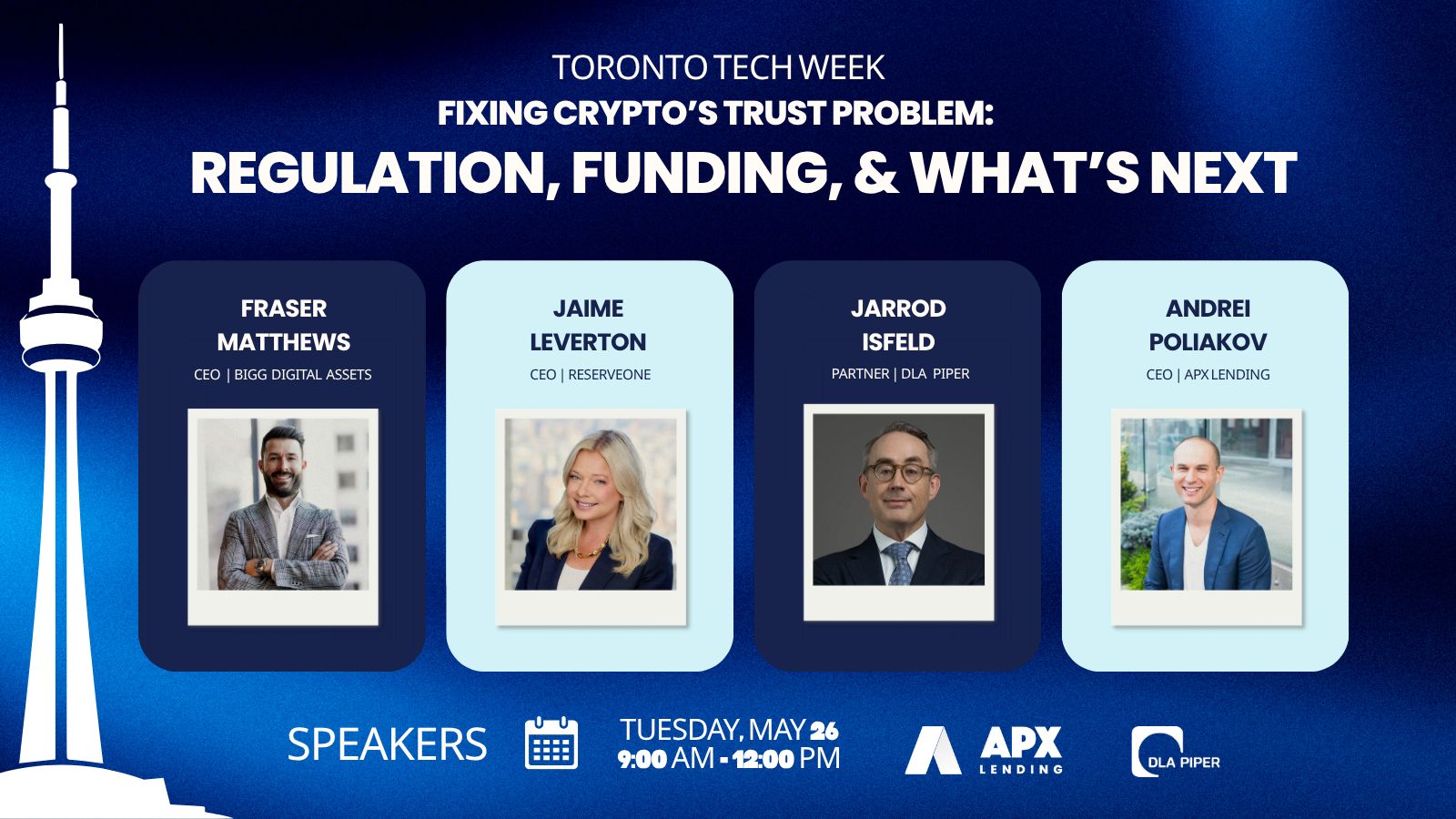


%201%20(3).png)


.png)
.webp)


